Guides / Materials
Materials for Semiconductor Tooling: Pick the Metal, Plastic and Finish, Write the Callout, Prove It on Receipt
November 21, 2026
Choose a tooling material by what the part must touch and survive, in this order: the device contact and static, the temperature range, the chemistry it meets, the wear it takes and the clearance it can spare when it heats. Aluminum 6061 carries most plates, tool steel carries wear surfaces, laminates carry heat and insulation, POM and PEEK carry nests and finishes, ceramics and contact alloys fill the gaps. This guide is for process engineers, equipment engineers and buyers who write the callout. It leads to one decision: which material and finish lines go on the drawing before the RFQ goes out.
You send one RFQ and we quote the finished parts, place the work with a Vietnamese partner shop and follow the run. How we choose shops is on how an order runs.
Last reviewed: October 2026. Figures carry the source they came from; confirm material data against the maker’s sheet for the grade you order, and regulations against your customer’s own documents.
- Pick the material by function
- Aluminum for plates and bases
- Steels, stainless and nickel alloys
- Laminates for test and solder fixtures
- Plastics for nests and carriers
- ESD materials and the incoming test
- Anodize, electropolish and nickel plating
- Ceramics and contact alloys
- Wire EDM and jig grinding
- Thermal expansion and clearances
- Cleaning agents and chemical resistance
- RoHS, REACH and halogen-free declarations
- Checklist and the RFQ
Pick the material by function
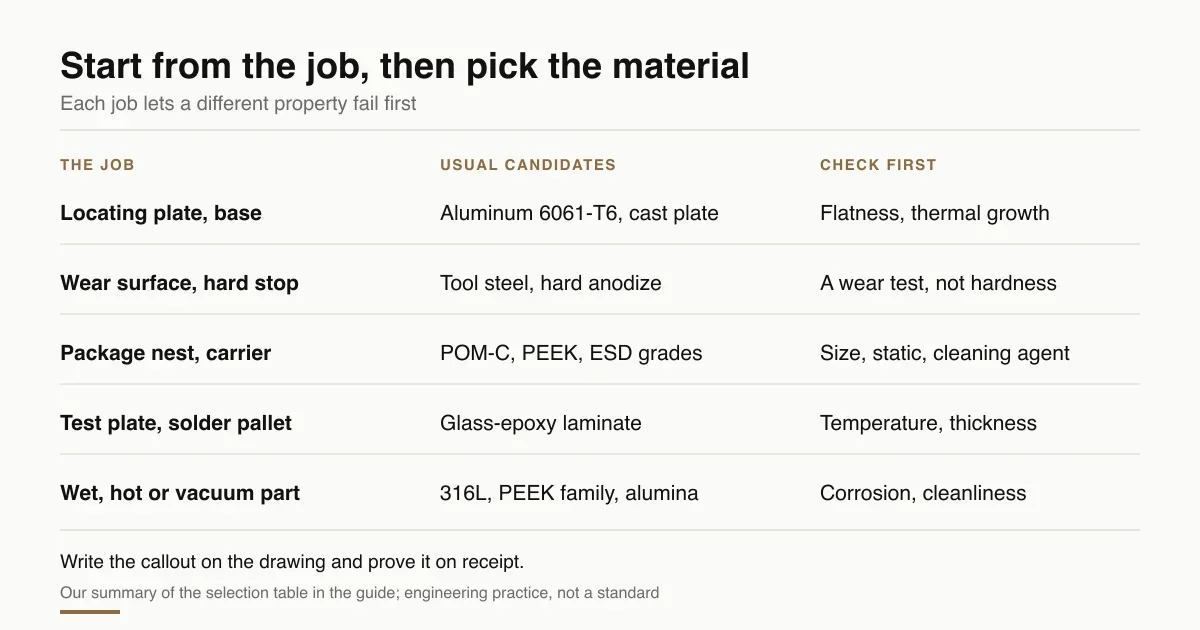
Start from the job, because the job decides which property is allowed to fail. A base plate may only need to stay flat. A nest that guides a package thousands of times a shift needs stable size and a surface that does not mark mold compound. A solder pallet needs a rating for the process temperature. The table puts the usual candidates next to the property to check first.
| Function | Usual candidates | The property to check first | Where it is covered below |
|---|---|---|---|
| Locating plate, base, bracket | Aluminum 6061-T6, cast tooling plate, stainless | Flatness after the part is unclamped, thermal growth | Aluminum, steels |
| Wear surface, hard stop, guide | Tool steel, hard anodized aluminum | A wear test, not a hardness number | Steels, anodize |
| Package nest, carrier, tray insert | POM-C, PEEK, ESD grades | Size stability, static, the cleaning agent | Plastics, ESD, cleaning |
| Test plate, probe guide, solder pallet | Glass-epoxy laminate, Durostone-type composite | Temperature rating, thickness after finishing | Laminates |
| Wet, hot or vacuum-facing part | 316L stainless, PEEK family, alumina | Corrosion, temperature, cleanliness | Steels, ceramics |
| Spring contact, clip, probe | Beryllium copper | Alloy, aging, safety rules | Ceramics and contact alloys |
Caption: our summary of the guides linked in each section; it is engineering practice, not a standard.
Five questions sort most choices: what touches the device, what temperature it sees, what cleans it, what wears it and how much it can grow before the clearance is gone. A sixth question comes from the customer, what declaration the material needs. The sections below follow that order. The parts themselves, by assembly and test step, are laid out in our guide to semiconductor jigs and fixtures.
Read more: Semiconductor jigs and fixtures: which part family, what to specify, what fails
Aluminum for plates and bases
Aluminum carries most machined semiconductor hardware because it machines fast, weighs little and conducts heat. A Proto Labs data sheet for 6061-T651 and T6 lists a density of 2.70 Mg per cubic meter, thermal conductivity of 167 W per meter kelvin, a Brinell hardness of 95 and a linear expansion of 23.6 micrometers per meter kelvin from 20 to 100 °C. That is soft against steel and it expands almost twice as much, which sets the two limits to design around: wear surfaces and clearance at temperature.
The material property that decides flatness is stress. A plate carries internal stress from rolling or casting. Machining removes material unevenly, so a plate that measured flat in the machine can bow on the inspection table. The alloy post lists 6061, 6082, 5052, 7075 and cast tooling plate by use, and says what to write for stress relief, certificate and flatness datum.
The form of the plate matters as much as the alloy. Our supply post puts three forms behind the word “stock”: rolled 6061-T651, cast tooling plate and sawn blanks, which inherit the stress of their parent plate. It also found no public list of plate rolling capacity or stockholders in Vietnam, so the useful question to a shop is the form, the mill and the lot, not the country. Write “no substitution without written approval” when the alloy matters to a process.
Read more: Aluminum alloys for semiconductor parts
Read more: Aluminum plate supply in Vietnam: form, mill and lot
Steels, stainless and nickel alloys
Tool steel goes where something wears: locating plates, pins, guide blocks and punches. Uddeholm’s data sheet for Sverker 21, a D2 type, calls it a steel with very good abrasive wear resistance and rather limited cracking resistance, and lists gauges, measuring tools, guide rails and bushes at 58 to 62 HRC. That fits the logic of the SKD11 post, which pairs SKD11 with parts whose life is set by contact wear and warns that it chips at corners and thin sections.
The hot-work grade is the other end. Uddeholm’s sheet for Orvar Supreme, an H13 type made by electro-slag refining, calls it an all-round steel that is also used in molds for plastics. SKD61 is the JIS name for the grade our post pairs with H13, chosen for toughness under thermal cycling rather than for edge wear. The Uddeholm sheets are brand-name grades of D2 and H13 type, so read them as a guide to the family; the post is explicit that nearest grades are close but not identical, and that the certificate should cite the standard.
Heat treatment decides hardness and distortion: austenitize, quench, temper, then grind and wire cut after the furnace. Stainless takes the wet, vacuum and corrosive jobs. The stainless post puts 316L as the workhorse for gas lines and wet parts, and nickel alloys as the expensive grades with long lead times that few shops take casually. Passivation changes almost nothing dimensionally, while electropolish removes metal and changes size.
Read more: SKD11, SKD61 and S50C for jig tooling
Read more: Heat treating tool steel fixtures and stainless and nickel alloys
Laminates for test and solder fixtures
When a fixture must hold a board, carry a package through a test or ride through a solder step, steel is often the wrong answer because it conducts, weighs and scratches. Glass-reinforced laminates fill the gap. FR4 is the plain glass-epoxy sheet. Durostone-type composites are a family of glass-fiber sheets made for repeated heat, and the brand belongs to one maker. The two share a look and machine the same way but they are not interchangeable.
The rule from our laminate post is to choose by temperature first and by cost second. A fixture at test temperatures usually does fine in FR4, while one that rides wave solder or reflow needs a composite rated for it. Probe plates are drilled, so hole position depends on the drilling method, not on the material, and the post asks for the position tolerance and the method on the drawing.
Three practical points follow. Sheet is not ground to thickness at the mill, so state the tolerance on the finished plate and ask how the shop will reach it. Glass dust is hard on tools and a hazard to people, and it contaminates clean areas, so parts for them need washing and often a sealed edge. And for ESD grades, a rough cut can expose conductive filler, so measure surface resistance after machining, not only on the sheet. Laminates also move differently along and through the sheet, which the thermal section below covers.
Read more: Durostone and FR4 for test fixtures
Plastics for nests and carriers
Nests, carriers, guides, covers and spacers are often plastic, because plastic is light, gentle on the product and quick to machine. Three families appear most: POM, cast nylon sold as MC nylon and bakelite, meaning phenolic laminate. Our comparison says to pick POM when size stability matters most, nylon where toughness matters and humidity is steady and phenolic for heat.
Water and temperature set the limits. A maker data sheet for POM-C lists a density of 1.41, a long-term maximum operating temperature of 100 °C and 140 °C short term and an expansion of 130 micrometers per meter kelvin from 23 to 60 °C. Our POM post lists lower expansion figures than this sheet, about 100 to 120. Grades differ, so use the sheet of the grade you order. At 130, a 100 mm POM nest that warms 20 °C grows about 0.26 mm, which is why the post cuts nests as individual inserts pinned to a steel base.
The engineering plastics PEEK, polyimide such as Vespel and Torlon PAI take higher temperatures. The post on them says the shop’s discipline shows fastest here, because the material moves: stress in the blank, moisture, heat from the cut and clamping all change the part, so annealing before finish machining and conditioning matter. With Vespel and Torlon the blank can be most of the price, so ask which stock sizes the shop can buy before you fix the geometry.
Read more: POM, MC nylon and bakelite for jigs
Read more: PEEK, Vespel and Torlon parts
ESD materials and the incoming test
Static is one of the few requirements that leaves no visible evidence when it goes wrong. The part looks perfect, the devices fail later and the root cause takes weeks. Our ESD post lists the options: dissipative PEI and PEEK grades, carbon-filled polymers, conductive coatings, masked anodize with a designed ground path and bare or passivated stainless. It says “ESD safe” is not a specification and asks for four things: a resistance range with units, a test method and voltage, the area it applies to and the grounding path.
The incoming test proves that. The ESD Association’s STM11.11 is the surface resistance method for planar materials, with the 2022 edition current in its store, and STM11.13 is a two-point method for parts where the concentric ring electrodes cannot be used. We did not read either text. What we could read is one static-control maker’s qualification report for a packaging material. It accepts surface resistance from 1.0 x 10^4 to below 1.0 x 10^11 ohms, tests at 12 and 50 percent relative humidity and 23 °C after 48 to 72 hours of conditioning, applies 100 V and uses a concentric ring probe. The same report shows how much humidity matters: an interior mean of 9.41 x 10^9 ohms at 12 percent against 3.59 x 10^8 at 50 percent.
Published bands differ at both ends, and one document is not “the” band. Take the band, the unit and the edition from the customer. The test post sets out the steps, a record sheet and a drawing note.
Read more: ESD materials and coatings for fixtures
Read more: How to test ESD fixture materials on receipt
Anodize, electropolish and nickel plating
Finishes change a part more than most buyers expect. Hard anodize grows an oxide layer on aluminum, so it adds size and insulates. Electropolish removes metal from stainless to leave a smoother, more cleanable surface. Electroless nickel deposits a nickel-phosphorus alloy evenly, including in bores, which is why tooling buyers choose it over electroplating.
The Aluminum Anodizers Council guideline for hard coat gives the controls that matter. It sets a default thickness of 2 mils (50 µm) unless the order says otherwise, with normal coating thickness variation of about 20 percent. It says the standards call out a hardness test but that hardness results cannot be used to prove wear resistance, and it names abrasion tests, the Taber method and a wheel test, for that purpose. It also says the corrosion test should be application based, especially for alkaline use.
Local capacity is the other half. Our anodizing post found no public count of anodizing lines in Vietnam, so it asks who runs the line, to which specification and with what environmental permit, and it lists the call-outs that let any anodizer quote the same job. Thickness tolerance on a fit, masked threads and bores, racking marks and the certificate belong on the drawing. Our hard-anodize post adds that finishing, not milling, usually turns a four-week job into a six-week one. For nickel, the post notes that plating thickness is per surface, so a bore loses twice the layer.
Read more: Anodizing in Vietnam: what is local
Read more: Hard anodize or electropolish and electroless nickel plating
Ceramics and contact alloys
Ceramics appear where a part must insulate, stay flat and hold size at temperature: burn-in sockets, contact guides, heater covers, work holders and pick tips. A Kyocera data sheet for a dense alumina above 99.5 percent lists a density of at least 3.90 g per cubic centimeter, flexural strength of 300 MPa, thermal conductivity of 34.9 W per meter kelvin at 100 °C and mean expansion of 7.5 micrometers per meter kelvin from 20 to 100 °C. Against aluminum’s 23.6 that is about a third.
Our ceramic post separates alumina, zirconia, aluminum nitride and machinable glass-ceramic, and gives a candid account of the Vietnamese supply chain: it warns that this is the category where a buyer is most likely to hear “yes, we can” from a shop that is not sure. Ceramic is formed, machined green, sintered and ground, so prototype first and ask where each step happens.
Contact parts use beryllium copper, because it is springy, tough and conductive. The alloy is supplied soft and age-hardened afterward, which is when it reaches its strength. The post covers the high-strength and high-conductivity grades, the safety rules a shop must follow and the alternatives. Both ceramics and beryllium copper are specialist materials, so say so in the RFQ and ask the shop to describe its experience before it quotes.
Read more: Ceramic machining in Vietnam for insulators
Read more: Beryllium copper contact parts
Wire EDM and jig grinding
Material choice sets the process route. On hardened tool steel the locating features are rarely milled: they are cut by wire EDM after hardening, because the steel is already at full hardness and the process cuts without cutting force. Hardness does not matter to the cut, only electrical conductivity does. Heat treatment goes first so that the features land where the drawing says, and the faces are ground before the wire cut.
The few holes that decide whether a fixture works are jig ground: the dowel holes that locate a top plate to a base, the pin holes a part sits on, the bushing bores that guide a probe. Jig grinding works on hardened steel, corrects the position and shape left by the earlier step and leaves a fine finish suited to a sliding or pressed fit. It costs more, so it is reserved for holes that matter.
The materials link is simple. A plate that will be wire cut and jig ground should be a tool steel with a heat treatment plan, not a soft plate hoped into position. A coated hole changes size, so say whether the hole is ground before or after plating, as the nickel post explains. The wire EDM post names the drawing notes that change the result.
Read more: Wire EDM for jig plates
Read more: Jig grinding locating pin and dowel holes
Need a quote for this part? Get a quote
Thermal expansion and clearances
Materials move with temperature at very different rates, and a clearance set at room temperature has to survive the range. Here are the coefficients we opened for the main groups.
| Material | Thermal conductivity, W per meter kelvin | Expansion, ppm per kelvin | Source note |
|---|---|---|---|
| Silicon | 130 (1.3 W per cm kelvin) | 2.6 | Ioffe Institute reference |
| Alumina above 99.5 percent | 34.9 at 100 °C | 7.5, 20 to 100 °C | Kyocera DD57 sheet |
| Tool steel, D2 type | 20.0 at 20 °C | 12.3, 20 to 200 °C, low-temperature temper | Uddeholm Sverker 21 sheet |
| Tool steel, H13 type | 25 at 20 °C | 12.6, 20 to 400 °C | Uddeholm Orvar Supreme sheet |
| Aluminum 6061-T6 | 167 | 23.6, 20 to 100 °C | Proto Labs sheet |
| POM-C | 0.39 | 130, 23 to 60 °C | Angst+Pfister sheet |
Caption: datasheet values, not guarantees; the ranges differ, so the figures are not strictly comparable. The cluster post gives the full table including laminates, stainless and PEEK. Older posts on this site use 23.1 or 23 for aluminum in general; 23.6 is the 6061 sheet value from 20 to 100 °C.
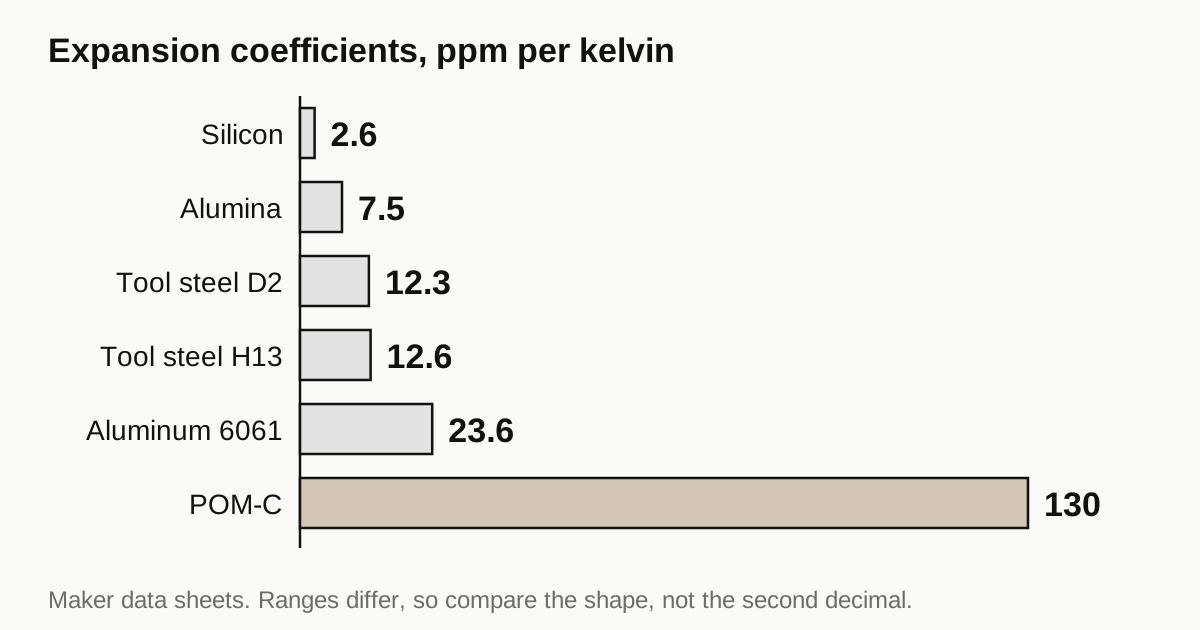
A 150 mm aluminum plate that heats from 25 to 150 °C grows about 0.44 mm using 23.6, while the same plate in alumina grows about 0.14 mm and a silicon part about 0.05 mm. The aluminum plate and the silicon part move apart by about 0.39 mm over that length. The sums treat each quoted mean as constant over the range, which is approximate. The practical answers are to locate pockets from one datum, keep plastic inserts small and pin them to a stable base and write the dimension temperature and working range on the drawing.
Read more: Thermal expansion of fixture materials: aluminum, steel, laminates and plastics against silicon
Cleaning agents and chemical resistance
A fixture is cleaned many times in its life, and the agent can matter as much as the process temperature. Ensinger’s category table, tested at 23 °C and 50 percent humidity, rates PEEK resistant to alcohols and ketones, POM-C resistant to alcohols and only conditionally to ketones and PEI resistant to alcohols but not to ketones. It also rates POM-C and PEI as not resistant to strong alkalis, while PEEK is resistant. The same page warns that stress cracking can follow when a loaded part meets a chemical.
Alkaline flux removers are the trap for aluminum and plated parts. A cleaning-agent maker’s paper says aqueous cleaners tend to have pH from 8 to 14 and lists anodized and plated coatings, aluminum and copper among the sensitive materials it studied. The anodizing guideline says the corrosion test should be application based for alkaline use. For cast nylon and laminates we found no maker rating against alcohols or ketones, and for plasma we found no maker table at all.
The conclusion is dull and useful: name the agent, its concentration, its temperature and its contact time on the drawing, and prove a doubtful pairing with a coupon before it goes on an order. Charts from distributors disagree with maker tables in places, so do not settle a close case from a chart.
Read more: Cleaning agents against fixture materials: IPA, acetone, flux removers and plasma
RoHS, REACH and halogen-free declarations
Customers can ask for declarations on the materials that go into tooling, for instance through a restricted-substance clause in a supplier manual. The legal texts are narrower than such a clause. RoHS 2011/65/EU applies to equipment that depends on electric current to work, with Annex II limits of 0.1 percent for lead, mercury, hexavalent chromium, PBB, PBDE and four phthalates and 0.01 percent for cadmium. REACH Article 33 requires a supplier of an article containing a Candidate List substance above 0.1 percent weight by weight to give the recipient the substance name. A plain machined plate has no electrical function, so on our reading it is outside RoHS, but we found no ruling on tooling and the customer decides.
| Material | The question to ask | Document that answers it |
|---|---|---|
| Aluminum, steel, stainless | Which grade, and is lead or cadmium content stated | Mill certificate and the maker’s declaration |
| Glass-epoxy laminate | Is the resin halogen-free, and which flame retardant | Sheet maker’s declaration for the exact grade |
| Engineering plastic | Which additives, fillers and colorants | Maker’s declaration by trade name |
| Plating and anodize | Which bath and which stabilizers | The finisher’s statement per process |
Caption: our summary of questions a customer can send; RoHS Annex II figures are from the consolidated text of 1 January 2025 and REACH from the consolidated text of 23 June 2025. The Annex III lead exemptions were renewed by Commission Delegated Directive (EU) 2025/2364, published 21 November 2025, which supersedes the dates in that consolidation: 6(a) lead in steel expires on 11 December 2026, 6(b) lead in aluminum on 11 June 2027 and 6(c) lead in copper alloy on 30 June 2027, with sub-entries that carry their own dates and equipment categories. Dates are as of October 2026, and the customer’s compliance team decides which entry applies.
A shop can sign for the stock it bought and the processes it ran, backed by the maker’s and finisher’s statements. It cannot sign for what it cannot trace. The declaration post gives the halogen-free limits and where they come from, the common misreadings and the spec lines.
Read more: RoHS, REACH and halogen-free declarations for jig and fixture materials
Checklist and the RFQ
The lines that matter differ by material, so use the table for the line to check first in each family, then the list.
| Family | The line to check first | What goes wrong without it |
|---|---|---|
| Aluminum plate | Temper, form and flatness datum | A plate that bows after unclamping |
| Tool steel | Heat treatment and wear test | Early wear or distortion |
| Laminate | Temperature rating and thickness after finishing | Delamination or a pocket that varies |
| Plastic nest | Grade, humidity state and growth budget | A nest that drifts or swells |
| ESD part | Band, test method and test points | A plate that passes at the shop and fails in the plant |
| Finish | Specification, thickness tolerance and masked features | A thread that will not accept a screw |
Caption: our summary of the lines each material guide above flags first.
- The drawing with its revision, and the material grade and temper as a hard callout, with “no substitution” if it matters.
- The temperature range of use and the temperature at which the dimensions apply.
- The cleaning agent, its concentration, temperature and contact time.
- The ESD band, standard, edition, quantity and test points, if there is a static requirement.
- The finish specification with its thickness tolerance, masked features and test.
- The wear test and its limit for any sliding surface.
- The clearance budget at both ends of the temperature range.
- The declaration form: statement, attached maker’s declaration or lab report, with the rule set and its date.
- The certificates required with the shipment, by lot.
- Quantity, spares and the inspection you want.
Send the list with the drawing through the RFQ form. We quote the finished parts and place the work with a Vietnamese partner shop, and we reply within 24 business hours with a quote or a plain no. You deal with one contact and get one invoice. Confirm material data with the maker and declarations with your customer before the order.
Sources
- RoHS Directive 2011/65/EU, consolidated text of 1 January 2025 (scope, Annex II limits) and Delegated Directive (EU) 2025/2364 (Annex III exemptions 6(a) to 6(c), expiry dates)
- REACH Regulation (EC) 1907/2006, consolidated text of 23 June 2025 (Article 33)
- Uddeholm, Sverker 21 data sheet (AISI D2 type, wear and cracking resistance, applications, expansion)
- Uddeholm, Orvar Supreme data sheet (AISI H13 type, expansion, conductivity)
- Proto Labs, aluminum 6061-T651/T6 material data sheet (density, conductivity, expansion, hardness)
- Ioffe Institute, silicon thermal properties
- Kyocera Fineceramics, DEGUSSIT DD57 alumina data sheet
- Angst+Pfister APSOplast, POM-C data sheet (density, temperature limits, expansion)
- Aluminum Anodizers Council, application guideline for hard anodic oxide finishes (thickness, abrasion tests, corrosion test)
- Desco Industries (SCS brand), S20.20 qualification report, DS 2700 series (test conditions, band, humidity results)
- Ensinger, chemical resistant plastics (category table, stress cracking note)
- Tosun and others, pH neutral cleaning agents, IPC proceedings (cleaning-agent maker paper; pH range, sensitive materials)
Frequently asked questions
What is the best material for a semiconductor jig plate?
For most plates it is aluminum 6061-T6 or a stress-relieved cast tooling plate, with tool steel for the wear surfaces and a laminate where the plate must insulate or take solder heat. The best choice follows the temperature, the cleaning agent, the static requirement and the clearance budget, so write the grade, temper and finish as hard callouts.
Why do plastic nests drift when the plant warms up?
Plastics expand far more than metals. A maker data sheet for POM-C lists 130 ppm per kelvin from 23 to 60 °C against 23.6 for aluminum 6061 and 2.6 for silicon. A 100 mm nest warming 20 °C grows about 0.26 mm. Keep plastic inserts small and pin them to a stable base.
Does hardness tell me how long a wear surface will last?
No. The Aluminum Anodizers Council guideline says hardness results cannot be used to prove wear resistance of an anodic coating, and it names abrasion tests for that job. The same caution fits tool steel. Put a wear test and a limit on the order when life matters, and buy spares with the first order.
How do I check that a plate is ESD safe when it arrives?
Measure surface resistance with the method your customer names, at stated humidity, on every area that touches a device or a ground path, and keep the readings. A maker's report on a packaging material read about 26 times lower at 50 percent humidity than at 12 percent, so humidity must be on the record sheet.
Can a Vietnamese machine shop sign a RoHS or REACH declaration?
It can sign for the stock it bought and the processes it ran, backed by the stock maker's and the finisher's statements. It cannot sign for a material it cannot trace. Put the rule set, the form of the declaration and who pays for lab analysis on the order, and agree how the customer's compliance team reads it.
How do I get tooling in the right material quoted from Vietnam?
Send one RFQ with the drawing, the grade and temper of each material, the finish with its test, the temperature range, the cleaning agent and the declaration you need. We reply within 24 business hours with one itemised quote and place the work with a Vietnamese partner shop. There is no separate service fee.
Need a quote for this part?
Send the drawing. We quote the finished parts, place the work with a partner shop in Vietnam and reply within 24 business hours.
Get a quoteMore on materials
- Cleaning Agents Against Fixture Materials: IPA, Acetone, Alkaline Flux Removers and Plasma
- RoHS, REACH and Halogen-Free Declarations for Jig and Fixture Materials: What a Shop Can Sign and What It Cannot
- Thermal Expansion of Fixture Materials: Aluminum, Steel, Laminates and Plastics Against Silicon
- Aluminum Plate for Semiconductor Parts in Vietnam: Local Stock or Imported
All guides and the sourcing glossary.