Guides / Materials
Durostone and FR4 Laminates for Test Fixtures: What Each One Is For
October 14, 2026
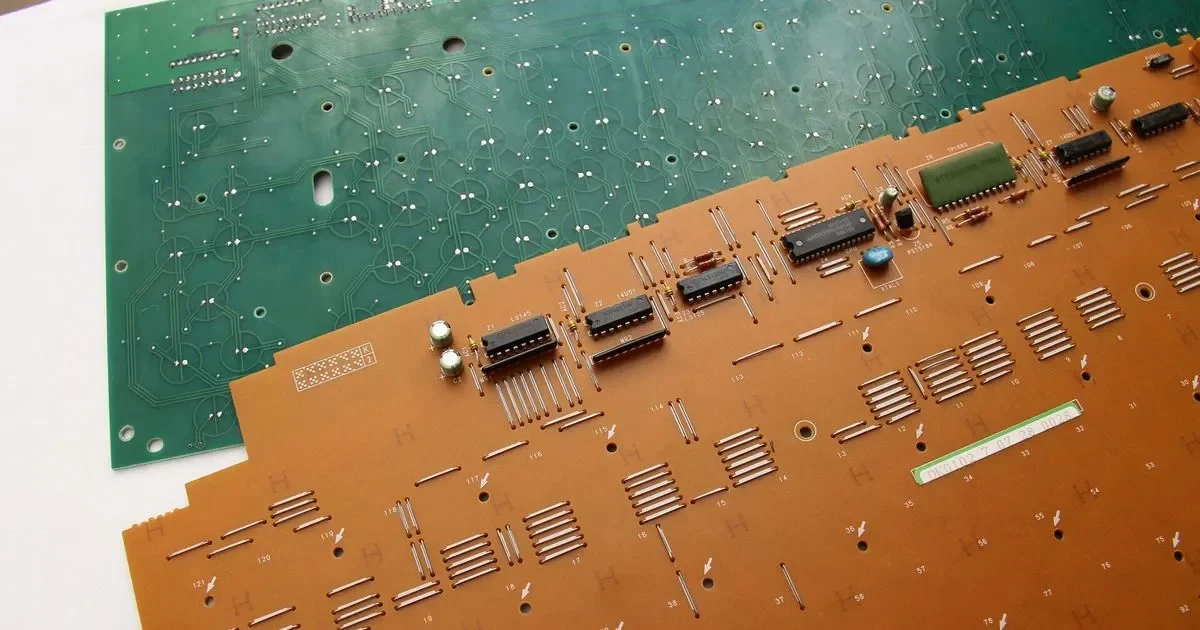
When a fixture has to hold a board, carry a package through a test or support a circuit during soldering, steel is often the wrong answer. It conducts, it is heavy and it scratches. The materials that fill the gap are glass reinforced laminates, and two names dominate: FR4, and a family of high temperature composites that buyers call by one brand name, Durostone.
They share a look and a machining pattern but they are not interchangeable. This guide shows what each one is, where each fits in a test or assembly fixture and what to specify when a Vietnamese shop will cut it.
What the materials are
FR4. A laminate of woven glass fabric and flame retardant epoxy resin. The same base material as most printed circuit boards, sold as plain sheet. Stiff, strong, a good electrical insulator, stable in size and moderate in cost.
G10. The same construction without the flame retardant. Slightly cheaper in some markets and mechanically similar.
Durostone type composites. A family of glass fiber reinforced sheets, often epoxy or high temperature resin based, with mineral fillers. They are made for repeated heat, such as solder pallets, and some grades are ESD safe. The brand name belongs to one manufacturer and other makers offer comparable materials. The grade matters more than the name.
What each does best
| Property | FR4 | Durostone type composite |
|---|---|---|
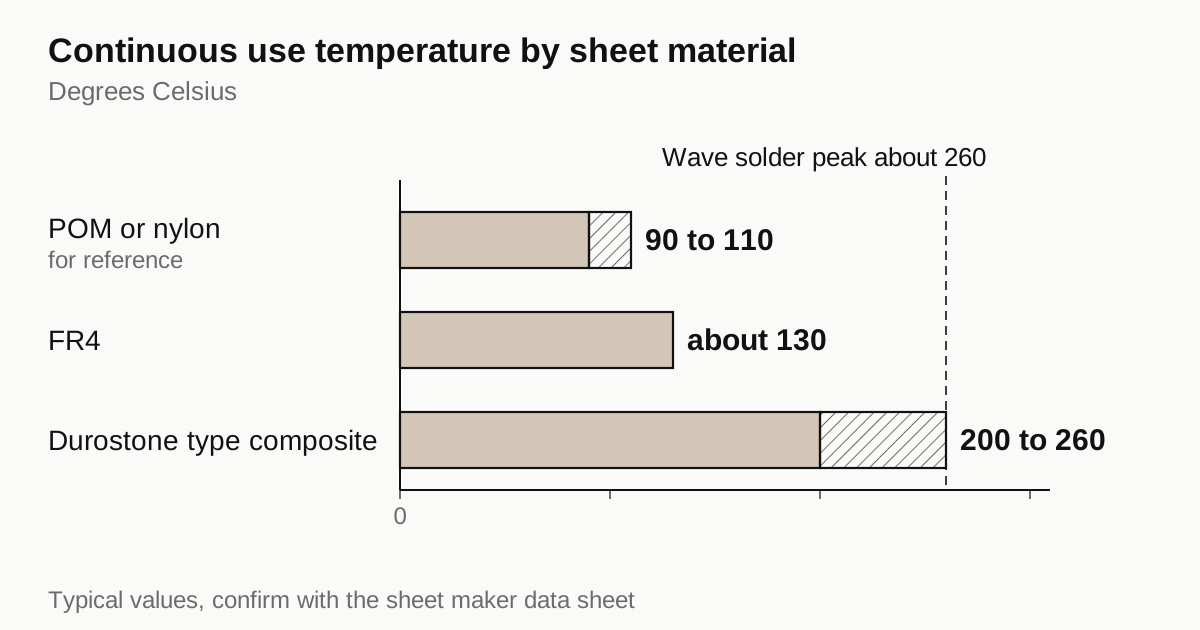
| Continuous temperature | about 130 °C, glass transition around 130 to 180 °C | about 200 to 260 °C, grade dependent |
| Repeated 260 °C exposure | Degrades, delaminates over cycles | Designed for it, within the grade rating |
| Flexural strength | High | Moderate to high |
| Dimensional stability | Good | Very good, low expansion |
| Machining | Abrasive, dusty | Abrasive, dusty |
| ESD grades | Limited | Available |
| Cost | Low | Medium to high |
Values are typical. The sheet maker’s data sheet sets the real numbers for a grade. A fixture that sees wave solder or reflow needs the composite. A fixture that sees test temperatures up to 125 °C usually does fine in FR4.
Where each belongs in a fixture
Probe plates and guide plates. FR4 is common for the plates that guide spring probes or pogo pins to a board. It drills cleanly, takes accurate hole patterns and insulates. The hole accuracy depends on drilling, not on the material, so state the hole position tolerance and the method.
Stiffeners and backing plates. A flat FR4 sheet stiffens a board during test or assembly. It is stable and cheap, and it can be cut to the outline of the board.
Burn-in and thermal test fixtures. Parts near a heat source or inside an oven need a material rated for the temperature, with a margin. For burn-in at 125 to 150 °C, a composite grade is the safer choice. See burn-in board and socket fixture parts.
Solder pallets and reflow carriers. Durostone type composites, because they hold flatness through repeated 260 °C cycles. The next steps are covered in reflow carriers and wave solder pallets.
Insulating spacers and washers. Cut from FR4 or composite sheet depending on temperature.
Thickness and flatness
Sheet laminate is not ground to thickness at the mill. Typical tolerance on the nominal thickness is wide: a 5 mm sheet may vary by plus or minus 0.3 mm or more, and sheet flatness can be off by a millimetre over a large panel. The consequences for fixtures:
- A pocket depth cut from the top surface varies with the sheet thickness. For a precise depth, machine from a reference face.
- A plate that has to be flat to 0.1 mm needs surface grinding or a skim cut on both sides after purchase.
- Large plates bow when material is removed on one side only. Balanced machining and a stress relief rest reduce it.
State the tolerance in your design on the finished plate, not on the sheet, and ask the shop to say how it will achieve it. A shop that quotes the plate at sheet thickness is either planning to accept the variation or has not read the tolerance. See flatness, parallelism and GD&T.
Machining and dust
Glass fiber is hard on tools. Carbide and diamond coated cutters last far longer than high speed steel. Tool wear changes hole size over a run, so a good shop checks size at intervals and replaces tools early.
The dust is a real issue. Cutting FR4 and composite produces fine glass and resin dust that irritates skin and lungs. Shops should use dust extraction and operators should wear protection. The dust also contaminates a cleanroom, so parts for clean areas need washing and often a sealed edge. For ESD safe grades, a rough cut surface can expose conductive filler that changes surface resistance, so check it after machining.
Hole quality matters in a probe plate. Entry and exit surfaces can fray, and drilling with worn tools leaves rough walls that grab probes. Back up the sheet on the exit side and drill with fresh tools for a pattern of fine holes.
Edge sealing and moisture
Laminates absorb a little moisture along cut edges and between layers. FR4 absorbs around 0.1 to 0.2 percent of its weight, little enough to ignore for most fixtures. Over a long time in a humid plant, edges may fray or delaminate at a cut. Edge sealing with a thin epoxy coat, or a chamfer to remove the sharp corner, extends life.
Need a quote for this part? Get a quote
ESD and cleanliness
Plain FR4 is an insulator and holds charge. For product that is sensitive to static, a dissipative composite with surface resistance in the range of 10^6 to 10^9 ohms is the standard route. See ESD materials and coatings for the ranges and the way to test them. Ask for a surface resistance measurement on the finished part, not only on the sheet, because machining exposes new surface.
A worked example: a probe plate and a solder pallet
Take a probe plate for a board test fixture, 3 mm FR4 with a field of 0.9 mm holes at a 1.27 mm pitch. The function depends on hole position: each hole guides a spring probe onto a pad, so a position error of 0.1 mm walks the probe off its target. FR4 is the right material, but the real work is in the drilling. The shop needs a drilling machine with accurate spindle runout, backup material on the exit side, fresh drill bits and a check of the first plate on an optical measuring machine. A sharp drill in a stable plate holds the pattern. A worn drill in the same plate drifts, and the probes miss.
Now take a wave solder pallet for a board that passes over molten solder at about 260 °C. FR4 would delaminate within a few dozen passes. The pallet needs a high temperature composite rated for repeated exposure, a thickness tolerance after skimming and cut outs that let solder reach the pads without bridging neighbouring parts. The same drawing standards, the same shop and the same machine, but the material and the failure mode are different. Choosing by temperature first and by cost second avoids the most common mistake with these sheets.
Cost and sheet sizes
Laminate sheet is sold in large panels, often around 1,000 by 1,200 mm or larger, in a fixed set of thicknesses such as 1.5, 2, 3, 4, 5, 6, 8 and 10 mm. A small fixture plate cut from a large sheet wastes the rest, which the shop either charges for or reuses on other work. Ordering several plates from one sheet, or choosing a standard thickness over a custom one, lowers the cost. Composite grades cost several times as much per kilogram as FR4, so a design that uses the composite only where the temperature demands it, and FR4 elsewhere, costs less than one made entirely of the higher grade.
What to ask a shop
- Which sheet grade and supplier, and is the data sheet available?
- How is thickness controlled: skim or surface grinding after purchase?
- What cutters are used and how often are they replaced?
- Is dust extraction fitted on the machines that cut glass laminates?
- Can the shop measure surface resistance for ESD grades?
- How are the parts washed and packed for a clean area?
Laminates are compared with metals and plastics in our guide to semiconductor tooling materials; a sheet’s halogen-free and declaration questions are in RoHS, REACH and halogen-free declarations for jig materials.
Checklist before you send the RFQ
- Material and grade, with the temperature rating you need
- Thickness before and after machining, and flatness on the finished plate
- Hole sizes, positions and the method of measurement
- Edge treatment: chamfer, sealed edge
- ESD requirement and surface resistance range
- Cleaning and packing
- Quantity and a spare allowance, since fixtures wear
Send them with the drawing through the RFQ form. We place it with a partner shop and send one itemised quote within 24 business hours. For a cost view of fixture parts as a whole, see what drives the cost of a test jig.
Frequently asked questions
Is Durostone a material or a brand?
It is a brand name from a European plastics group for a family of glass fiber reinforced composite sheets, widely used for solder pallets and test fixtures. Buyers often use the word for the whole class. A drawing should name the property needed, such as continuous temperature rating and ESD grade, and allow equivalent products.
Is FR4 the same as G10?
They are related. Both are woven glass fabric laminated with epoxy resin. FR4 carries a flame retardant that gives it a V-0 flammability rating, while G10 does not. Mechanically they are close, so FR4 is the common choice where a flammability rating matters, which in electronics is most of the time.
Why is the sheet thickness tolerance so loose?
Laminates are pressed and cured, not rolled to size, so a sheet nominally 5 mm can vary by a few tenths of a millimetre or more across the sheet. A fixture that needs a precise thickness has to be ground or machined flat after purchase, or the design has to tolerate the variation.
Need a quote for this part?
Send the drawing. We quote the finished parts, place the work with a partner shop in Vietnam and reply within 24 business hours.
Get a quoteMore on materials
- Cleaning Agents Against Fixture Materials: IPA, Acetone, Alkaline Flux Removers and Plasma
- RoHS, REACH and Halogen-Free Declarations for Jig and Fixture Materials: What a Shop Can Sign and What It Cannot
- Materials for Semiconductor Tooling: Pick the Metal, Plastic and Finish, Write the Callout, Prove It on Receipt
- Thermal Expansion of Fixture Materials: Aluminum, Steel, Laminates and Plastics Against Silicon
All guides and the sourcing glossary.