Guides / Process
Reflow Carriers and Wave Solder Pallets: Materials, Cutouts and Service Life
October 23, 2026
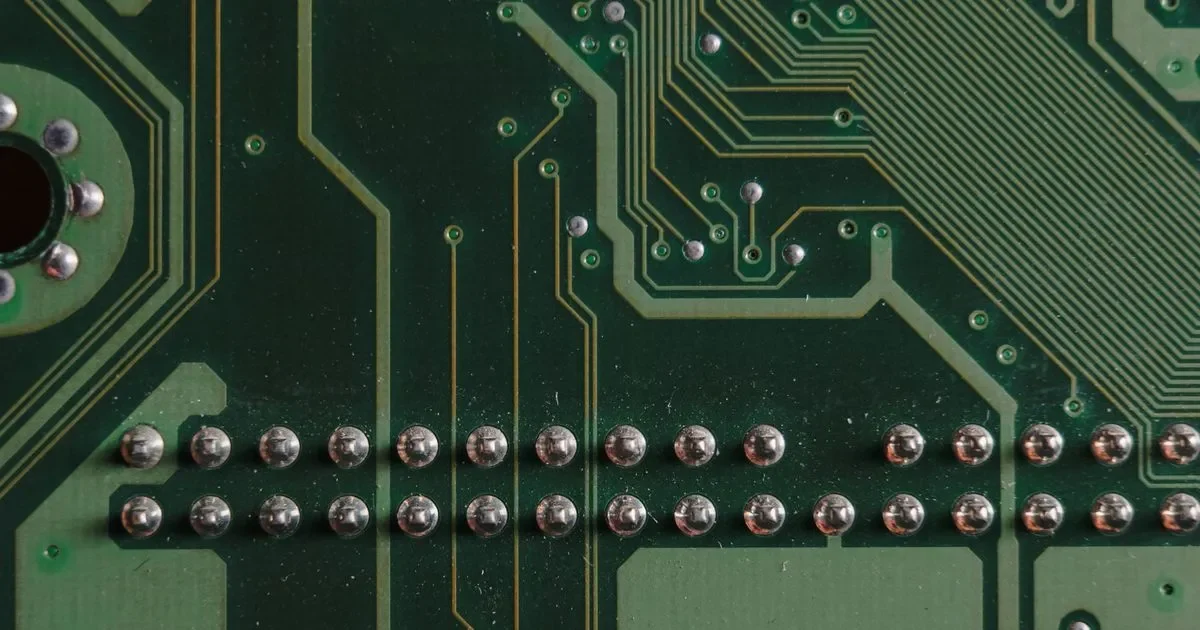
Soldering is where a board meets heat, and heat is hard on anything that carries a board through it. Wave soldering passes the underside of a board over molten solder at about 260 °C. Reflow melts solder paste in an oven, with peak temperatures around 240 to 260 °C for lead free solder. Both processes use carriers or pallets: rigid frames that hold the board, protect parts and keep everything flat while temperature does its work.
A pallet is made of a few plates with carefully shaped cutouts, and it is consumed. A plant with several products has dozens. This guide covers how they are built, the materials that survive the process and what the drawing needs so a Vietnamese shop can make them.
What a pallet does
A wave solder pallet does four jobs:
- Supports the board. A board that sags at 260 °C leaves some pins in the solder too deep and others dry.
- Masks the underside. Surface mount parts and areas that must stay free of solder are covered by the pallet material.
- Opens the right windows. Cutouts expose through-hole pins and pads to the wave.
- Shields from heat and flux. The pallet takes some of the exposure, and the board’s other side is protected.
A reflow carrier works differently. It carries a thin or flexible board, a board with irregular shape or a board with parts on both sides, through the oven. It holds it flat and keeps parts from touching the conveyor.
Materials
Pallet materials need to survive repeated cycles at solder temperature without warping, absorbing flux or releasing particles.
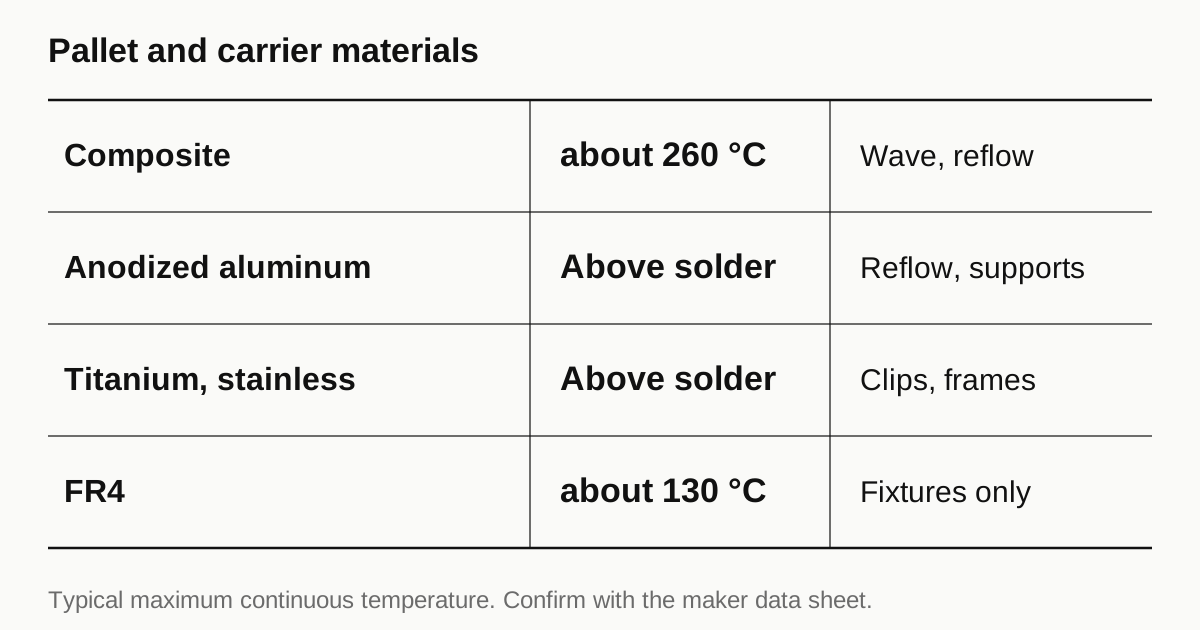
| Material | Max continuous temperature | Typical use | Strengths | Limits |
|---|---|---|---|---|
| Glass reinforced composite (Durostone type) | about 260 °C, grade dependent | Wave solder pallets, reflow carriers | Flat, stable, low heat conduction, machinable | Dust, cost, wear on edges |
| Titanium | far above solder temperature | Clips, thin carriers, special pallets | Strong, light, low thermal mass | Hard to machine, expensive |
| Stainless steel | far above solder temperature | Clips, frames, reflow carriers | Strong, durable | Heavy, conducts heat |
| Aluminum, hard anodized | far above solder temperature | Reflow carriers, support plates | Light, flat, conducts heat evenly | Solder can wet exposed metal, changes the thermal profile |
| FR4 | about 130 °C | Test fixtures only | Cheap | Not for solder temperature |
Typical values. The sheet maker’s data sheet gives the rating for a grade. Ordinary FR4 is not suitable for wave solder pallets. See Durostone and FR4 for test fixtures for the comparison.
For lead free wave soldering, composite grades rated for repeated 260 °C exposure are standard. Some plants specify ESD safe grades. Some shops use metal for the hold down parts and composite for the main body.
Thickness and shadowing
Wave solder pallets are typically 4 to 8 mm thick in the main body. Thickness gives stiffness and thermal mass, but it also creates a problem called shadowing: the pallet wall next to a pin blocks the wave and leaves a dry joint. The remedies are shaping the cutouts and the ramps.
A ramp is a sloped cut on the leading side of a window that lets the wave reach the pin more freely. A solder thief is an extra pad or cutout at the trailing edge that draws away excess solder and prevents bridging. These features are specified by the process engineer, from experience with the board design, and cut by the shop to the drawing. Angles and depths matter. A 45 degree ramp that is off by a few degrees changes the flow.
A drawing that shows only the outline of the window and a thickness leaves these decisions to the shop. State the ramp angle, the depth and the location of every thief, or provide the 3D model.
Cutout accuracy
The pallet masks a board whose parts sit at specific positions. A cutout 0.3 mm out of position can expose a surface mount part to solder. Position tolerance on cutouts is typically 0.1 mm, tighter on fine pitch boards. Pocket depths, which support the board edge, are held to about 0.05 mm so that the board sits level.
Cutouts are milled, often by CNC with small end mills. Glass filled composites wear tools quickly, so a shop that mills many pallets uses carbide tools and changes them on a schedule. Cutouts with small inside radii need small cutters, which are fragile. Specify the radii you can accept, the larger the better. See flatness, parallelism and GD&T for how to define position and flatness.
Hold downs, clips and magnets
A board sits in the pallet and has to stay there. Methods include:
- Spring clips, in stainless steel or titanium, that press the board edge down
- Hold down fingers, shaped parts of the pallet itself
- Magnetic hold downs, where magnets in the pallet pull down thin steel plates over the board
- Vacuum or gravity, rarely used for wave
Metal parts must survive heat, flux and cleaning, and they must not scratch the board. A clip that loses its spring after a few hundred cycles leaves the board loose. A magnet’s strength falls with temperature, so a magnet in the pallet near the hot zone needs a high temperature grade. These parts are often purchased and fitted by the shop to the drawing, and they are the first to fail.
Reflow carriers
Reflow carriers are lighter, thinner and often made of aluminum or composite. They support a thin board, or boards with parts on both sides, and hold the board edge. An aluminum carrier conducts heat evenly, which stabilizes the profile, and is stiff at small thickness. It is usually anodized, and sometimes has a coating on the board contact surface to reduce sticking.
The carrier changes the thermal profile of the board, because it adds thermal mass. The profile has to be set with the carrier in place, using thermocouples on the board. That is the process engineer’s job, but it reminds buyers that changing the carrier’s material or thickness changes the process.
Need a quote for this part? Get a quote
Selective soldering and mixed boards
Many boards now carry both surface mount and through-hole parts, and some skip the wave entirely in favour of selective soldering, where a small nozzle solders chosen pins one at a time. A board that passes through reflow first and then wave or selective soldering carries its surface mount parts through two heat cycles, and the pallet has to protect them in the second. This pushes pallet design toward deeper pockets over tall parts, tighter cutout position and a material that does not outgas onto the board. Where a plant moves a product from wave to selective soldering, the pallet may no longer be needed, or it may turn into a simple support plate. Raise this early, since it changes what is worth buying and in what quantity.
Handling and cleaning
Flux and solder residue build up on a pallet and are removed by cleaning, by hand with a scraper or in a cleaning machine with a solvent or water based process. Aggressive cleaning damages composite edges and strips coatings, and ultrasonic cleaning can delaminate a weak grade. Ask the pallet maker which cleaning methods the grade tolerates and write them into the plant’s instruction. Store pallets flat, on edge in a rack or in a carton with separators, never stacked under load, since a pallet that sits bowed for weeks takes a set.
Wear and end of life
Pallets degrade. Typical signs:
- Warp that exceeds the allowable flatness
- Swelling or delamination at the edges
- Solder and flux build up that does not clean off
- Wear at cutout edges that exposes parts
- Cracks near corners and slots
Plants measure flatness on a surface plate at intervals, clean pallets on a schedule and discard them by condition. Recording the number of passes per pallet gives a life estimate for each product. Order spares early for a high volume product, because a pallet that fails mid-run stops the line. Spares and consumable planning covers how to set quantities.
Cost and lead time
A pallet costs more than the plain composite sheet it is cut from. Costs come from the material grade, the machine time for the cutouts, the programming, the hold down parts and the inspection. Programming a complex pallet takes real time. Reorders are cheaper than first orders because the program exists, so keep the model and the program with the shop or the plant. The first pallet usually goes through a trial on the line, and a revision follows. Budget for it in the schedule.
What to ask a shop
- Which composite grades do you stock, and from which supplier?
- Have you made wave solder pallets and reflow carriers, and can you show examples?
- How do you hold thin composite sheets flat during milling?
- What cutters do you use, and how often do you change them?
- How do you check cutout position and pocket depth?
- Can you supply and fit clips and magnets, and what grades?
- How do you clean and pack the pallets?
For where carriers and pallets sit next to handler and strip tooling, see our guide to semiconductor jigs and fixtures.
Checklist before you send the RFQ
- Board file, with component positions and keep out areas
- Process: wave, selective or reflow, with solder temperature
- Pallet material and the temperature rating
- Thickness, ramps, thieves and window geometry
- Cutout position tolerance and pocket depth tolerance
- Hold down method and parts
- ESD requirement
- A trial pallet before the batch, and who runs it
Send them with the model and drawings through the RFQ form. We place it with a partner shop and send one itemised quote within 24 business hours.
Frequently asked questions
What is a wave solder pallet?
A rigid carrier that holds a circuit board as it passes over a wave of molten solder. The pallet masks the areas that must not get solder, such as surface mount parts on the bottom side, and opens windows for the pins or pads that do. It keeps the board flat at about 260 °C and protects it from the solder.
How many cycles does a pallet last?
There is no fixed number. Life depends on the material, the solder temperature, the flux and cleaning, handling and the board design. Plants inspect pallets for warp, swelling, solder build up and edge wear, and replace them on condition. A record of passes per pallet helps predict the end of life.
Can I use aluminum for a reflow carrier?
Yes, for reflow where flexible or thin boards need support and heat has to flow evenly. Aluminum is flat, stiff and light, and is often hard anodized. It conducts heat very well, which changes the thermal profile, so the profile has to be re-tuned with the carrier in place.
Need a quote for this part?
Send the drawing. We quote the finished parts, place the work with a partner shop in Vietnam and reply within 24 business hours.
Get a quoteMore on process
- JEDEC Matrix Trays and Custom Carrier Trays: When Machined Replaces Molded
- Designing a Package Nest: Pocket Size, Clearance, Lead-In and Datum
- Planning Production When Urgent Spares and New Jigs Share the Machines
- Semiconductor Jigs and Fixtures: Which Part Family, What to Specify, What Fails and Who Makes It
All guides and the sourcing glossary.