Guides / Process
JEDEC Matrix Trays and Custom Carrier Trays: When Machined Replaces Molded
November 21, 2026
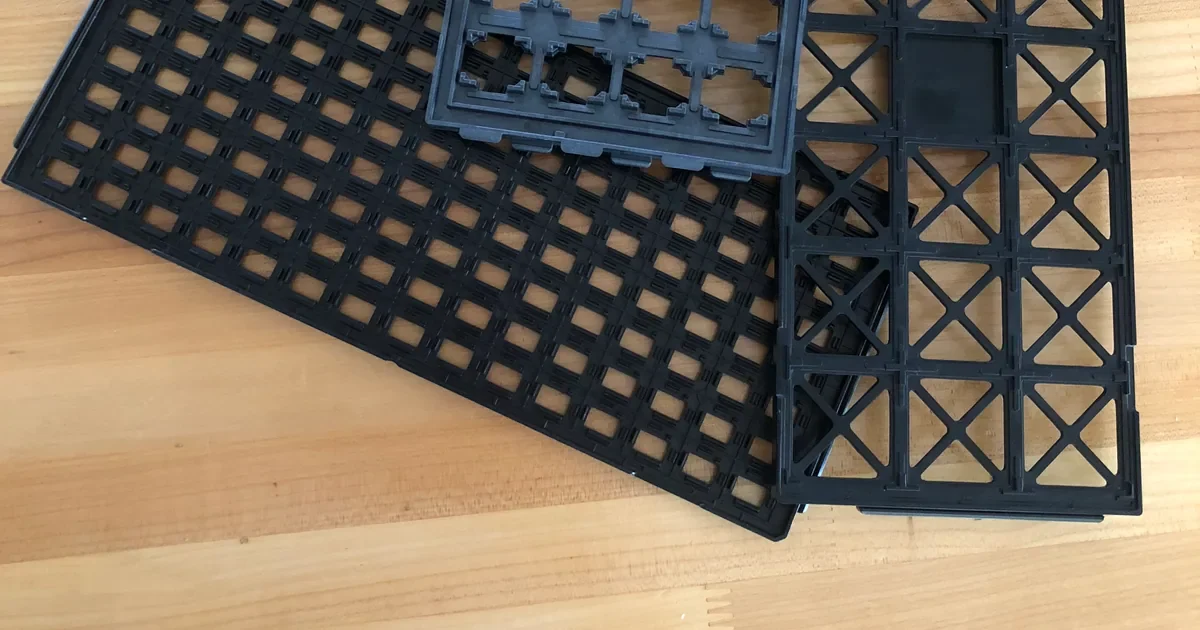
A JEDEC matrix tray is a flat plastic tray of fixed outline that holds packaged chips in rows of pockets, so that handling machines and people can move them in bulk. A machined carrier replaces a molded tray when no standard tray fits the package, when the volume is low or when the package is still changing. This post is part of our guide to semiconductor jigs and fixtures and covers what the tray reference fixes, what a custom carrier must copy and how to word the RFQ.
JEDEC’s own documents are registration-gated. Its pages refused automated access, so we did not read any JEDEC text. What follows comes from a US patent, tray vendors and an ESD standards table of contents, and each figure says where it came from.
What the JEDEC tray reference is
JEDEC is the standards body that publishes package outlines and tray designs for the chip industry. A US patent granted in 2000 describes JEDEC publication 95-1 as providing a tray outline, with a thin and a thick version. We could not open any JEDEC tray document, so we cannot say what its current revision contains or how JEDEC numbers it.
For a buyer, the reference does one main job. It makes tray, handler, stacker and magazine from different companies fit each other. That is why a custom carrier that departs from the outline can fail at the first machine even when its pockets are perfect.
What we could and could not verify
Read the table as a record of what we found, not as the content of the standard.
| Feature | What we found | Source | Status |
|---|---|---|---|
| Outline | 322.6 mm by 135.9 mm (12.7 by 5.35 inches) | US patent 6,082,547 quoting JEDEC 95-1; a tray vendor gives the same | Two secondary sources agree |
| Thickness | 6.35 mm and 10.16 mm, or 7.62 mm and 12.19 mm | Vendor guide against the patent | Sources disagree; not verified |
| Pockets | Cells pitched to JEDEC spacing in fixed rows and columns | Tray vendor guide | Vendor description |
| Pick-up | Center cells flat so vacuum tools can lift the tray | Tray vendor guide | Vendor description |
| Orientation | Scalloped side for a pin, 45 degree chamfer on one corner for pin 1 | Tray vendor guide | Vendor description |
| Stacking | Same family and model only, usually 5 to 7 trays, empty tray as lid | Tray vendor guide | Vendor description |
| Pocket tolerance | We found no public figure | None | Not verified |
| Material and bake | Bakeable ratings of 140, 150 or 180 °C; non-bakeable 50 to 75 °C | Tray vendor guide | Vendor description |
Caption: sources are a US patent (filed 1998) and a tray vendor’s educational page. The JEDEC documents were not read.
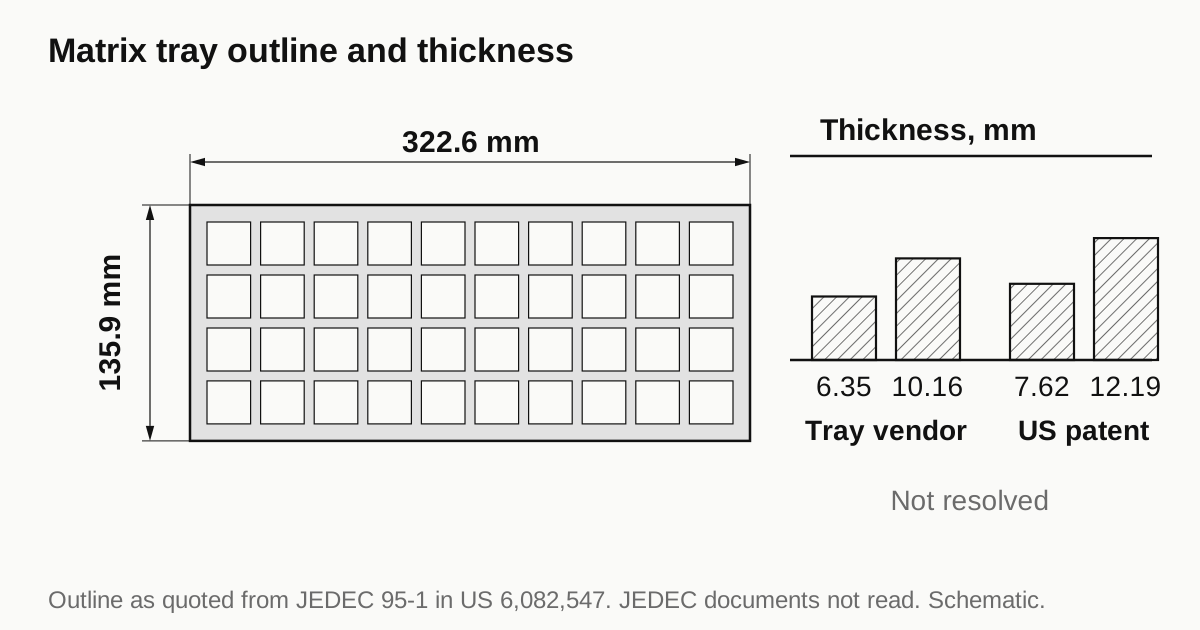
The thickness row shows why a tray reference is not enough. Two sources give different numbers for the same outline family, and we cannot tell whether the cause is an old revision, a different tray class or a rounding of inches. If a handler or stacker depends on thickness, take it from the customer’s current document and a sample tray.
When a machined carrier replaces a molded tray
Molded trays are the default for standard packages in volume. A machined carrier earns its place in three cases.
- No standard tray exists. Modules, connectors and odd-shaped packages may have no tray at all. One vendor describes its machined trays as aimed at components where standard JEDEC trays do not exist.
- The volume is low. One vendor describes combining injection molding and CNC machining to make custom trays without tooling, aimed at prototypes and low to moderate volumes, in a conductive polymer with heights from 0.5 mm to more than 25 mm. Another sells machined trays to a custom pocket design with no minimum order.
- The package may still change. Engineering lots move between package revisions. A machined tray can follow the revision without a new mold.
We found no public figure for the tooling cost of a molded tray, and no public cost comparison with a machined one. The vendor pages give lead times and options, not prices we can compare. Ask for both quotes on the same package drawing and compare them with the quantity you will actually buy.
What a machined carrier must still copy
A carrier that will pass through handling equipment inherits the equipment’s expectations. Check each against the customer’s drawing.
- Outline and thickness, to the revision the customer names.
- Orientation features: the keyed edge and the pin 1 mark, so that a tray cannot be loaded backward.
- Flat pick-up area, if a vacuum tool lifts the tray.
- Stacking behavior: trays that stack in one family and not across makers, so a custom carrier must stack on itself and on a standard cover tray.
- Bake rating and material, if the tray goes through dry packing. A tray vendor says dry packing bakes the trays and contents at 125 °C for several hours, and that exceeding the stamped maximum changes the tray dimensions.
- Static control, stated as a resistance range, because plastics carry it or not by compound.
On material, the same vendor says trays are generally molding compounds, with carbon fiber or carbon powder making them dissipative or conductive, and that aluminum is also permitted. A machined plastic carrier from a non-ESD acrylic, which is one vendor’s standard grade, would not meet a dissipative requirement unless an ESD grade is specified.
Need a quote for this part? Get a quote
How to cite the reference in an RFQ
Write the reference so that it fixes what it can fix and leaves nothing implied. A workable pattern:
Carrier tray for the attached package drawing (revision C). Outline and orientation features per the JEDEC matrix tray reference your handler uses, document and revision letter as held by the customer. Pocket size 7.20 +0.02/-0.00 mm per the attached sketch. Material dissipative, with the surface resistance range in the attached ESD line, tested to the method the customer names. Stacks on itself and on the customer’s cover tray. Bake rating 150 °C.
The values in this wording (revision C, 7.20 +0.02/-0.00 mm, 150 °C) are placeholders, not recommendations.
The resistance range and the test method come from the customer’s own plan, so leave them as a line the customer fills in. ANSI/ESD S541-2026 has a section that classifies packaging materials as conductive, dissipative or insulative and a table of test methods and limits. We read the table of contents only, so take the numeric limits from the customer’s copy of the standard. A listing that summarizes S541 names ANSI/ESD STM11.11 as the surface resistance method for planar materials.
Common misreadings
- “JEDEC tray” means the pockets are standard. The outline is common. The pocket is cut to the package, and its tolerance is a design choice we found no public figure for.
- Any tray stacks on any tray. The vendor guide says to stack within the same family and model and not to mix brands.
- Bakeable means the same for every tray. The rating is stamped on the tray and depends on the compound.
- Matrix tray documents are one document. Other tray documents exist, from other standards bodies. We did not read them, so ask the customer which one governs.
What to write in your spec
- The tray document, number and revision letter held by the customer
- Package drawing and revision, with the pocket size and tolerance you want
- Orientation features and pin 1 mark
- Material, surface resistance range and test method
- Bake rating and any dry-pack process
- Thickness, stacking and cover tray
- Quantity, and whether a molded tray quote is wanted alongside
For how the pocket itself is sized, see designing a package nest. If the carrier will sit in a handler, test handler change kits lists the parts around it.
Send the package drawing and the line above through the RFQ form and we reply within 24 business hours with a quote or a plain no. The guide to semiconductor jigs and fixtures shows where trays and carriers fit among the other part families. Confirm the JEDEC revision and the ESD limits with your customer before the order.
See also: ESD packaging and ANSI/ESD S541, for parts that carry or touch devices.
Sources
- US 6,082,547, Adapter jig (JEDEC 95-1 tray outline and thickness as quoted in the background)
- TopLine, Understanding JEDEC Trays (vendor page: dimensions, pockets, stacking, bake ratings, materials; directional)
- ElectronicSpecifier, matrix trays safely and securely contain components (custom JEDEC-outline trays made without tooling; vendor)
- ElectronicSpecifier, custom matrix tray system (machined custom trays, standard grade and lead time as stated in 2015; vendor)
- ESD Association, ANSI/ESD S541-2026 table of contents (resistance classification and test method sections; text not read)
- Racklify encyclopedia, testing standards for surface resistivity (names ANSI/ESD STM11.11; directional)
Frequently asked questions
What size is a JEDEC matrix tray?
A US patent that cites JEDEC publication 95-1 gives an outline of 322.6 mm by 135.9 mm. Thickness is where sources differ: a tray vendor lists 6.35 mm and 10.16 mm, and the patent lists 7.62 mm and 12.19 mm. The JEDEC document governs, and we could not open it, so confirm the thickness on the copy your customer holds.
Can a matrix tray be machined from aluminum?
A tray vendor's guide says trays are generally molded but that aluminum is also permitted. Custom machined trays are sold in plastics as well. Whatever the material, state the surface resistance you need, the bake temperature if the tray goes through dry packing and the outline the handling equipment expects.
When does a machined carrier make sense instead of a molded tray?
When no standard tray fits the package, the volume is low or the package is still changing. One vendor combines molding and CNC machining to make custom trays without tooling for prototypes and low to moderate volumes, and another sells machined trays with no minimum order. We found no public figure for the tooling cost of a molded tray, so ask for both quotes on the same package drawing.
How do I cite the JEDEC tray reference in an RFQ?
Name the document, its number and the revision letter on the copy you hold, then list the features you need beyond it, such as pocket size, bake rating and surface resistance. Do not write 'JEDEC standard tray' alone. That phrase fixes the outline at best and leaves the pocket, material and static requirement open.
Need a quote for this part?
Send the drawing. We quote the finished parts, place the work with a partner shop in Vietnam and reply within 24 business hours.
Get a quoteMore on process
- Designing a Package Nest: Pocket Size, Clearance, Lead-In and Datum
- Planning Production When Urgent Spares and New Jigs Share the Machines
- Semiconductor Jigs and Fixtures: Which Part Family, What to Specify, What Fails and Who Makes It
- Lead Frames Explained: The Metal Skeleton Inside the Package
All guides and the sourcing glossary.