Guides / Process
Lead Frames Explained: The Metal Skeleton Inside the Package
November 21, 2026
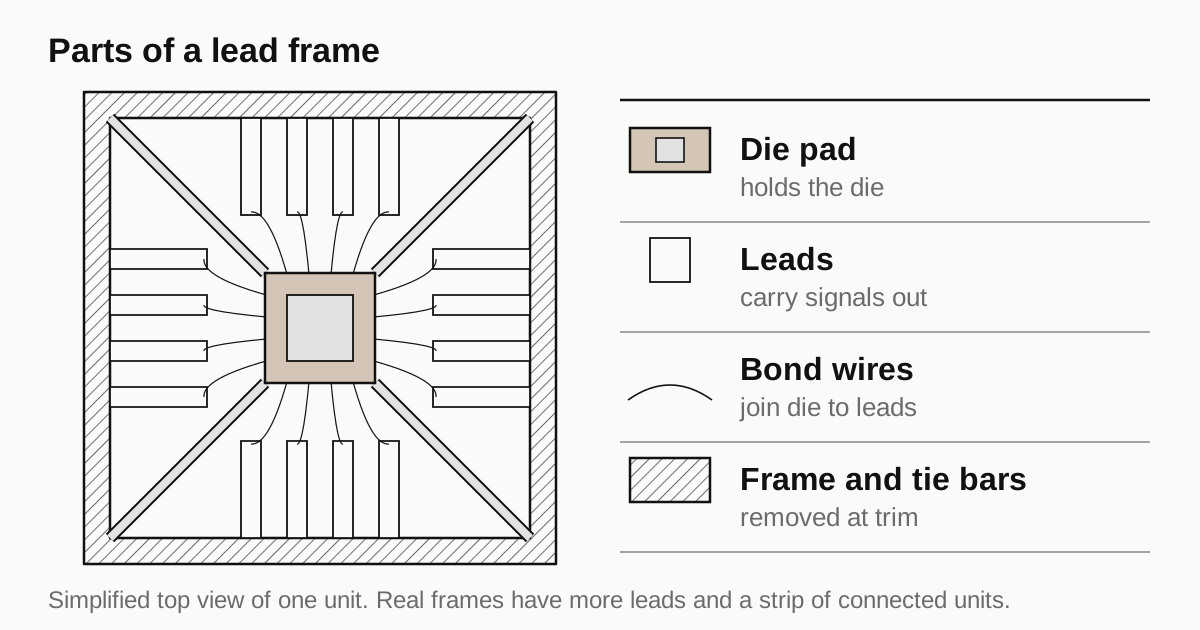
A lead frame is the metal structure inside a chip package that carries signals from the die to the outside. It holds the die on a pad, gives each pin a lead to leave through and is trimmed away to leave the leads. It is cut from a flat metal plate by stamping or etching and travels through assembly as a strip. For the parts that handle those strips, start with our guide to semiconductor jigs and fixtures.
What a lead frame does
Wikipedia describes the sequence for packages such as QFN, QFP and DIP. The die sits on the die pad and is glued or soldered in place. Bond wires connect the die to the bond pads at the lead ends. A plastic body is then molded around the frame and the die, leaving only the leads exposed. The leads are trimmed, the supporting structures are removed and the external leads are bent into shape. The wire step is covered in what wire bonding is.
Where it sits in the assembly flow
Wikipedia’s article on integrated circuit packaging gives the order of the steps. After dicing, the die is picked from the wafer with a vacuum tip or suction cup. It is then mounted and fixed to the package or support structure. Low-cost devices are usually glued to the substrate with epoxy or soldered, and high-power devices are eutectic bonded, often with gold-tin or gold-silicon solder. Fine wires then connect the package leads to conductive pads on the die. Many devices are molded out of epoxy plastic for protection and strength. Baking, plating, laser marking and trim and form follow, and the packaging stage is followed by test.
The lead frame is present from die attach to trim and form. That is why strip handling matters at every station, and why a warped strip is a problem for the whole line and not for one machine. The article does not describe lead frames in detail, so the strip behavior in this guide comes from the sources listed below. The trim and form tools that cut the frame away are covered in trim and form tooling for OSAT lines.
Materials
Wikipedia lists copper, a copper alloy or an iron-nickel alloy such as alloy 42. It gives the criteria: the alloy should bond well with the molding compound, have a thermal expansion coefficient close to that of the die and compound, conduct heat and electricity well, be strong and be easy to form. A 1979 patent names Kovar, an iron, cobalt and nickel alloy, and alloy 42, which it calls similar. That older text is not current practice, so ask the lead frame maker for the alloy datasheet.
Stamped against etched
Both processes remove metal from the plate. The choice follows the lead count, the pattern and the volume.
| Process | Suits | Trade-off stated | Source |
|---|---|---|---|
| Etching | High lead density, complicated patterns, low volume | Photomasks are inexpensive, the process is slower | Wikipedia; US 4,137,546 |
| Stamping | Low lead density, high volume | Needs a very substantial investment in tooling; the patent says it can involve as many as 15 progressive steps | Wikipedia; US 4,137,546 |
Source: Wikipedia, Lead frame, and US patent 4,137,546 (filed 1977, published 1979). The patent also says Kovar is preferred for etched frames and alloy 42 for stamping. It is a 1970s document, so treat the alloy pairing as history and not as a current rule.
Need a quote for this part? Get a quote
The strip, and why it matters to tooling
Lead frames move through assembly as strips, not as single units. SEMI G89, Specification for Leadframe Strip Size, defines the width and length of a lead frame strip for QFP and SOP leadframes. According to the SEMI catalogue page, it does not cover the unit size design or configuration, and the current designation is SEMI G89-0211. We did not read the standard text, which is paid, so we quote no dimension from it.
Strips are loaded into magazines and heated on a block during bonding. The wire bonder is where tooling and strip meet. A 2002 patent for a bondhead clamp describes a heat block that heats the die pad, the die and the lead fingers, with a desired setpoint of 230 C and a limit of 300 C to avoid thermal damage to the die. An independent lead clamp keeps each lead finger pressed against the heater so the bonding tool lands on the right spot. Those figures are one patent’s preferred values for one design, not a rule for every machine.
What a machine shop can make
Lead frames themselves are stamped or etched, so a general machine shop is asked for the tooling around the strip instead:
- Magazines and strip carriers, covered in our lead frame magazine checklist
- Heater blocks, window clamps and vacuum chucks at the wire bonder, see wire bond and die attach tooling parts
- Trim and form dies and nests
For any of these, give the shop the real strip drawing and a worst-case warpage figure, not only the nominal.
Send the RFQ with the strip drawing and the tooling drawing, and we reply within 24 business hours with a quote or a plain no. The full parts map is in the jigs and fixtures guide.
Sources
- Wikipedia, Integrated circuit packaging (order of assembly steps)
- Wikipedia, Lead frame (structure, materials, stamping and etching, packaging steps)
- US 4,137,546, Stamped lead frame for semiconductor packages (etching against stamping, background; 1979)
- SEMI G89, Specification for Leadframe Strip Size (catalogue page: scope and revision)
- US 6,435,400, Bondhead lead clamp apparatus and method (heat block and lead clamp; 2002)
Frequently asked questions
What is a lead frame made of?
Wikipedia's article on lead frames says a flat plate of copper, a copper alloy or an iron-nickel alloy such as alloy 42. The alloy should bond well with the molding compound, expand at a rate close to the die and compound and conduct heat and electricity well. The right choice depends on the package and the maker.
What is the difference between a stamped and an etched lead frame?
Both remove metal from a plate. Etching suits a high density of leads and complicated patterns, and uses inexpensive photomasks. Stamping suits a low lead density and high volume, but needs a large investment in tooling. A 1979 patent states those trade-offs, and Wikipedia agrees on the lead density point.
Is there a standard for lead frame strip size?
Yes for some types. SEMI G89 standardizes the width and length of lead frame strips for QFP and SOP types. It does not cover the unit size design or configuration inside the strip. The standard text is paid, so we read only the catalogue page and cannot quote its dimensions.
Need a quote for this part?
Send the drawing. We quote the finished parts, place the work with a partner shop in Vietnam and reply within 24 business hours.
Get a quoteMore on process
- JEDEC Matrix Trays and Custom Carrier Trays: When Machined Replaces Molded
- Designing a Package Nest: Pocket Size, Clearance, Lead-In and Datum
- Planning Production When Urgent Spares and New Jigs Share the Machines
- Semiconductor Jigs and Fixtures: Which Part Family, What to Specify, What Fails and Who Makes It
All guides and the sourcing glossary.