Guides / Process
Wire Bonding Explained: Ball Bonds, Wedge Bonds and the Tooling Under Them
November 21, 2026
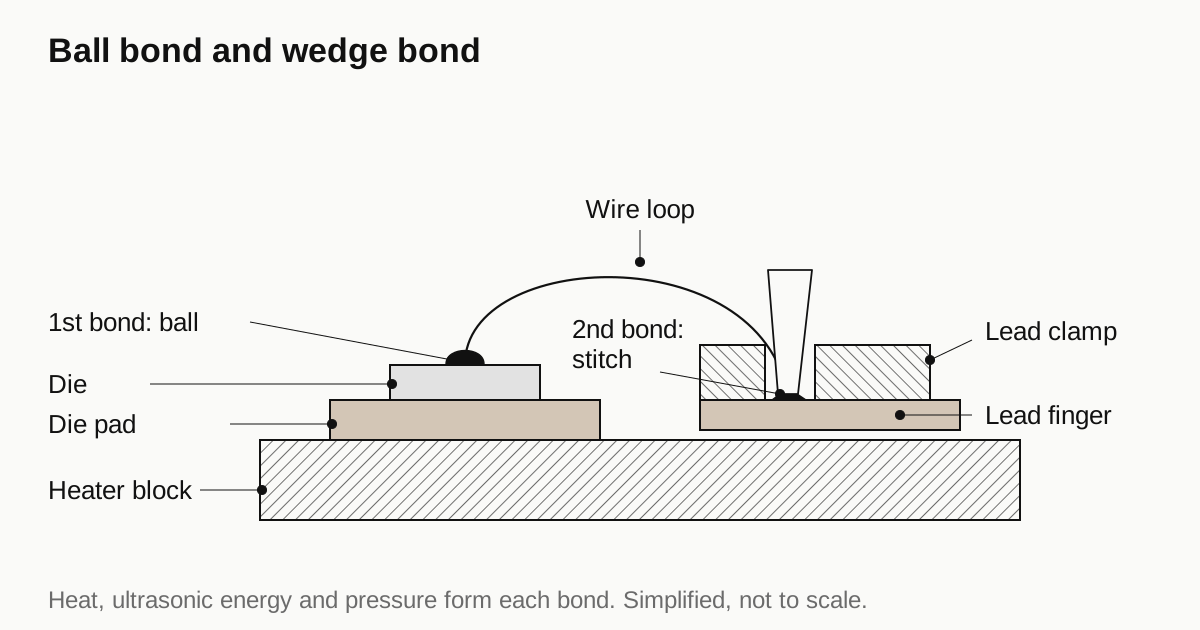
Wire bonding joins a chip to its package with fine metal wire. A tool presses one end of the wire to a pad on the die, loops it over and presses the other end to a lead on the package. The wire is the electrical connection. The machine that does this has a heated base and clamps that hold the work still, and those are the parts a machine shop is asked to make. The wider parts map is in our guide to semiconductor jigs and fixtures.
How a bond is made
In either kind of bond the wire is attached at both ends with a combination of downward pressure, ultrasonic energy and in some cases heat. Using heat with ultrasonic energy is called thermosonic bonding.
TWI, the engineering research body, describes the gold ball process. The wire tip is melted into a free-air ball, whose diameter is 1.5 to 2.5 times the wire diameter, and the ball is bonded to the pad. A wedge-style bond is then made on the lead finger. Aluminium wedge bonding forms no ball: a clamped wire is pressed to the pad and bonded with ultrasonic energy. The lead frame that carries the die in many packages is covered in what a lead frame is.
Ball against wedge
| Method | Wire | Wire diameter stated | Note |
|---|---|---|---|
| Ball bonding | Gold or copper | Copper fine wire: 10 to 75 micrometers. Gold: from 8 micrometers | Small diameter wire only; wire can leave in any direction; needs heat |
| Wedge bonding | Gold, aluminum or copper | Copper wedge: up to 500 micrometers. Power packages: 250 to 400 micrometer aluminum | First bond drawn in a straight line; large wire or ribbon possible |
Source: Wikipedia, Wire bonding. Wire diameters in the article run from under 10 micrometers to several hundred for high power. The page gives no pitch, temperature or force values, so we quote none from it.
Wikipedia also notes that pure gold is usually doped, for example with beryllium, for ball bonding, and that alloyed aluminum is generally preferred over pure aluminum except in high-current devices. Gold ball bonding on aluminum pads is not suitable for hermetic packages because of the high sealing temperatures, according to TWI, while gold on gold pads can be used. Wikipedia adds that copper is replacing gold because of gold’s rising cost, and that copper’s hardness and corrosion call for tighter control and forming gas.
Wirebond packages make up more than 80 percent of the overall packaging market in a 2017 article that cites Kulicke and Soffa. That figure is old, so check a current report before you rely on it. The surrounding OSAT business is explained in what an OSAT is.
Where wire bonding sits in the flow
Wikipedia’s article on integrated circuit packaging puts wire bonding after die attach and before molding. The die is first mounted and fixed to the package or support structure. Fine wires then connect the package leads to conductive pads on the die. Many devices are then molded out of epoxy plastic for protection and mechanical strength. The article lists thermosonic bonding and tape automated bonding as bonding variants. The wires are very fine and molding comes next, so the work-holding parts at the bonder deserve attention.
Need a quote for this part? Get a quote
The tooling around the wire
A 2002 patent for a bondhead lead clamp shows the working layout for a lead frame. A heat block heats the die pad, the die and the lead fingers during bonding. The patent calls 230 C desirable and says the block should not exceed 300 C, to avoid thermal damage to the die. An independent lead clamp holds the lead finger against the heat block and limits deflection of the finger end, so the bonding tool lands where it should. The same patent prefers a wire-to-lead bond at about 190 C with a bonding force of 50 to 100 grams, and says the bond to the lead finger is typically a wedge bond. These are the preferred values of one patent for one design. Your bonder and process set your own.
For a shop, the consequences are specific. A heater block is a flat, thermally stable plate. A clamp is a thin window cut to the strip layout. A vacuum chuck needs a clean hole pattern. The detail on what a shop can and cannot make is in wire bond and die attach tooling parts.
Why the choice of wire matters to tooling
The wire and the bond type set the process, and the process sets what the heater block and clamps must do. Copper needs higher ultrasonic power than other wires according to Wikipedia, and it needs forming gas, so a copper line has its own gas requirement. Gold ball bonding needs heat, while aluminum wedge bonding in the sources above relies on ultrasonic energy. A shop quoting a heater block should ask which wire the line runs, because the answer may change the temperature the block must hold.
What to send with an RFQ
- The bonder maker and model, and the existing part or its drawing
- The strip or substrate drawing and its worst-case warpage
- The working temperature of the heat block
- Flatness and surface requirements, and the material
- Quantity and spares
Send the RFQ and we reply within 24 business hours with a quote or a plain no. The wider parts map is in the jigs and fixtures guide.
Sources
- Wikipedia, Wire bonding (ball, wedge, materials, diameters)
- TWI, What is wire bonding (gold ball bonding, aluminium wedge bonding, thermosonic)
- US 6,435,400, Bondhead lead clamp apparatus and method (heat block, lead clamp; 2002)
- Wikipedia, Integrated circuit packaging (order of assembly steps)
- Semiconductor Engineering, OSAT biz growth and challenges (February 2017)
Frequently asked questions
What is the difference between ball bonding and wedge bonding?
Ball bonding forms a ball on the first bond, so the wire can leave in any direction, which is faster. Wedge bonding draws the wire in a straight line from the first bond, which adds alignment time, but it can use large wire or ribbon. Wikipedia describes both. Ball bonding suits small diameter wire.
Why is copper replacing gold wire?
Wikipedia and TWI both say copper is increasingly used because the cost of gold is rising. Wikipedia adds that copper is harder and prone to corrosion, so it needs tighter process control and forming gas. Which wire a plant uses is a process decision for its engineers, not for the tooling supplier.
Does a machine shop make bonding tools?
The capillary or wedge that touches the wire is a specialist product, not a general machining job. A shop is asked for the parts around it: heater blocks, window clamps and vacuum chucks. These need flat faces and clean hole patterns, and the shop should confirm which steps it does itself.
Need a quote for this part?
Send the drawing. We quote the finished parts, place the work with a partner shop in Vietnam and reply within 24 business hours.
Get a quoteMore on process
- JEDEC Matrix Trays and Custom Carrier Trays: When Machined Replaces Molded
- Designing a Package Nest: Pocket Size, Clearance, Lead-In and Datum
- Planning Production When Urgent Spares and New Jigs Share the Machines
- Semiconductor Jigs and Fixtures: Which Part Family, What to Specify, What Fails and Who Makes It
All guides and the sourcing glossary.