Guides / Process
OSAT Explained: The Company That Packages and Tests the Chip
November 21, 2026
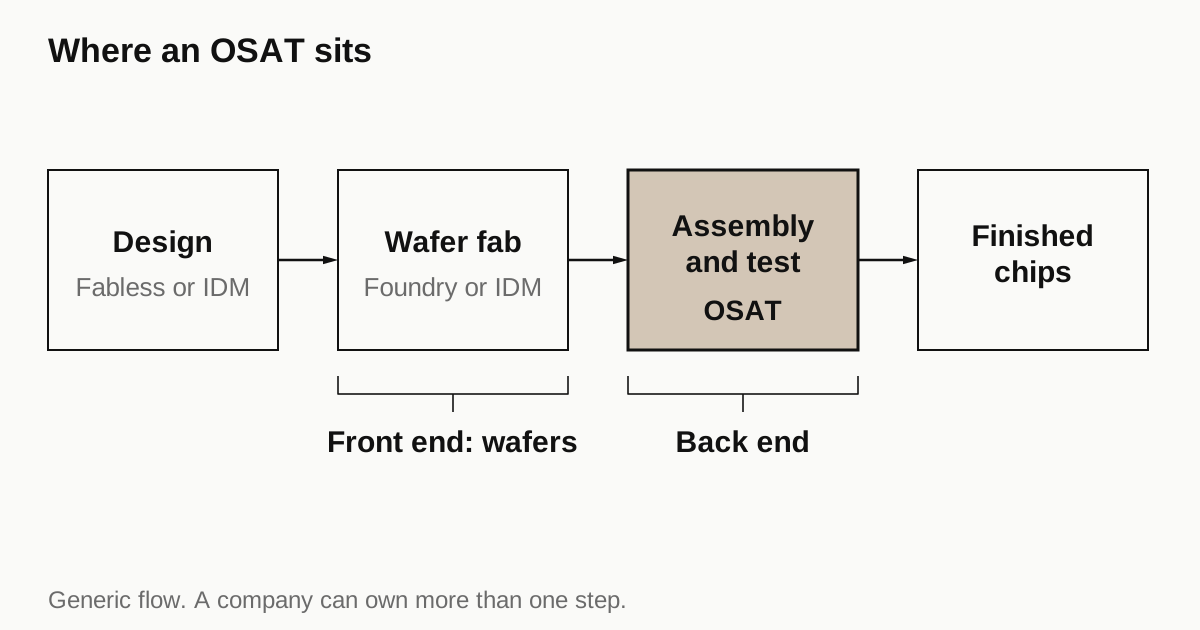
An OSAT is an outsourced semiconductor assembly and test company. It takes finished wafers, cuts them into dies, packages the dies and tests the result for chip designers and chipmakers that do not do those steps in house. If you buy jigs, fixtures or change kit parts, the OSAT floor is where those parts are used. For the parts that run there, start with our guide to semiconductor jigs and fixtures.
OSAT against IDM, foundry and fabless
Four business models share the chip supply chain. They differ in which steps they own.
| Model | Owns the wafer fab | Owns assembly and test | Examples named in the source |
|---|---|---|---|
| IDM (integrated device manufacturer) | Yes | Yes, in house, and may outsource some | Intel, Samsung, Texas Instruments |
| Foundry | Yes, makes wafers for others | Usually no | Not named |
| Fabless | No, uses a foundry | No, uses an OSAT or a foundry | Not named |
| OSAT | No | Yes, as a merchant service | Not named |
Source: Wevolver, “OSAT semiconductor services”, 17 March 2025, and Semiconductor Engineering, “OSAT biz growth and challenges”, February 2017.
The 2017 article adds two details. IDMs package chips for their own products and also outsource part of that work to OSATs because they lack capacity for everything. A few foundries, Intel, Samsung and TSMC among them, offer packaging and test to customers, while most other foundries do not develop packages for customers. A fabless company can therefore send its wafers to an OSAT, to a foundry that offers packaging, or to both.
What an OSAT actually does
The back end is a sequence of steps, and an OSAT may run all of them or a subset. Wevolver lists the services this way:
- Assembly. Dicing wafers into dies, attaching dies to a substrate or lead frame, connecting them by wire bonding or flip-chip bonding, encapsulating them and singulating the packages.
- Packaging. Placing the die in a protective housing with electrical connections, for example QFN, WLCSP, BGA or SOIC.
- Test. Wafer probe before packaging and final test on automatic test equipment after it. Burn-in, reliability screening and system level tests can follow.
- Logistics. Shipping in tape and reel or trays, and in some cases holding inventory.
Each of these steps has its own machine, and each machine has its own tooling. We describe two of the main ones in separate guides: what a test socket is and what wire bonding is.
Why companies outsource the back end
Semiconductor Engineering gives the reason for IDMs: they package chips for their own products but lack capacity for everything, so they send part of the work to OSATs. Fabless firms have no fab and usually no packaging line, so they outsource both steps. Wevolver adds that packaging and testing were a bottleneck contributing to the global chip shortage in 2020 and 2021, and that the US CHIPS and Science Act of 2022 was passed to strengthen domestic packaging. The back end gets less attention than the wafer fab, but a chip is not a product until it is packaged and tested.
Need a quote for this part? Get a quote
How big the OSAT business is
Figures in the sources are dated, so read them as a snapshot and not as today’s market.
| Figure | Value | Year | Source |
|---|---|---|---|
| OSAT packaging and test revenue (Gartner) | USD 25.9 billion | 2016 | Semiconductor Engineering, 2017 |
| IDM in-house packaging and test (Gartner) | USD 23.9 billion | 2016 | Semiconductor Engineering, 2017 |
| Number of OSATs | More than 100 | 2017 | Semiconductor Engineering, 2017 |
| Share of OSAT sales held by about 10 firms | More than 75 percent | 2017 | Semiconductor Engineering, 2017, citing TechSearch International |
| Share of the packaging market using wire bonding | More than 80 percent | 2017 | Semiconductor Engineering, 2017, citing Kulicke and Soffa |
Source: Semiconductor Engineering, February 2017. We did not find a free, current figure of the same quality. For a current view, check a recent market report before you quote a number.
The pattern in those figures is the useful part. A few large firms hold most of the revenue, and a long tail of smaller ones serves specific package types and regions.
Where Vietnam fits
Vietnam’s role in the chip supply chain is mostly the back end. TrendForce reported in May 2025 that Amkor was running a USD 1.6 billion system-in-package and advanced test site in Bac Ninh Province, and that CT Semiconductor was building what the article calls Vietnam’s first wholly owned OSAT in Thuan An City, named in the article as part of Binh Duong Province. The same article says Vietnam’s national plan targets ten packaging and test factories by 2030. These are reported plans and investments, so confirm them with the plant before you build a supply plan on them. Our overview of the local buildout is in what Vietnam’s back end buildout means for parts buyers.
What an OSAT plant buys from a machine shop
An OSAT floor runs many package types, and every change of package changes some parts. That is why the demand is repeat demand: nests, carriers, magazines, socket plates, guides and spares. The full parts map is in our guide to jigs and fixtures for semiconductor plants.
If you have an OSAT part to source and want to see which Vietnamese shops fit it, send the RFQ. We reply within 24 business hours with a quote or a plain no.
Sources
- Wevolver, OSAT semiconductor services: the backbone of outsourced chip assembly and testing (17 March 2025)
- Semiconductor Engineering, OSAT biz growth and challenges (February 2017)
- TrendForce, Vietnam’s semiconductor packaging and testing industry picks up steam (16 May 2025)
Frequently asked questions
What does OSAT stand for?
OSAT stands for outsourced semiconductor assembly and test. It is a merchant company that takes fabricated wafers or dies and turns them into packaged, tested chips for customers that do not do those steps themselves. Some of those customers are fabless design firms and some are chipmakers with their own fabs.
Is an OSAT the same as a foundry?
No. A foundry makes chips on wafers, which is the front end. An OSAT starts after the wafer is made and handles dicing, packaging and test, which is the back end. A few foundries also offer packaging, but the roles are different, and one company can hold both.
Why do OSAT plants buy so many machined parts?
Each package type needs its own nests, carriers, sockets and change kit parts, and wear parts are replaced on a schedule. A plant that runs many package types therefore orders tooling repeatedly. The size of that demand depends on the plant, so ask for its real spare and change kit forecast.
Need a quote for this part?
Send the drawing. We quote the finished parts, place the work with a partner shop in Vietnam and reply within 24 business hours.
Get a quoteMore on process
- JEDEC Matrix Trays and Custom Carrier Trays: When Machined Replaces Molded
- Designing a Package Nest: Pocket Size, Clearance, Lead-In and Datum
- Planning Production When Urgent Spares and New Jigs Share the Machines
- Semiconductor Jigs and Fixtures: Which Part Family, What to Specify, What Fails and Who Makes It
All guides and the sourcing glossary.