Guides / Process
Test Sockets Explained: Contactor Types and the Parts Around Them
November 21, 2026
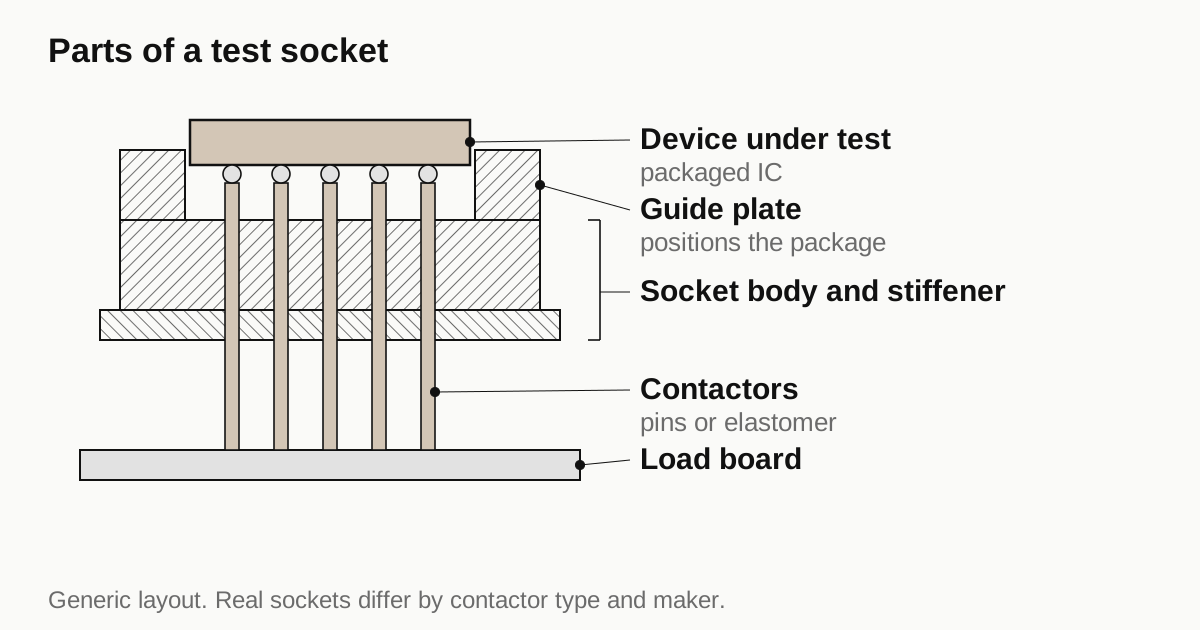
A test socket is the removable connector between a packaged chip and the tester. The device is pressed into it and its pins or balls touch contactors that carry the signals to the board underneath. Because sockets see the production floor all day, they are replaced often, which makes the parts around them a repeat order. The wider parts map is in our guide to semiconductor jigs and fixtures.
What a socket does
Automatic test equipment talks to the chip through an interface, and the socket is the part of that interface that the device actually touches. Wikipedia’s article on automatic test equipment says a socket must survive the demands of a production floor, so sockets are usually replaced frequently. A handler places each device into the socket and takes it out again, which is covered in what a test handler is.
Where the socket is used depends on the test step. Wevolver lists wafer probe before packaging and final test on automatic test equipment after it, and adds burn-in, reliability screening and system level tests as further steps. Wafer probe uses a prober and not a socket. Final test and burn-in are the steps where packaged devices go into sockets.
Contactor types
The contactor is the part that touches the device. A technical article in Semiconductor Digest, written by consultants at Dimensions Consulting, sorts them like this.
| Contactor | Use named in the source | Figure stated |
|---|---|---|
| Double-ended spring pin (pogo) | Most QFP, BGA and LGA testing | Pitch 0.15 mm to 1 mm |
| Area-array pogo | Area-array packages | Pitch 0.4 mm to 0.65 mm |
| Elastomer contact | Conductive particles or wires in a rubber sheet | Superconductive polymer sheet: 0.3 mm uncompressed, 100,000 or more insertions |
| Stamped contact | Burn-in sockets, high volume economy | Burn-in about 125 C, 24 to 72 hours |
| Gull-wing 50 ohm contact | Controlled impedance signals | Not stated |
Source: Semiconductor Digest, “Optimizing Contactors for High-performance Test Sockets” (undated page). Figures are the article’s, not a standard. A pogo pin 2 mm long is said to support about 20 GHz, and RF work needs under 1 mm.
The article calls standard pogo pins the preferred choice for most high performance sockets. The same article lists several elastomer designs from different makers, so there is no single elastomer contact. Treat the table as directional and ask the socket maker for the datasheet of the exact contactor.
The parts a machine shop is asked for
The contactors usually come from a specialist maker. The structure around them is machined, and that is where a shop is involved:
- Socket body or frame that holds the contactors in position
- Guide or alignment plate that places the package. The same article mentions a floating guide plate that positions the balls of a BGA
- Lid or pusher that presses the device onto the contactors
- Stiffener or backing plate under the board, to keep the board flat when the contactors push
- Hardware, dowels, screws and standoffs
Typical plastics, temperatures and tolerances for these parts are on our reference page, test socket bodies, alignment plates and stiffeners. For burn-in boards and their sockets, see burn-in board and socket fixture parts.
Need a quote for this part? Get a quote
Why material and cleanliness matter
A socket guide touches the package, so a burr or a rough edge can mark the device. Insulating plastics can build up charge, which is why static dissipative grades are common around devices, so state any static requirement on the drawing. Burn-in and other raised temperature uses also limit the plastic: a plate that creeps or warps at temperature shifts the guide against the contactors.
Contact force, compliance and burn-in
The same article gives figures that explain why the plates matter. It says a force under 20 g is enough to penetrate the oxide on a contact, and that forces of 40 to 60 g can leave witness marks. It gives a Z compliance of 0.010 to 0.030 inch, about 0.25 to 0.76 mm. Read that as a rule of thumb about the contactor, not as a tolerance for your parts, but the consequence is clear: a guide plate that sits a fraction of a millimeter off its height changes how far the contactors travel.
Burn-in is a different duty. The article describes burn-in at about 125 C for 24 to 72 hours, with up to 10,000 sockets on a run, and it lists stamped contacts for burn-in sockets where high volume and cost matter. A plastic plate near the contactors has to hold its shape at that temperature for days, which is why plastic choice and heat limits come up in burn-in RFQs.
What to send with an RFQ
- The socket maker’s drawing or the 3D model of the body and guide
- The package outline and its tolerance
- The operating temperature and how long the part sits at it
- The plastic or metal you want, and any static requirement
- The quantity, spares and the revision
Send the RFQ with those lines and we reply within 24 business hours with a quote or a plain no. The wider parts map is in the jigs and fixtures guide.
Sources
- Semiconductor Digest, Optimizing Contactors for High-performance Test Sockets (Dimensions Consulting authors; page undated)
- Wikipedia, Automatic test equipment (handler, interface and socket wear)
- Wevolver, OSAT semiconductor services (final test and burn-in as OSAT services, 17 March 2025)
Frequently asked questions
What is the difference between a test socket and a burn-in socket?
A test socket sits in a production test cell and is opened and closed constantly. A burn-in socket holds a device on a board for many hours at raised temperature. One technical article puts burn-in at about 125 C for 24 to 72 hours, and notes that stamped contacts serve high volume burn-in sockets where cost matters.
Are pogo pins or elastomer contacts better?
Neither wins everywhere. Spring pins are the preferred choice for most high performance sockets according to one contactor article, and they cover pitches from 0.15 mm to 1 mm. The same article also lists several elastomer designs. The device, pitch, temperature and signal speed decide the choice.
How often is a test socket replaced?
There is no single answer. A general reference on automatic test equipment says sockets must survive the production floor and are usually replaced frequently. Life depends on the contactor type and on how often the handler opens and closes it. Ask the socket maker for the rated insertion count of the exact contactor.
Need a quote for this part?
Send the drawing. We quote the finished parts, place the work with a partner shop in Vietnam and reply within 24 business hours.
Get a quoteMore on process
- JEDEC Matrix Trays and Custom Carrier Trays: When Machined Replaces Molded
- Designing a Package Nest: Pocket Size, Clearance, Lead-In and Datum
- Planning Production When Urgent Spares and New Jigs Share the Machines
- Semiconductor Jigs and Fixtures: Which Part Family, What to Specify, What Fails and Who Makes It
All guides and the sourcing glossary.