Guides / Process
Test Handlers Explained: Types, Parts and Where the Change Kit Fits
November 21, 2026
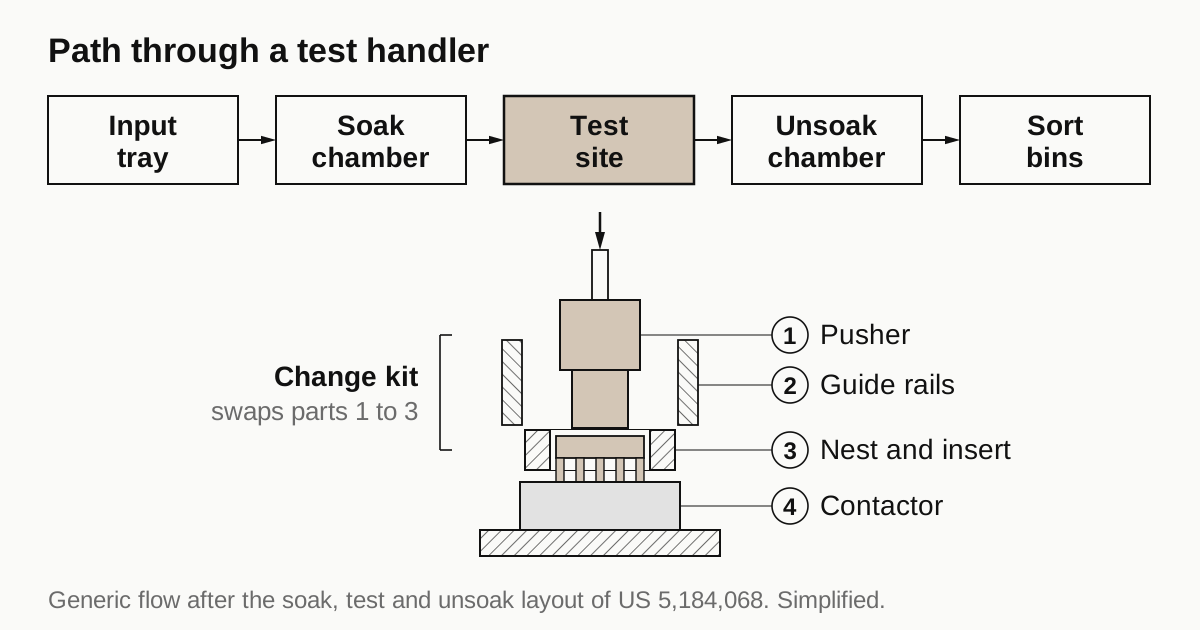
A test handler is the machine that brings packaged chips to the tester and takes them away again, sorted by result. It loads a device, puts it on the tester’s contactor, waits for the test and moves the device to a pass or fail bin. When a plant changes to a different package, the handler stays and a set of parts is swapped. That set is the change kit, and it is the part a machine shop makes. The wider parts map is in our guide to semiconductor jigs and fixtures.
What a handler does
Wikipedia’s article on automatic test equipment says test systems typically interface with an automated placement tool called a handler. The handler physically positions the device under test on the interface so the equipment can measure it. The tester does the measuring and the pass or fail decision. The handler does the moving and the sorting into bins.
A handler can also hold the device at a set temperature. US patent 5,184,068, assigned to Symtek Systems, describes one design: trays go into a pre-test soak chamber, travel along a test track to a test site, and then pass through a post-test chamber that brings the devices back toward ambient temperature. A pusher lifts the insert carrying the device from its tray into contact with the fixed contactor at the test site.
Handler types
Cohu, a handler maker, groups its products into pick-and-place, gravity and turret families on its handler page. Patent texts describe how devices move in the first two.
| Type | How the device moves | Stated detail | Source |
|---|---|---|---|
| Gravity | Devices move in a vertical direction under their own weight | Cohu names octal and quad site test, which means 8 and 4 sites | US 5,865,319; Cohu |
| Pick-and-place | A mechanism or arm picks a device from a tray and places it on the contactor | A conventional unit in the patent measures 180 cm by 106 cm | US 5,865,319 |
| Turret | Devices are handled on a turret platform with a fixed number of positions | Cohu lists a 20 position and a 32 position model | Cohu |
Source: US patent 5,865,319 (Advantest, filed 1996, granted 1999) and the Cohu test handler page. The patent figures are dated and describe one 1990s machine, not a current one. Cohu gives no throughput figure on that page, so we do not quote one.
The patent also names the weak point of the pick-and-place design it describes: test time and sorting time often differ, and the slower step sets the overall speed. Throughput on a real line depends on the package, the parallel sites and the test time, so ask the handler maker and not a general article.
Where nests, guides and the change kit sit
In the Symtek design the device rides in a secondary carrier, an insert with seats for one or more devices, and the inserts sit in a standard tray. V-shaped channel guides and guide rails keep the trays aligned on the front platform and the test track. The patent says standard trays and a standard insert interface let the handler take many device types through inexpensive change-over kits.
That points to the parts a change kit usually holds:
- Nests or inserts that seat the package
- Guides and rails that keep carriers aligned
- Contactor and socket plates at the test site, see what a test socket is
- Pushers, plungers and shuttle plates that move the device
Names differ between handler makers, and the kit for one machine will not fit another. The kit, its materials and its tolerances are covered in test handler change kits: what buyers should specify.
Need a quote for this part? Get a quote
Handlers and temperature
Many parts are tested hot or cold as well as at room temperature. The Symtek patent builds temperature control into the handler: devices are soaked in a chamber before test and brought back to near ambient afterwards. Cohu uses the word tri-temp for some of its pick-and-place models and names a very wide temperature range for its gravity family, without giving a numeric range on that page. For a parts buyer, the point is simple. A nest or guide in a temperature handler sees repeated heating and cooling, so its material and its expansion matter more than on a room temperature machine.
Why the kit is on the critical path
The handler stays on the floor while each new package needs its own kit. The change-over kit is therefore small and specific, and it often sits on the path to qualifying a new product. Our reference page on test handler change kit parts by type lists the parts, typical materials and the points that belong in an RFQ.
What to know before you order a kit
- The handler maker and model, and the kit drawing or a sample part
- The package outline and its tolerance, with the worst case of production devices
- The test temperature range and soak time, since plastics move with heat
- Any static requirement on parts that touch the device
- The spare wear parts you want with the first kit
Ask the supplier which parts it makes and which it buys or subcontracts, because that is where schedule risk sits.
If you have a kit to source, send the RFQ with the drawing package. We reply within 24 business hours with a quote or a plain no. The wider parts map is in the jigs and fixtures guide.
Sources
- Wikipedia, Automatic test equipment (handler and prober)
- US 5,184,068, Electronic device test handler, Symtek Systems (trays, inserts, soak chamber, change-over kits)
- US 5,865,319, Automatic test handler system for IC tester, Advantest (gravity and pick-and-place description)
- Cohu, Test Handlers (pick-and-place, gravity and turret families)
Frequently asked questions
What is the difference between a handler and a prober?
A handler positions packaged parts for test. A prober moves across a wafer and tests the dies before they are cut and packaged. Wikipedia's article on automatic test equipment makes the same split: handlers for packaged parts and probers for wafers. Both talk to the tester, which does the measuring.
What is a change kit?
A change kit is the set of parts swapped when a handler moves to a different package. The patent for one handler design describes standard trays and a standard insert interface so that many device types can be run through inexpensive change-over kits. In practice the kit holds nests, guides and similar plates.
Which type of handler is best?
There is no best type. Gravity, pick-and-place and turret handlers suit different packages, test times and temperature needs. Cohu lists all three families and describes gravity handling as suited to a wide range of package sizes and temperatures. Match the type to the package and test plan, not the other way round.
Need a quote for this part?
Send the drawing. We quote the finished parts, place the work with a partner shop in Vietnam and reply within 24 business hours.
Get a quoteMore on process
- JEDEC Matrix Trays and Custom Carrier Trays: When Machined Replaces Molded
- Designing a Package Nest: Pocket Size, Clearance, Lead-In and Datum
- Planning Production When Urgent Spares and New Jigs Share the Machines
- Semiconductor Jigs and Fixtures: Which Part Family, What to Specify, What Fails and Who Makes It
All guides and the sourcing glossary.