Guides / Process
Planning Production When Urgent Spares and New Jigs Share the Machines
November 21, 2026
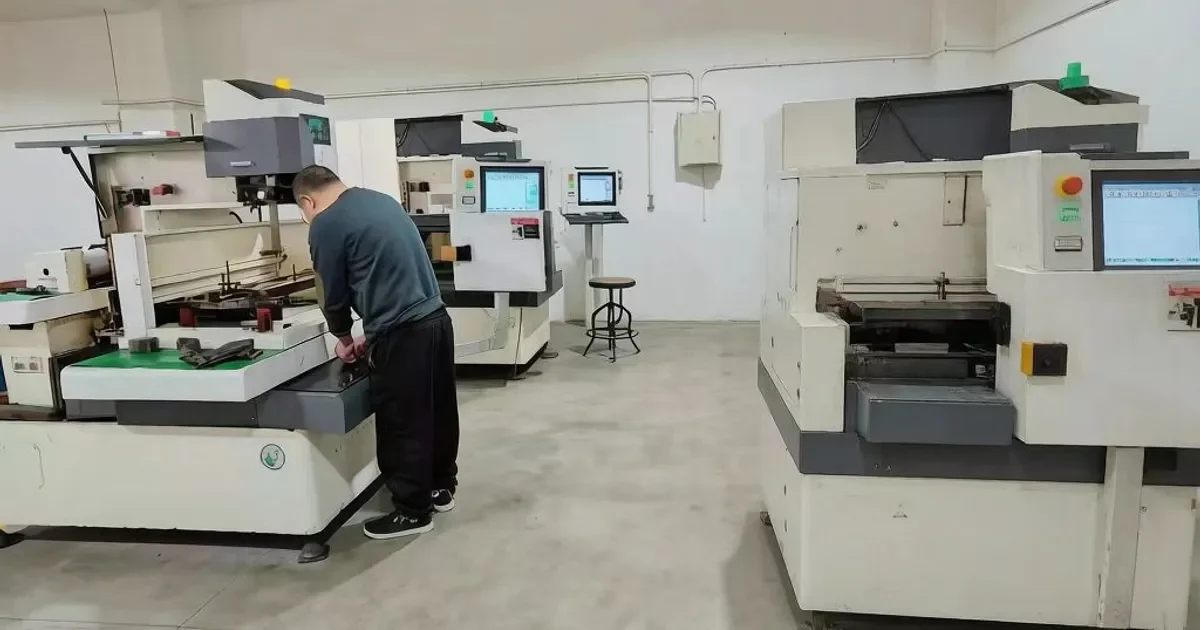
A jig shop that serves OSAT plants runs two kinds of orders on the same machines. New jig projects are planned weeks ahead and pay for the shop’s capacity. Urgent spares arrive when a line is down, need an answer in hours and break whatever plan was made on Monday. A shop that treats both the same loses on both: the new jigs slip, and the spares come out late enough that the plant looks for another source. This guide gives a weekly planning routine that keeps a slot for spares without wrecking the rest. It is practical, short and built around one board.
Two order types, one set of machines
New jig projects and urgent spares differ in what the customer needs from you.
| New jig project | Urgent spare | |
|---|---|---|
| Lead time the customer expects | Weeks, agreed at order | Days or hours |
| Drawing | New or revised, may need questions | Existing, ideally one you can quote at once |
| What breaks if you are late | A project milestone | A production line |
| How it reaches you | RFQ, quote, PO | A message, often with a part number only |
| What helps most | A stable plan | A reserved slot and a ready package |
The ready package for a spare is covered in spare parts and consumable planning: released drawing and model at one revision, the accepted first article report, the finish specification, the packing level and the last quote. If a spare is quotable from a folder, the planning problem shrinks to one question: which hour of which machine.
ISO 9001:2015 clause 8.1 asks an organization to plan and control the processes it needs, including planning for changes. For a jig shop the practical reading is that the plan must say how an urgent job enters it. A plan that cannot absorb an urgent job will be broken by one.
Reserve capacity for spares: how much and on which machines
Reserve on the machines where urgent work waits, not on all of them. A reserve on a machine that is never the queue buys nothing.
- List the steps a typical urgent spare passes through: programming or program recall, milling or turning, wire EDM, grinding, outside finish, inspection, packing.
- Look at your last eight to twelve weeks of spare orders and note the hours each used on each step.
- Reserve slots on the steps that are the longest queue, a little above the typical week.
- Review monthly. Cut the reserve if it often goes unused, raise it if spares often wait.
We found no public benchmark for how much to reserve, and a percentage of capacity from someone else’s shop is not a useful number for yours. Records of your own spare orders are. If you have no records yet, start with a small reserve on the busiest machine and a one-line log of every urgent request: date, part, machine hours, how long it waited.
A weekly plan board: fixed, flexible and reserved slots
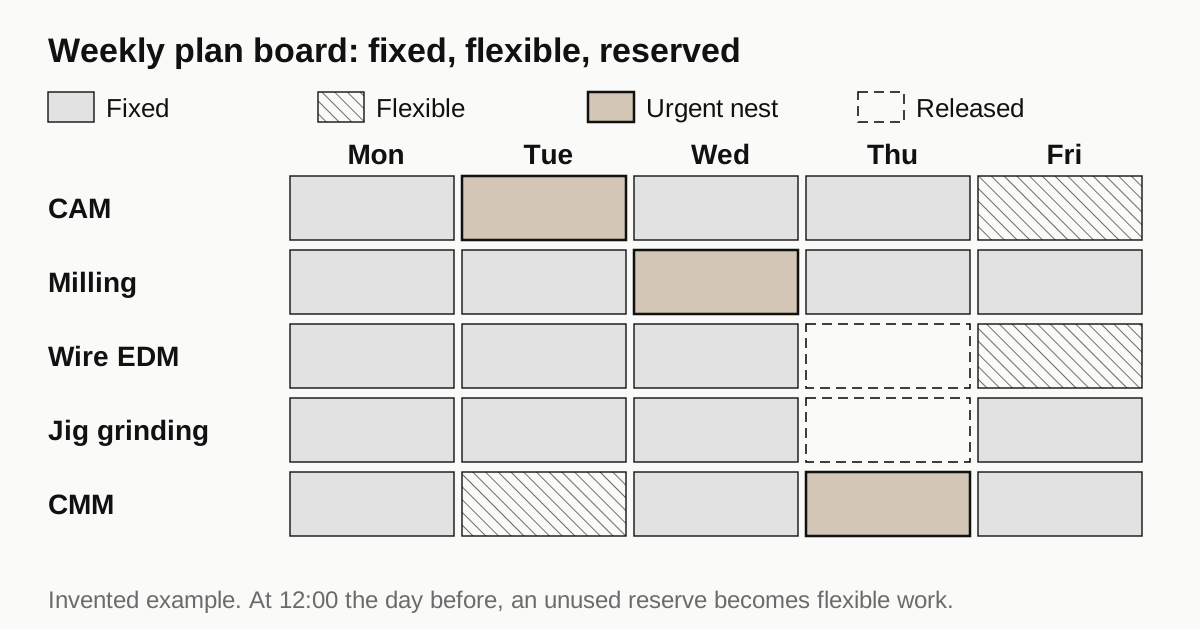
Divide the board into three kinds of slots. A day or half day per machine is enough detail for a small shop.
- Fixed (F). Committed work with a customer date. These move only when you tell the buyer.
- Flexible (X). Work that can move a day or two without touching any customer date, such as internal tooling, rework or stock parts.
- Reserved (R). Held for urgent spares. If no urgent job arrives by a set time, the slot is released to flexible work.
JIS Z 8141, the Japanese production management terminology standard, separates load planning (assigning the load to each workplace over the planning period) from remaining capacity management (comparing current load with available capacity and reassigning work to balance them) and from progress management (tracking how work is advancing). We read these through a Japanese industry column that lists the term numbers 3305, 4103 and 4104. The board is a small version of all three. You plan the load by marking F, X and R. You manage the remaining capacity when an urgent job arrives. You track progress by updating it each day.
| Resource | Mon | Tue | Wed | Thu | Fri |
|---|---|---|---|---|---|
| CAM and programming | F | R | F | F | X |
| 3-axis milling | F | F | R | F | F |
| Wire EDM | F | F | F | R | X |
| Jig grinding | F | F | F | R | F |
| Inspection (CMM) | F | X | F | R | F |
Rules for the board:
- Fix Monday’s plan by Monday midday. After that only R and X slots change.
- Release an unused R slot at a fixed time, for example 12:00 on the day before it. Then it becomes X.
- Put your name on every R slot. A reserve with no owner is an open slot that anyone can take.
- Print or display the board where people at the machines can see it.
Bottlenecks in a jig shop: CAM, wire EDM and jig grinding
Where the reserve goes depends on where work waits. In a jig shop the likely places are the ones a hardened tool steel plate passes through one after another. In the usual sequence described in wire EDM for precision jig plates and jig grinding for locating pin holes, the plate is hardened, ground flat, wire cut and then jig ground. A shop with one wire EDM and one jig grinder has a queue at those two machines by construction. Programming is the third: a person, not a machine, but only one job can be programmed at a time, and an unquotable spare needs the longest programming of all.
Two more steps sit outside the board and matter just as much. The outside finish is a batch process at another company, and the finisher’s batch cycle is usually the longest wait in the chain, as shown in where the weeks go on a machined part. Ask your finisher how an urgent part can ride the next batch and what a dedicated batch costs. Material is the other: a spare in a stocked grade starts today, a spare in an imported grade starts when the material arrives.
Need a quote for this part? Get a quote
A worked week
The week below is invented to show the method. The hours are illustrations, not targets. The job is an urgent replacement nest, a spare for a test handler change kit with an existing drawing and an accepted first article report on file.
| Day | What happens | Effect on the board |
|---|---|---|
| Monday 15:00 | The buyer reports a line down and asks for a replacement nest. The shop checks the folder: drawing at the current revision, first article report, finish spec, material in stock | Quote sent within 24 business hours, with a ship date based on reserved slots |
| Tuesday | Buyer confirms. The shop uses the Tuesday CAM reserve to recall and check the program | One reserved slot used. No fixed job moves |
| Wednesday | Milling in the Wednesday reserve on the 3-axis machine. At 12:00 the shop sees the nest needs no wire EDM or jig grinding and releases Thursday’s reserve on both | The two released slots become flexible work |
| Thursday morning | First piece measured in the reserved CMM slot. The outside finisher is asked whether the nest can ride a batch going out that day | If yes, the nest leaves with the batch. If not, the shop tells the buyer the finish date now |
| Thursday afternoon | A fixed job on the same mill is checked: still on its date | No customer date moved, so no message is needed |
| Following week | Finish returns. Final check, packing, shipment | The nest ships on the date quoted on Monday, or earlier |
The week works because three things were true before the call came. The folder was complete, the reserve existed and someone had a rule for what moves.
Saying yes to an urgent spare: what moves and who is told
Use a simple order of questions when the call comes:
- Is there a reserved slot on each bottleneck step? If yes, take it.
- If a step has no reserve, which flexible work can move? Move that first.
- If only fixed work can move, how much slack does it have? If it has none, the answer is to quote a later date or to ask the urgent buyer what date they really need. Do not delay a fixed job silently.
- Tell the buyer of any job whose forecast date changes, the same day, with the new date.
Semsysco’s guideline TE_0030 states that schedule deviations must be communicated immediately to the buyer or project manager. Following it costs little: one message, one new date, one sentence of cause. A buyer who gets that message plans around the delay. A buyer who does not will discover it on the due date.
Measuring on-time for both order types
Track two numbers, not one. A single on-time rate hides the fact that spares are shipping on time while projects are slipping, or the other way around.
| Measure | New jig projects | Urgent spares |
|---|---|---|
| Quote returned | Within 24 business hours | Within 24 business hours |
| Shipped by the date confirmed at order | Yes or no, per order | Yes or no, per order |
| Days late, if late | Count them | Count them |
| Reserve slots used | Used or released unused |
Customers keep their own scorecards. The same guideline lists on-time delivery, quantity accuracy and the number of complaints among its supplier evaluation criteria, so a shop that measures the same things sees its score before the customer does. Review both columns monthly. If urgent spares eat the reserve every week, the reserve is too small or too many requests are being called urgent. If the reserve is mostly released unused, cut it.
Talk to us
If your shop makes jigs, change kits and spares for semiconductor plants and wants to see how we place work with partner shops that can plan for both, read for suppliers. Tell us which machines and finishes you have and we will say plainly whether we have work that fits.
Sources
- NQA, ISO 9001:2015 Clause 8: Operation (summary of 8.1 operational planning and control, including planned changes; a certification body’s guide, not the standard text)
- Issoh, column on JIS Z 8141 production management terms (load planning 3305, remaining capacity management 4103, progress management 4104, reading of the 2022 edition; a Japanese industry column, not the standard)
- Semsysco, Quality Assurance Guidelines TE_0030 revision 03, file hosted by Lam Research (section 6 supplier evaluation criteria, section 15 schedule deviations; one equipment maker’s rules)
Frequently asked questions
How much machine time should a jig shop reserve for urgent spares?
No public benchmark exists, so take it from your own records. Log the hours each urgent spare used on each bottleneck machine for the last eight to twelve weeks and reserve a little above the typical week. Review the figure monthly and release unused reserve on a fixed day so the machine does not stand idle.
Which machines usually become the bottleneck in a jig shop?
Programming (CAM), wire EDM and jig grinding are the likely ones, because hardened plates pass through them one after another and a shop often has only one of each. This is our reading from the plate sequence, not a measured survey. Find your own bottleneck by looking at where jobs wait longest.
Who should be told when an urgent spare pushes a new jig job back?
The buyer of the delayed job, the same day, with a new forecast date. Semsysco TE_0030, one equipment maker's guideline, requires schedule deviations to be communicated immediately. A late job the buyer hears about from the shop is a delay. One the buyer finds out about on the due date is a complaint.
Should urgent spares jump the queue every time?
No. Agree a rule: a line-down spare for a customer's running line takes a reserved slot, anything else queues as normal. Without a rule every request becomes urgent and the reserve disappears in the first week.
Need a quote for this part?
Send the drawing. We quote the finished parts, place the work with a partner shop in Vietnam and reply within 24 business hours.
Get a quoteMore on process
- JEDEC Matrix Trays and Custom Carrier Trays: When Machined Replaces Molded
- Designing a Package Nest: Pocket Size, Clearance, Lead-In and Datum
- Semiconductor Jigs and Fixtures: Which Part Family, What to Specify, What Fails and Who Makes It
- Lead Frames Explained: The Metal Skeleton Inside the Package
All guides and the sourcing glossary.