Guides / Process
Lead Frame Magazines and Strip Carriers: A Checklist Before You Order
November 5, 2026
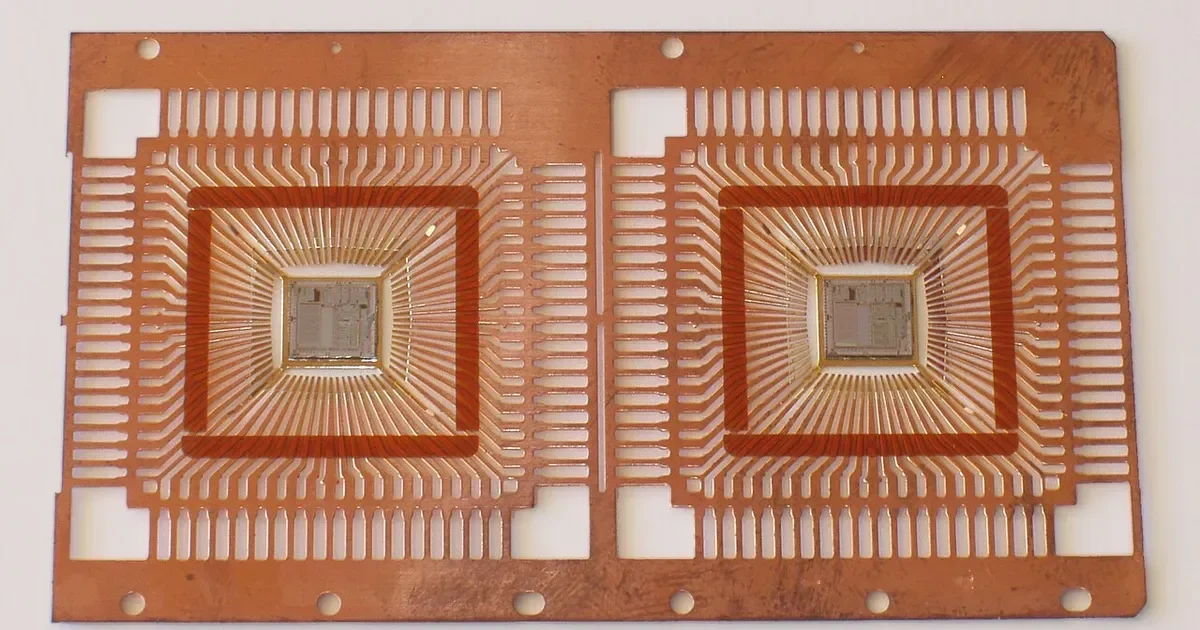
A lead frame magazine looks like the simplest part on an assembly line, a box with slots. It is also where a handling problem turns into a lost lot, because every strip passes through one at each station. Specify the strip you really run, including its warpage, then the slot pitch, the clearance, the stops, the material and the bake limit. This checklist covers each one.
What a magazine does
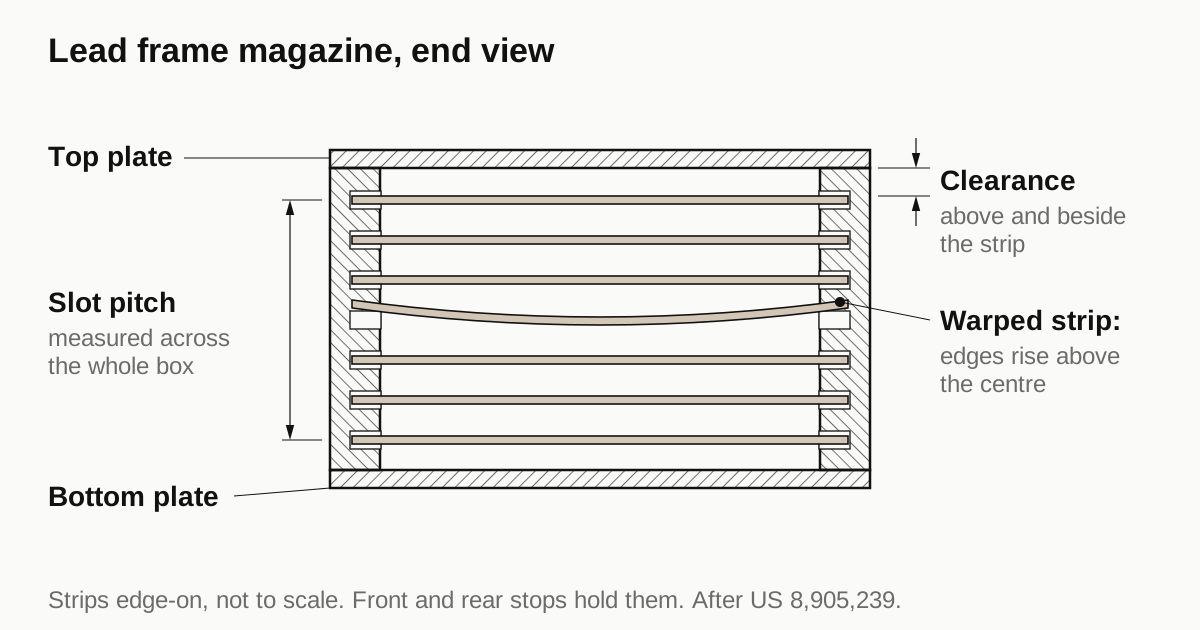
A magazine carries diced lead frames between packaging steps such as wire bonding, molding, trimming, forming and ink marking. A published patent on an adjustable design describes the layout: an open box with a flat bottom plate and a parallel top plate, joined on each side by slot plates. Each strip rests in one slot on each side. Stoppers at the front and rear keep strips from falling out in transit.
The strip it carries is a thin metal frame. Lead frames are stamped or etched from copper, a copper alloy or an iron-nickel alloy such as alloy 42, and the connecting structure makes the frame rigid enough for automatic handling. Strip warpage is what makes that rigidity less reliable in practice.
Start with the strip, not the box
SEMI G89, Specification for Leadframe Strip Size, defines the width and length of a leadframe strip for QFP and SOP types, and can serve as a purchasing specification for those lead frames. It does not cover the unit layout inside the strip. The current revision is SEMI G89-0211, reapproved in 2023.
That fixes the strip’s outline. It does not fix the magazine. We did not find a SEMI standard for magazine dimensions, so the magazine comes from the equipment maker’s drawing or the plant’s own. Get the drawing, and get a sample magazine that already runs on the line. Working from a physical reference avoids a re-make, as in wire bond and die attach tooling parts.
Warpage is the number the drawing leaves out
Strips do not stay flat. A 2024 patent application on magazine clamping describes package strips loaded into magazines for pre-bake before molding. Heating can warp the strip, because the substrate, the dies and the layers have different thermal expansion. A warped strip rests on its central zone while the front and rear edges rise. The same application names a target of strip warpage below 3.0 mm to allow automated molding. Its comparison table shows about 3.7 mm after pre-bake in a conventional magazine against roughly 2.7 to 2.8 mm with clamps, figures the patent presents as approximate.
That patent is about package strips, a related format, not copper lead frames. The lesson carries over: nominal flatness is not the shape the magazine sees. Measure warped production strips, give the shop the worst case, and size the slot for it.
A checklist of what to specify
The table lists what the drawing and the order should state. The values are yours; the headings are the part most orders miss.
| Parameter | What to state | What it prevents |
|---|---|---|
| Strip size | Length, width and thickness range, from SEMI G89 or your strip drawing | A slot that does not fit the strip family |
| Warped strip | Worst warpage in mm and how it is measured | Strips that bind in the slot or ride up |
| Slot count and pitch | Number of slots, pitch and tolerance, measured across the whole magazine | Strips that collide, or a handler that misses a slot |
| Slot clearance | Clearance above and beside the strip | A strip that jams when tight or slides when loose |
| Adjustable width | Fixed, or adjustable between listed widths | Several magazines for one product family |
| Stops and latches | Front and rear stops, how they open and close | Strips falling out in transit |
| Lead-in geometry | Chamfers and entry radii at the slot mouth | Crumpled strips at the hand-off |
| Material | Aluminum, stainless or a plastic, with the finish | Static, wear and weight |
| Bake limit | Maximum temperature if the magazine goes through a bake | Distortion of the slots after the oven |
| Marking | Product code and revision on the body | Mixed magazines on one line |
The accumulated pitch error across forty slots is not the same as the error of one slot, a point worked through in automation parts for OSAT plants. Ask for pitch measured across the whole magazine, not slot by slot.
Need a quote for this part? Get a quote
Where jams actually start
Two published sources point at the hand-off, not the box. A wire-bonding patent says heated lead frames and substrates tend to jam and crumple as they are ejected into the output magazine, and that contact sensors often detect the jam only after damage. A Philippine plant paper on crumpled strips in a tin-plating line records 69 crumpled cases over April to September 2022, 30 of them on one machine. Its root cause list starts with strip warping, followed by aligner and belt set-up and sensor mounting. Affected lots added two to three days of extra inspection and testing before moving on, against an 11 day committed cycle time. The countermeasures reduced the crumpled-strip defect rate at that machine by 97 percent.
Both are cases of strip handling, not of magazine design. They show where the cost sits: a strip that is not what the drawing says, meeting a hand-off with no margin. For the magazine, that argues for a generous lead-in, a clearance sized for the worst strip and a pitch you can measure.
Jams at the strip hand-off are one case in why jigs and fixtures fail on the line, from our guide to semiconductor jigs and fixtures.
What a machine shop can make
Slot plates, bodies, stops and latches are machined or sheet metal parts, so they fit a shop with good flatness and pitch control. The material and cleanliness questions are the same as for other handling hardware: see ESD materials and coatings for fixtures for static control and the tolerance stack up guide for how slot position errors add. Trim and form tools that receive these strips are covered in trim and form tooling for OSAT lines.
Ask the shop to run the first articles against real strips. A magazine that fits a flat gauge strip and jams a warped production strip has passed the wrong test.
Before you send the RFQ
- The equipment maker’s magazine drawing, or a sample magazine
- The strip drawing, with SEMI G89 reference if it applies
- Worst-case warpage and how you measure it
- Slot count, pitch and the accumulated tolerance you can accept
- Bake temperature, material and finish, including any static requirement
- The number of magazines, spares and the revision marking
Send the RFQ with those lines and a note on how your handler picks the strip, and we come back within 24 business hours with a quote or a plain no. Shop criteria are on how an order runs.
Sources
- US 8,905,239, Magazine for loading a lead frame (structure, slot plates, adjustable width)
- US 2024/0332050, Carrier assembly for carrying semiconductor package strips with improved warpage control (strip warpage, 3.0 mm target)
- US 2006/0144899, Jam detection apparatus and method for indexing of substrates and lead frames (jams at the output magazine)
- SEMI G89, Specification for Leadframe Strip Size (scope and revision)
- Wikipedia, Lead frame (materials, stamping and etching)
- Allegro MicroSystems Philippines, reduction of crumpled strips on a tin-plating machine, ASEMEP symposium paper
Frequently asked questions
What is a lead frame magazine?
A magazine is an open box with slots on both inner side walls. Each lead frame strip rests in one slot pair, and the box moves strips between machines such as wire bonders, molding presses, trim and form tools and markers. Stops at the front and rear keep the strips from sliding out in transit.
Is there a SEMI standard for lead frame magazine dimensions?
We did not find one. SEMI G89 defines the width and length of a lead frame strip for QFP and SOP types, which fixes what the magazine must carry. Magazine dimensions come from the equipment maker or the plant's own drawing, so ask for those before you quote a new part.
Why do strips jam or crumple at the output magazine?
A published patent on wire bonder output reports that heated lead frames and substrates tend to jam and crumple as they are ejected into the output magazine, and that contact sensors catch it late. Warped strips, a misaligned entry and a tight slot all raise the odds. The fix starts with the strip's real shape, not only its drawing.
How much warpage can a strip have before it causes trouble?
There is no universal number. One 2024 patent application on magazine clamps names a target of strip warpage below 3.0 mm to allow automated molding. Your handler and your strip decide the real limit, so measure warped production strips and give the shop the worst case, not the nominal.
Need a quote for this part?
Send the drawing. We quote the finished parts, place the work with a partner shop in Vietnam and reply within 24 business hours.
Get a quoteMore on process
- JEDEC Matrix Trays and Custom Carrier Trays: When Machined Replaces Molded
- Designing a Package Nest: Pocket Size, Clearance, Lead-In and Datum
- Planning Production When Urgent Spares and New Jigs Share the Machines
- Semiconductor Jigs and Fixtures: Which Part Family, What to Specify, What Fails and Who Makes It
All guides and the sourcing glossary.