Guides / Choosing a Supplier
Automation and Line Hardware for OSAT Plants in Vietnam: What to Source Locally
October 10, 2026
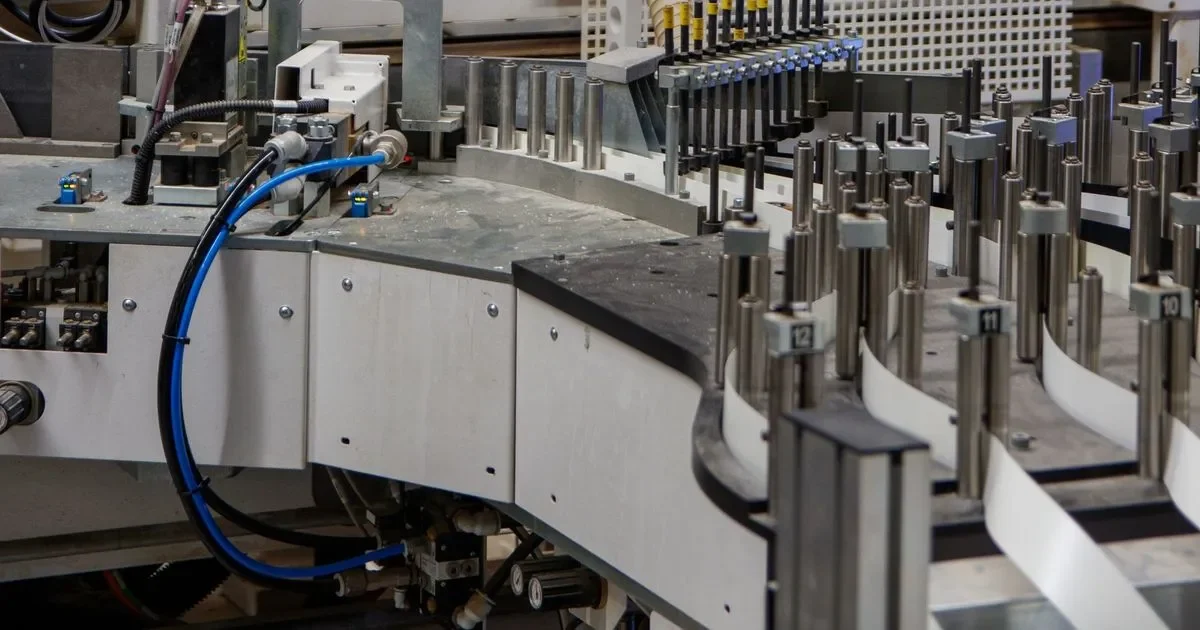
An OSAT plant, which assembles and tests semiconductors for other companies, runs on automation. Handlers move packages through test. Die bonders and wire bonders place and connect dies. Molding presses, trim and form tools, marking stations and inspection systems all pass product along conveyors and magazines. Behind every machine is a long list of small mechanical parts that wear, break or need adjustment.
When that plant is in Vietnam, a question arises: which of those parts can be made nearby instead of ordered from the equipment maker abroad, and how should a buyer approach them? This guide sorts the parts by how easy they are to source locally and by what the order has to include.
Why local sourcing matters for plants in Vietnam
Vietnam’s back end semiconductor base has grown fast, with large plants in the north around Bac Ninh and Bac Giang and in the south around Ho Chi Minh City, as covered in Vietnam’s back end buildout. A plant that depends on parts shipped from Europe, Japan or the United States waits weeks for a bracket. The same bracket made within an hour’s drive can arrive in days.
The savings are in time more than in price. A line stopped for a missing part costs far more than the part. A spare made nearby, to a drawing the plant owns, shortens the wait. That is the main reason maintenance and engineering teams look for local suppliers.
Which parts fit which source
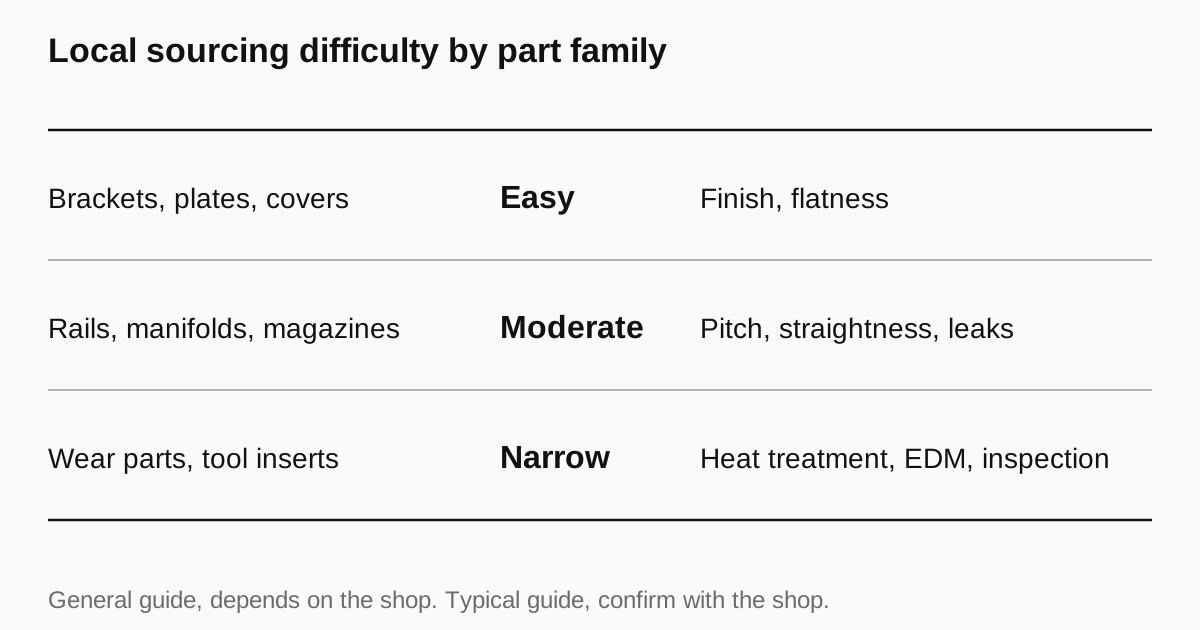
| Part family | Material | Typical tolerance | Local sourcing | Watch for |
|---|---|---|---|---|
| Brackets, plates, covers | Aluminum, mild steel | plus or minus 0.1 mm | Easy, many shops | Finish and flatness |
| Sensor mounts, adjustment blocks | Aluminum, stainless | plus or minus 0.05 mm | Easy | Slot and hole position |
| Conveyor rails and guides | Aluminum, stainless | straightness 0.1 mm per metre | Moderate | Length, straightness, anodize |
| Pneumatic manifolds | Aluminum, brass | port position 0.1 mm | Moderate | Cross drilling, leak testing |
| Simple grippers and fingers | Aluminum, steel, plastic | plus or minus 0.02 mm | Moderate | Wear surfaces, contact material |
| Magazines and trays | Aluminum, stainless, plastic | slot pitch 0.05 mm | Moderate | Accumulated pitch error |
| Shafts, bushings and guides | Hardened steel, bronze | h6, H7 | Narrower | Hardening and grinding |
| Wear parts and tool inserts | Tool steel, carbide | 0.005 mm | Narrow | Heat treatment, EDM, grinding |
| Parts that touch product or set accuracy | Varies | 0.005 to 0.02 mm | Narrow | Inspection, cleanliness, ESD |
The table is a rough guide, not a ruling. A capable shop makes any of them, and an unprepared shop fails even the easy ones. The pattern is that difficulty rises with tolerance, with hardness and with the need for finishing or inspection that few shops control.
Easy parts: brackets, covers and mounts
These parts are made by almost every shop and priced by material and machine time. The risks are small and the savings are real. Specify the material, the finish and a general tolerance, with tighter tolerances only on features that mate with other parts. Anodize or paint where the plant requires it, and ask for edge breaks, since sharp edges cut cables and hands. A plain drawing and a clear finish note cover most of what is needed. Drawing mistakes that make a part unquotable shows what a usable drawing looks like.
Moderate parts: rails, manifolds and magazines
Here accumulated error matters. A magazine with forty slots at 4.76 mm pitch has to hold the pitch across its length, not just at each slot, so a tolerance of 0.05 mm per slot can add up to 0.2 mm or more over the full set. Conveyor rails need to be straight and parallel over their length, and long parts bow during machining and anodizing. Pneumatic manifolds need cross drilled ports that meet cleanly and do not leak, which requires careful deburring and a leak test.
For these parts, ask about measurement. A CMM or a long travel optical machine can verify pitch and straightness. A caliper cannot. See tolerance stack-up for fixtures and weldments and machine frames for the related issues in larger parts.
Narrow parts: shafts, wear parts and precision components
Hardened shafts, bushings, guide pins and tool steel inserts need heat treatment and grinding, and few shops control the whole chain. The question is not whether the shop can cut the shape. It is whether it can heat treat, grind to size and prove the hardness and the finish. The detail is covered in heat treating tool steel fixtures and jig grinding.
Parts that touch product or set accuracy carry the strictest requirements. A pick nozzle, a test socket guide, a die collet and a locating nest all fall here, and are covered in other guides such as pick and place nozzles and collets, test handler change kits and wafer handling end effectors. The cost of a bad part is a lot or a line, not a bracket.
Working from a sample or a broken part
Most automation spares are ordered because something broke, and the original drawing is with the equipment maker. The usual starting point is a physical part. The process is:
- Measure the sample, noting wear. Ideally use an unused part from the same machine.
- Draw it, or have the shop draw it, and agree the critical dimensions.
- Confirm the material and hardness. A hardness test and an analyzer check cost little.
- Make a first piece and test it on the machine.
- Freeze the drawing and order the batch.
Do not skip step 4. A part that matches the dimensions but not the stiffness, the finish or the material can fail in weeks. Second sourcing a critical part covers the same process for parts you already buy from someone else.
Need a quote for this part? Get a quote
Intellectual property and drawings
Equipment makers own their drawings. A plant that measures a part and has it copied locally takes on a question of rights, especially if the part is patented or the maker has restrictions in the contract. Read the contract. For non critical spares such as brackets, the risk is small. For core components, ask the maker or use the maker’s approved supplier. Where a plant owns the design, the drawing is yours and can be shared under an agreement. See NDAs when drawings cross borders.
Lead time and what drives it
For machined spares, lead time depends on material availability, machine queue, finishing and inspection. Simple aluminum parts can move in days. Hardened parts need a furnace slot and take longer. Anodize and plating add days, because they run in batches. Where the weeks go on a machined part describes where the time hides. A plant with a repeat list of spares can place blanket orders and get parts faster than one that orders one by one.
Turning one-off orders into a spares programme
Plants that buy automation parts one at a time pay for it twice, once in price and once in downtime. A better pattern is to list the parts that fail or wear on each machine type, record how many are replaced each year and agree a schedule with the supplier. The supplier machines a batch of blanks or semi finished parts, holds them and finishes the number needed on short notice. That cuts lead time to days for the parts that matter, without a plant carrying a full stockroom of finished goods.
The same list helps the plant decide what to stock. A part that costs little and stops a line when missing belongs in the stockroom in quantity. A part that costs a lot and rarely fails can be ordered on demand with a longer lead time accepted. Use the machine’s service history as the guide, not a general rule. Spares and consumable planning walks through a simple version of this.
Labels, packing and the stockroom
A part that arrives unmarked in a plain bag is hard to use. Ask for each part to carry its number and revision on the bag or the part, and for the packing list to match the order lines. Fragile or finished surfaces need separate cells. For parts that go into a cleanroom, state the cleaning and packing level. Little of this costs the shop anything extra, and it saves time at receiving and at the machine. See packing and shipping to a fab for a pack specification that works.
What to ask a shop
- Which kinds of automation parts have you made for plants in Vietnam, and can you share photos or reports?
- How do you measure pitch, straightness and position on long or multi feature parts?
- Do you heat treat and grind in house, or through partners?
- How do you handle drawings from a sample, and who approves them?
- What lead time applies to repeat orders, and can you hold stock of blanks?
- How do you pack and label spares for a plant stockroom?
For the jig and nest side of the same plants, see our guide to semiconductor jigs and fixtures.
Checklist before you send the RFQ
- Part list with drawings, samples or the maker’s part numbers
- Machine model and where the part is used
- Material, hardness, finish and ESD requirement
- Critical dimensions, and which are measured
- Quantity now and expected usage per year
- Stockroom labelling and packing
- First piece trial on the machine
- Any rules from the equipment maker about substitution
Send them through the RFQ form. We place it with a partner shop and send one itemised quote within 24 business hours. The vietnam machining map shows where capacity sits for plants in the north and the south.
Frequently asked questions
Which automation parts are easy to source in Vietnam?
Brackets, plates, covers, guards, conveyor rails, sensor mounts, pneumatic manifold blocks, simple grippers and spacers. They are machined from aluminum or stainless steel, need moderate tolerances and are made by many shops. Items with heat treated wear parts, precision bores or tight position tolerances narrow the field.
What about parts from the equipment maker?
For equipment under warranty or covered by a service contract, parts normally come from the maker. After the warranty, and for wear and consumable items, plants often source locally to cut lead time and cost, provided the parts are made to the maker's drawing or a measured sample and tested before use.
Do local parts affect the equipment warranty?
They can. Read the warranty and the service agreement before substituting parts, and agree the change with the equipment maker if it applies. Many plants substitute non critical parts such as brackets and covers freely, and treat parts that touch product or set accuracy with more care.
Need a quote for this part?
Send the drawing. We quote the finished parts, place the work with a partner shop in Vietnam and reply within 24 business hours.
Get a quoteMore on choosing a supplier
- How to Check a Vietnam Shop's Real Capacity and Backlog
- Weekly Progress Reports From a Vietnam Jig Shop: What a Useful One Contains
- Reading the Job Board in a Vietnam Jig Shop: Visual Management Signs a Buyer Can Check
- Moving an Existing Jig Program to a Vietnam Machine Shop
All guides and the sourcing glossary.