Guides / Choosing a Supplier
How to Check a Vietnam Shop's Real Capacity and Backlog
November 21, 2026
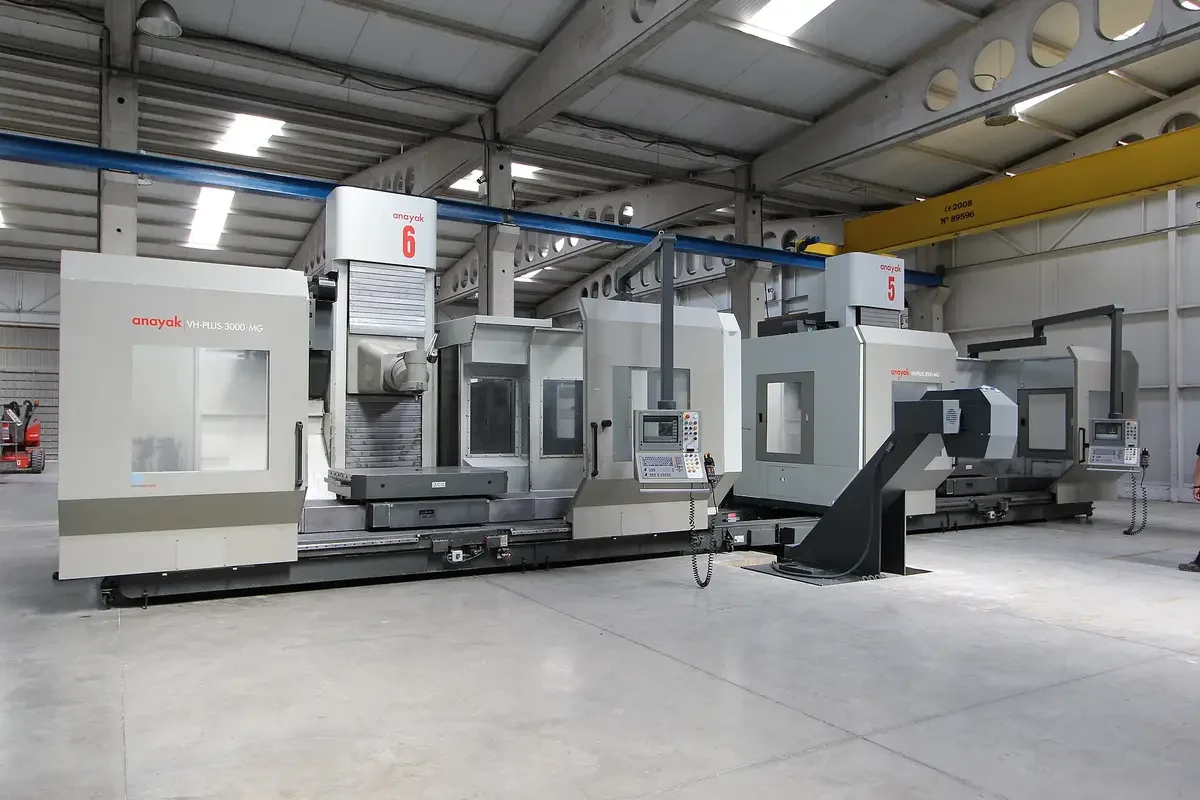
A machine list tells you what a shop owns. It does not tell you when your jig will ship. The date depends on two numbers the list leaves out: how many hours a week the relevant machines can actually cut, and how many hours of work are already in line ahead of you. Divide the second by the first and you have the shop’s backlog in weeks, which is the number to compare with the lead time it quotes. This guide shows what to ask, how to turn the answers into weeks and what to do when the shop will not say. It sits next to reading a job board in a jig shop, which covers the visual signs a buyer can check on a visit. Here the focus is the arithmetic.
Why the machine list misleads
Two shops can show the same line of machines and have very different capacity. The differences are in the hours behind the counts:
- Shifts. One machine on one shift is not one machine on two.
- Maintenance and changeovers. A machine that is down or being set up is not cutting.
- Programming. The CAM seat that writes the programs can be the real limit, not the spindle.
- Outside steps. Finishing, heat treatment and grinding done elsewhere add queues the machine list never shows.
- What is already booked. A new shop with few jobs and an old shop with a full board can both own six mills.
The management idea behind this is old and simple. The theory of constraints says every system has at least one constraint, and that only increasing flow through the constraint raises total output. For your order, the constraint is the one machine or step with the longest queue. Ask the shop which it is.
The three numbers to ask for
| Number | What to ask | Why it matters |
|---|---|---|
| Available hours per week | For the machine types your part needs: how many machines, how many shifts and how many hours a week each can actually run | Sets the speed of the queue |
| Open order hours | The sum of programmed or planned hours on those machines for orders already accepted | Sets the length of the queue |
| Share that leaves the shop | Which of your operations are outside (anodize, plating, heat treatment, grinding) and the queue at each | Adds weeks the machines never see |
Ask for the figures in writing. A shop that gives you hours is planning in hours. A shop that answers “we are not so busy” is not giving you a number.
From hours to weeks of backlog
The arithmetic is short.
- Weekly available hours = machines × shifts × productive hours per shift × share of time the machine is actually available.
- Backlog in weeks = open order hours ÷ weekly available hours.
- Earliest start for your job = backlog in weeks, unless the shop agrees to move you ahead.
- Earliest ship date = start + machining weeks + outside steps + inspection + packing.
The same idea appears in queueing theory as Little’s law: the average time a job spends in a system equals the average amount of work in the system divided by the rate at which work leaves it. Manufacturers use it to predict lead time from work-in-process and throughput. You do not need the proof. You need to see that a long queue and a slow exit rate produce a long wait, and that no machine list changes it.
A worked example with invented numbers
The numbers below are invented to show the method. They are not typical figures for any shop.
| Line | Value |
|---|---|
| Milling machines suitable for the part | 4 |
| Shifts and productive hours per week | 2 shifts, 80 hours per machine |
| Share of time actually available | 75 percent |
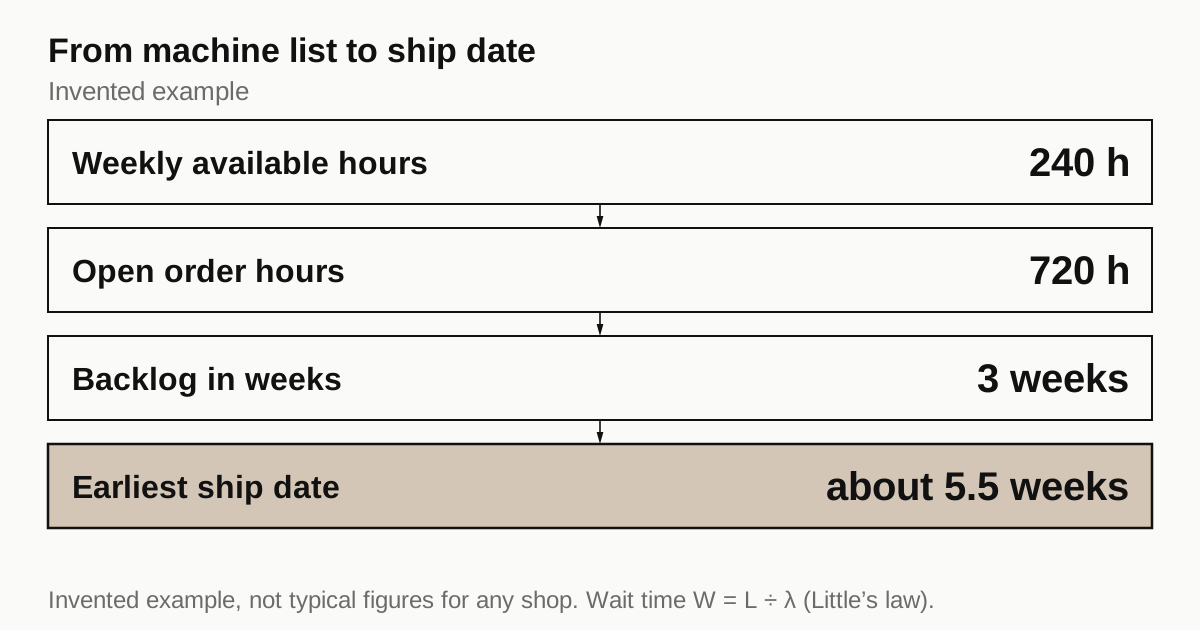
| Weekly available hours | 4 × 80 × 0.75 = 240 hours |
| Open order hours on those machines | 720 hours |
| Backlog | 720 ÷ 240 = 3 weeks |
| Your part: machining | 1 week |
| Outside anodize queue | 1 week |
| Inspection and packing | 3 days |
| Earliest ship date | about 5.5 weeks |
If the same shop quotes you 3 weeks, the quote is shorter than the backlog alone. Either the shop plans to push your job ahead of others, or the quote is an optimistic guess. Both can be acceptable, but only the first is a real answer. Ask which it is.
Machine hours are not labor hours
Check what the plan assumes about people. Vietnam Briefing summarizes the 2019 Labor Code and Decree 145/2020 as capping normal hours at 8 per day and 48 per week, with overtime limited per day, per month and per year, and a general annual limit of 200 hours, extended to 300 in listed cases. These limits cap how long people work, not how long a machine can cut. A shop can run more spindle hours with extra shifts or with unmanned running, within the law. So ask what the plan assumes:
- Is the weekly figure one shift, two shifts or three?
- Does it count overtime, and how many hours a month?
- Are any hours unmanned, and which jobs are allowed to run that way?
A date that needs a Saturday and a night shift every week is a date with no slack. This is our reading. The legal text should be checked with a labor lawyer before anyone quotes it in a contract, and we are not suggesting any shop breaks it.
Utilization and OEE: ask, do not assume
Overall equipment effectiveness (OEE) multiplies availability, performance and quality. Wikipedia describes it as a measure of how well equipment is used compared with its full potential and notes that an OEE of 100 percent is a theoretical value. The same page warns that treating 85 percent as a universal world-class target is often wrong. So do not ask whether a shop meets some number. Ask whether it measures anything at all: planned hours against actual cutting hours, by machine, for the last month. A shop that tracks it can tell you the real weekly hours. One that does not is estimating.
Need a quote for this part? Get a quote
Find the bottleneck
Ask: which one machine or step is busiest, and what is the queue ahead of it today? In a jig shop the constraint is often not the milling machine. The usual candidates are CAM programming, wire EDM, jig grinding and the outside finisher, as described in where the weeks go on a machined part. Your part may use only some of them. If your jig needs wire EDM and the wire EDM queue is six weeks, six weeks is your queue, whatever the mills are doing. On the shop side, planning production when urgent spares and new jigs share the machines shows how a shop reserves slots, which tells you what a good answer sounds like.
Questions to send, and red flags in the answers
Send these in one email, with the drawing:
- Which machines would run this part, and how many hours a week can that group run?
- What is the open order load on those machines today, in hours or weeks?
- Which step is the busiest in the shop this month?
- Which operations are outside, who does them and what is the queue?
- Does the quoted lead time already include the queue? If not, what is the earliest start?
- What would you do if an urgent order arrived while mine was in progress?
- How is the Tet holiday handled in the plan, see Tet holiday lead time for machined parts?
| Answer | What it suggests |
|---|---|
| “We always have capacity” | No number. Ask again in hours |
| The same lead time for 1 piece and 20 | Either the shop is lean on setup or the date is a guess |
| A machine list but no shifts | The count is the only thing it can say |
| A lead time shorter than the backlog | The shop plans to move you ahead. Get it in writing |
| Cannot say which step is busiest | No view of its own constraint |
| Detailed answer in hours, with outside steps named | A shop that plans in hours |
Verify what you were told
Numbers on an email prove little. Check them in three steps. First, ask for a live board or a video of the shop and follow your order across it, as in reading a job board. Second, agree a weekly report against dates, see weekly progress reports from a Vietnam jig shop. Third, start with a small paid order rather than the whole program, see what a first sample must prove to a new semiconductor customer. A shop that is honest about its backlog will usually deliver the sample on the date it gave.
Capacity numbers also do not prove quality. They tell you when, not whether the part will pass. For the other half of the check, use the supplier audit questions.
If you would rather start with shops that can show their load, send the RFQ with your drawing, quantity and needed-by date, and we reply within 24 business hours with a quote or a plain no.
Sources
- Wikipedia, Little’s law (L = λW, lead time from work-in-process and throughput, use in manufacturing)
- Wikipedia, Theory of constraints (at least one constraint, five focusing steps)
- Wikipedia, Overall equipment effectiveness (definition, formula, caution on the 85 percent target)
- Vietnam Briefing, overtime regulations and compensation in Vietnam (48-hour week, overtime limits, 200 and 300 hour annual limits; cites Labor Code 45/2019/QH14 and Decree 145/2020/ND-CP; check the legal text before relying on it)
Frequently asked questions
How do I find out how much work a Vietnam shop already has?
Ask for the open order hours on the machine types your part needs, and the weekly hours that group can run. Divide the first by the second to get weeks of backlog. A shop that cannot answer in weeks is planning by feel, which is a risk signal in itself.
Is a longer machine list better evidence of capacity?
Not by itself. Two shops with the same list can differ in shifts, maintenance, programming capacity and the share of work already booked. Ask for hours, not counts, and ask which one machine or step is busiest, because that one sets the pace.
Do Vietnamese labor rules limit how much a shop can run?
They limit the hours people work, not the hours a machine can cut. Normal hours are capped at 48 per week, with overtime limits per day, month and year. Ask whether the promised date assumes overtime, extra shifts or unmanned running, and how much of each.
Can I trust a quoted lead time if the shop is busy?
Only if it already includes the queue. A lead time shorter than the backlog in weeks means the shop plans to push your job ahead of others. That can be agreed, but it should be said out loud and written into the order.
Need a quote for this part?
Send the drawing. We quote the finished parts, place the work with a partner shop in Vietnam and reply within 24 business hours.
Get a quoteMore on choosing a supplier
- Weekly Progress Reports From a Vietnam Jig Shop: What a Useful One Contains
- Reading the Job Board in a Vietnam Jig Shop: Visual Management Signs a Buyer Can Check
- Moving an Existing Jig Program to a Vietnam Machine Shop
- OEM Change Kits vs Locally Made Tooling: What to Buy From Whom
All guides and the sourcing glossary.