Guides / Choosing a Supplier
OEM Change Kits vs Locally Made Tooling: What to Buy From Whom
November 21, 2026
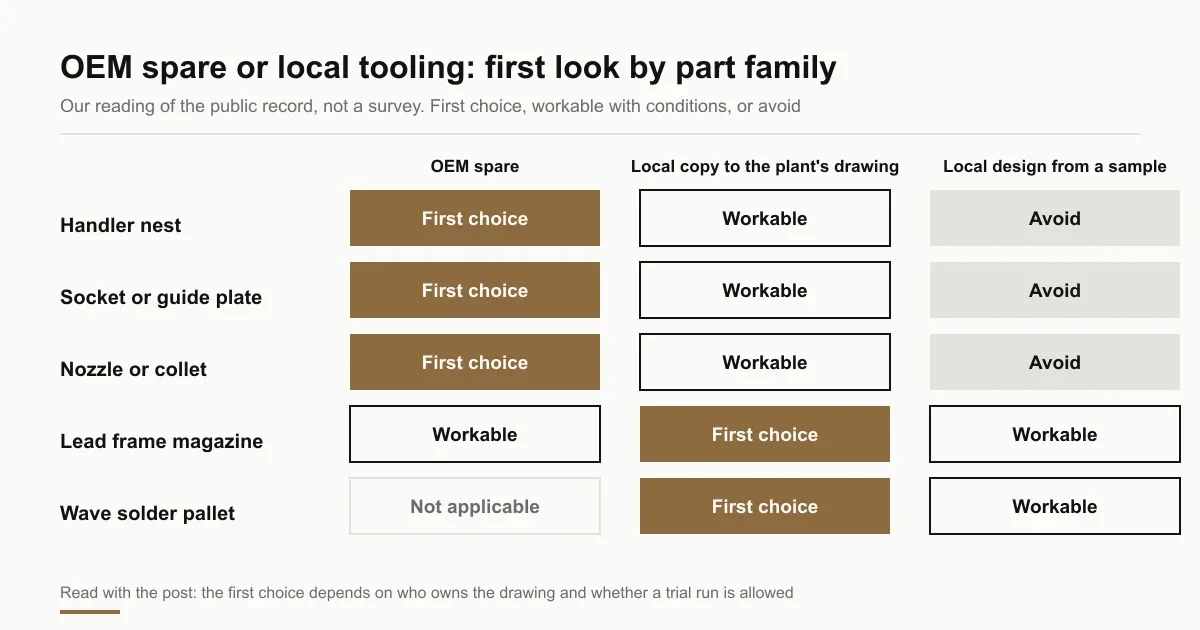
For most handler parts that touch the device, the OEM spare is the first choice, and a local copy is workable when the plant owns a drawing and a trial run on the machine is allowed. A local design from a worn sample is the option to avoid. For simple parts that the plant defines itself, such as lead frame magazines and solder pallets, local tooling is often the first choice. This post is part of our guide to semiconductor jigs and fixtures and sets out the reasoning, part family by part family.
The table is our reading of the public record, not a survey of who buys what. We found no public price comparison, so nothing below claims that one route costs less.
The decision table
| Part family | OEM spare | Local copy to the plant’s drawing | Local design from a sample |
|---|---|---|---|
| Handler nest | First choice | Workable with a trial | Avoid |
| Socket or guide plate | First choice | Workable with the maker’s drawing | Avoid |
| Nozzle or collet | First choice | Workable with the maker’s interface drawing | Avoid |
| Lead frame magazine | Workable | First choice | Workable with the strip drawing |
| Wave solder pallet or reflow carrier | Not applicable | First choice | Workable with the board file and a process engineer |
Caption: first choice means the option to ask for first, not the cheapest. No public figure for price differences was found.
What the three options are
OEM spare. The equipment maker supplies the part. Advantest describes a change kit as a custom-designed, swappable tool that is part of the handler and lets one handler support a variety of IC packaging. Its page lists parts such as match plate, set plate, socket guide, contact chuck and test tray.
Local copy to the plant’s drawing. The plant, or the maker, gives a drawing and a local shop cuts to it. The drawing carries the interface and the tolerance, and the shop supplies the machining.
Local design from a sample. The shop measures a physical part and designs from it. This is the riskiest route, because the sample has worn since it was new and the shop does not know which of its dimensions were intended.
Qualification and warranty: what the public record says
Two points matter and neither is settled by a standard.
Warranty. Edwards, a vacuum equipment maker, states on its genuine parts page that genuine parts and factory service keep its warranty valid, and says third-party parts can raise lifetime costs and compromise reliability. That is one vendor’s marketing for its own products and it gives no test data. We found no equivalent statement we could open for handlers, bonders or tool makers in this niche. Read your own warranty clause.
Qualification. Mark Firth of Ichor Systems wrote in Silicon Semiconductor in 2018 that a fab cannot simply buy a different spare, because new spare parts typically face a lengthy qualification process. He describes solutions ranging from a few days to find a replacement to projects of 12 to 18 months with in-field qualification. Ichor also supports equipment it supplies under license from the original makers, which is a different route from an unlicensed copy. An eeNews article by Owen Tangney of Ichor in 2017 says manufacturers typically have about 6 to 12 months to respond to an end-of-life announcement, and cites research that last-time buys cover only about 60 percent of future demand.
Both authors work for a supplier of replacement parts, so read them as the supplier’s view. The point that carries over to jigs is plain: a part that changes behavior costs qualification time, and that time has to be in the comparison.
Nests, socket plates, nozzles and collets
These parts touch the device, so their geometry is part of the process. The 2004 socket workshop paper says package positioning tolerances and repeatability depend on the handler design concept, and a Delta Design patent shows a nest opening as a trade-off between jamming and device movement, not a plain dimension. A local shop that copies the pocket without that context copies the size and misses the reason.
For nozzles and collets, the shank and spring seat have to match the head exactly, and a copy should come from the maker’s drawing or an unworn part. Pick and place nozzles and collets covers the reorder and trial steps in detail. OEM is the first choice, and a local copy is workable only with the interface drawing and a trial lot.
Magazines and solder pallets
A lead frame magazine is a box with slots, and its critical inputs, the strip drawing and the warped strip, belong to the plant. A local copy to the plant’s drawing is the first choice, and a sample from the line gives a reference. Solder pallets and reflow carriers are tooling for the board, not parts of a handler, so the OEM column does not apply to them. Pallet makers and machine shops cut them from the plant’s board file, and the process engineer sets ramps and cutouts. Reflow carriers and wave solder pallets gives the materials and the drawing notes.
Need a quote for this part? Get a quote
Who owns the drawing
Ownership is a contract question and we found no public standard that settles it. For a custom kit the maker’s design may remain the maker’s. For a local copy the plant may own the drawing only if it wrote or paid for it. Settle three things in writing before the first order:
- Who owns the drawing and the right to give it to a second source.
- What the shop may use it for, and what it must return or destroy.
- Protection by an NDA before the drawing leaves the plant.
When to choose which
- Choose the OEM spare when the part touches the device, the tool is under warranty, qualification time is scarce or no drawing exists that you may copy.
- Choose a local copy when you own the drawing or the maker gives you the interface drawing, a trial lot is allowed and the part is a plate, guide, magazine or pallet.
- Choose a local design from a sample only when the part is not critical, a drawing cannot be found and the plant accepts a revision after the trial.
Picking wrong costs a trial that fails, or a qualification that has to be repeated. Neither shows up in a quote.
What to put in writing
- The tool model and the part’s maker number, if there is one
- Which drawing governs and its revision
- A trial run on the real machine before the batch, and who runs it
- Pass limits for the trial: pick yield, alignment, jam rate
- Ownership and use of the drawing, and the NDA
- The warranty position, confirmed with the tool maker
Send the drawing and those lines through the RFQ form and we reply within 24 business hours with a quote or a plain no. The guide to semiconductor jigs and fixtures places this decision among the other part families.
Sources
- Advantest, change kit (what a change kit is, parts listed for two handler models)
- Edwards, genuine spare parts advantages (vendor claims on warranty and third-party parts)
- Silicon Semiconductor, M. Firth, the challenges of obsolescence (qualification of replacement parts, 2018)
- eeNews Europe, O. Tangney, how to manage semiconductor tool obsolescence (reaction window, last-time buys, 2017)
- BiTS Workshop 2004, session 6: positioning tolerances depend on the handler design concept
- US 10,852,321 B2, Test handler head having reverse funnel design, Delta Design (opening trade-off)
Frequently asked questions
Does using a third-party part void the warranty on a handler or bonder?
We found no public rule that applies to all makers. One vacuum equipment maker states that genuine parts and factory service keep its warranty valid, on its own page and for its own tools. For your tool, read the warranty clause in the purchase agreement or ask the maker in writing before you order a local part.
Can a local shop copy a worn nozzle or nest from a sample?
It can cut a part to the sample's size, but wear changes the sample, so the copy inherits the wear. Take dimensions from the maker's drawing or an unworn part, and trial the copy on the machine before a batch. A sample is a reference for the shape and a poor source for the tolerance.
Is a local copy cheaper than an OEM spare?
We found no public price comparison, and the vendor pages we read give claims and not figures. Ask for the OEM quote and the local quote on the same drawing and compare them with qualification time and downtime included. A cheaper part that needs a requalification can cost more than the spare it replaced.
Who owns the drawing of a custom change kit?
It depends on the purchase agreement, and we found no public standard that settles it. Write ownership, permitted use and the right to give the drawing to a second source into the order. Protect the drawing with an NDA before it leaves your plant.
Need a quote for this part?
Send the drawing. We quote the finished parts, place the work with a partner shop in Vietnam and reply within 24 business hours.
Get a quoteMore on choosing a supplier
- How to Check a Vietnam Shop's Real Capacity and Backlog
- Weekly Progress Reports From a Vietnam Jig Shop: What a Useful One Contains
- Reading the Job Board in a Vietnam Jig Shop: Visual Management Signs a Buyer Can Check
- Moving an Existing Jig Program to a Vietnam Machine Shop
All guides and the sourcing glossary.