Guides / Choosing a Supplier
Weekly Progress Reports From a Vietnam Jig Shop: What a Useful One Contains
November 21, 2026

A useful weekly report from a jig shop answers one question: against the dates we agreed, where is my order today and what could move it. Photos of a half-machined plate show that work exists. They do not show whether the finish has left for the anodizer, whether a drawing question is still open or whether Friday’s delivery date is still real. This guide lists what a report should contain, how to read it and gives a template you can send with the purchase order. No public standard defines a weekly supplier report, so the layout here is our suggestion.
Why photos alone do not tell you the order is late
A photo is a snapshot of one step. Lateness hides in the steps around it: the plate waits for material, the part waits for a machine, the part waits at an outside finisher, the report waits for a signature. The chain is described in where the weeks go on a machined part, and the point of it is that cutting is usually the smallest share of the calendar.
The standard that most OSAT-facing shops already work to points the same way. ISO 9001:2015 clause 8.2.1 covers communication with the customer about product information, enquiries, orders and feedback, and clause 8.5.1 asks for production under controlled conditions with monitoring where needed. Neither one prescribes a report format, but a weekly report is a simple way to show both.
The six lines of a useful weekly report
| Line | What it says | Why the buyer needs it |
|---|---|---|
| 1. Identification | PO number, part number, drawing revision, quantity | Confirms the shop is working to the revision you released |
| 2. Step finished | The last completed step, with the date | Shows what really happened, not what was planned |
| 3. Next step | The next step, who does it (in house or outside) and when it starts | Shows where the part goes next and whether it leaves the building |
| 4. Dates | Planned date and forecast date for each milestone | Shows drift early, while there is still time to react |
| 5. Open queries | Each drawing or material question, the date asked, the date a reply is needed | Shows whether the delay is on the shop or on you |
| 6. Risks | Anything that could move a date: material, outside process, inspection slot, holiday | Gives you a warning instead of a surprise |
Keep it to one page. A report that takes ten minutes to read gets skimmed, and a skimmed report is the same as no report.
Status against the agreed dates, not percentages
Agree the milestones on the purchase order, then report each one in the same table every week. For a typical jig order the milestones are the ones in the table below. Your order may have fewer, for example no heat treatment on an aluminum plate.
| Milestone | Planned date | Forecast date | State |
|---|---|---|---|
| Material received and certificate checked | Done / on track / late | ||
| Programming and setup released | |||
| Machining complete | |||
| Heat treatment or outside finish sent | |||
| Outside finish returned | |||
| Final inspection and report | |||
| Packed and handed to the carrier |
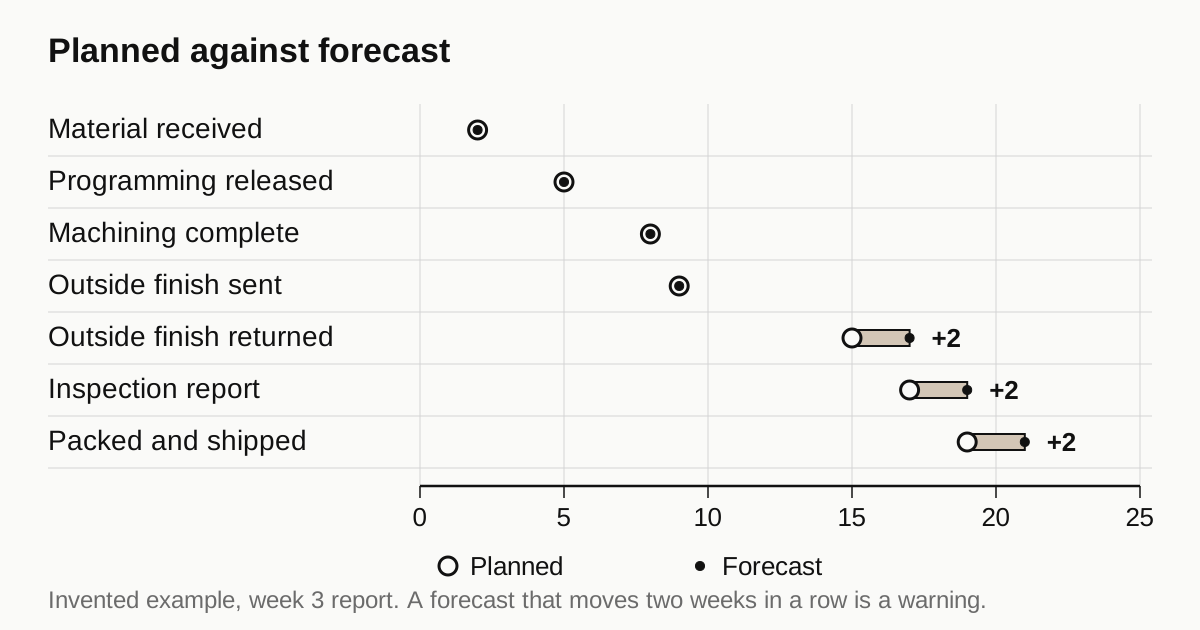
Planned dates never change after the order is accepted. Forecast dates change as often as the facts do. The gap between the two columns is the information. A forecast that moves two weeks in a row is a warning about the process, whatever the reason given.
Plan the report day around the time difference. Vietnam is on UTC+7 all year with no daylight saving. Japan and South Korea are on UTC+9, two hours ahead. US Eastern time is UTC-5 in winter and UTC-4 in summer, so a Friday 17:00 report from Vietnam lands at 05:00 or 06:00 Eastern the same Friday. A fixed day and time lets each side plan around it.
Open questions and drawing queries with a reply-by date
The most common reason a jig order stalls is a question nobody answered. Put every open query in the report with three fields: what is asked, the date it was asked and the date the shop needs an answer to keep the forecast. The buyer sees at once which delays are theirs. The shop gets a written record that the clock stopped waiting for the buyer, not for the shop.
Drawing queries often involve a revision. If a question leads to a change, release a new revision and update line 1 of the report, as described in drawing revision control with a supplier.
Finishing and inspection steps the report must show
Two parts of the chain are invisible unless the report names them: the outside process and the inspection.
- Outside process. Name the processor, the date the part left, the date it is expected back and what happens if it fails. Semsysco’s quality guideline TE_0030 says a subcontractor list must be provided on request and that the requirements pass down the supply chain. A buyer does not need the list every week, but the report should say when a part is not in the shop.
- Inspection. Say what has been measured, with which instrument, and whether the report is complete or partial. The same guideline lists the minimum content of a test report: part name and number, number of parts measured, the check dimension, the instrument, the tolerance, the measured value, the date and a confirmation by the person who checked. A shop that already writes reports to that list needs no extra work to say “inspection report 6 of 8 dimensions done”.
Tet and public holidays belong on line 6. A shop that is closed has no progress to report, so ask it to state the last working day, the first production day and the same two dates for its outside processor. The 2027 calendar and the three private-employer patterns are in Tet and machined part lead times.
Need a quote for this part? Get a quote
A report template to send with the PO
Send this table with the purchase order and ask the shop to return it each week in the same layout. Attach the milestone table above as page two.
| Field | Entry |
|---|---|
| Report date and week number | |
| PO number | |
| Part number and drawing revision | |
| Quantity ordered | |
| Step finished this week, with date | |
| Next step, in house or outside, and start date | |
| Milestones: planned date and forecast date | See page two |
| Open queries: question, date asked, reply needed by | |
| Risks to any date | |
| Outside processors: name, date out, date due back | |
| Inspection status: dimensions measured, instrument, complete or partial | |
| Name of the person who wrote the report |
A filled example
The example below is invented to show the level of detail. It is not data from any real order. The part is a test handler change kit nest plate in aluminum with a hard anodize finish, a family covered in test handler change kits.
| Field | Entry |
|---|---|
| Report date and week number | Friday, week 3 of the order |
| PO and part | PO 4471, nest plate NP-210, rev C, quantity 4 |
| Step finished | Machining complete, Wednesday |
| Next step | Hard anodize at an outside processor, sent Thursday, back in 8 working days |
| Milestone dates | Anodize returned: planned day 15, forecast day 17. Inspection report: planned day 17, forecast day 19 |
| Open queries | Pocket corner radius on sheet 2 is not dimensioned. Asked Monday. Reply needed by next Tuesday to hold the forecast |
| Risks | Processor batch day may shift a part one day. Public holiday on day 12 |
| Inspection status | 9 of 14 dimensions measured before finishing. Remaining dimensions and final report after the part returns |
| Written by | Production planner |
Read it like a buyer. The shop is on time through machining. The forecast has slipped two days because of the processor, and the shop has named the cause. One query is waiting for the buyer, so a late answer is the buyer’s delay and the report says so. Nothing is hidden and nothing needs a phone call.
What to do when the report is bad
A late report is the first sign of a late order. If a report is missing, vague or full of percentages, ask for the template and the milestone table by return email and agree the weekly day. If the same step slips again, ask what changed in the plan. A shop that will not name a processor, a date or a person is telling you something about how the order is run. That is the moment to decide whether to place the next order elsewhere, and a second source is easier to line up before you need it. See second sourcing a critical machined part.
If you want quotes from shops that commit to a milestone table, send the RFQ with the drawing, the quantity and the needed-by date, and we reply within 24 business hours with a quote or a plain no.
Sources
- NQA, ISO 9001:2015 Clause 8: Operation (summary of 8.1, 8.2.1 customer communication and 8.5.1 controlled production; a certification body’s guide, not the standard text)
- Semsysco, Quality Assurance Guidelines TE_0030 revision 03, file hosted by Lam Research (section 15 schedule deviations, section 16 test report content, section 18 subcontractor list; one equipment maker’s rules, not an industry rule)
- Wikipedia, Time in Vietnam (UTC+07:00, no daylight saving)
- Wikipedia, List of time zones by country (Japan and South Korea UTC+09:00, US Eastern UTC-05:00 standard time; daylight offset from general knowledge)
Frequently asked questions
How often should a jig shop send a progress report?
Weekly is a workable default for a jig order that runs three to eight weeks, sent on the same day each week so the buyer can plan around it. Add a same-day message whenever a milestone date moves. No public standard sets a frequency, so write the rhythm into the purchase order.
Should the report show percent complete?
No. A percentage hides which step is late. Ask for the last finished step, the next step and the planned and forecast date of each milestone. A job that is 80 percent done by hours can still be two weeks late if the outside finish has not left the building.
What should a shop do when a date moves?
Tell the buyer the same day, name the step that slipped, give the new forecast date and say what the shop is doing about it. One customer quality guideline, Semsysco TE_0030, requires schedule deviations to be communicated immediately, not at the next weekly report.
Does the report replace the inspection report?
No. The weekly report tracks progress and open questions. The inspection report records measured values on delivered parts. Ask for both, and agree before the order which dimensions the inspection report covers.
Need a quote for this part?
Send the drawing. We quote the finished parts, place the work with a partner shop in Vietnam and reply within 24 business hours.
Get a quoteMore on choosing a supplier
- How to Check a Vietnam Shop's Real Capacity and Backlog
- Reading the Job Board in a Vietnam Jig Shop: Visual Management Signs a Buyer Can Check
- Moving an Existing Jig Program to a Vietnam Machine Shop
- OEM Change Kits vs Locally Made Tooling: What to Buy From Whom
All guides and the sourcing glossary.