Guides / Choosing a Supplier
Moving an Existing Jig Program to a Vietnam Machine Shop
November 21, 2026
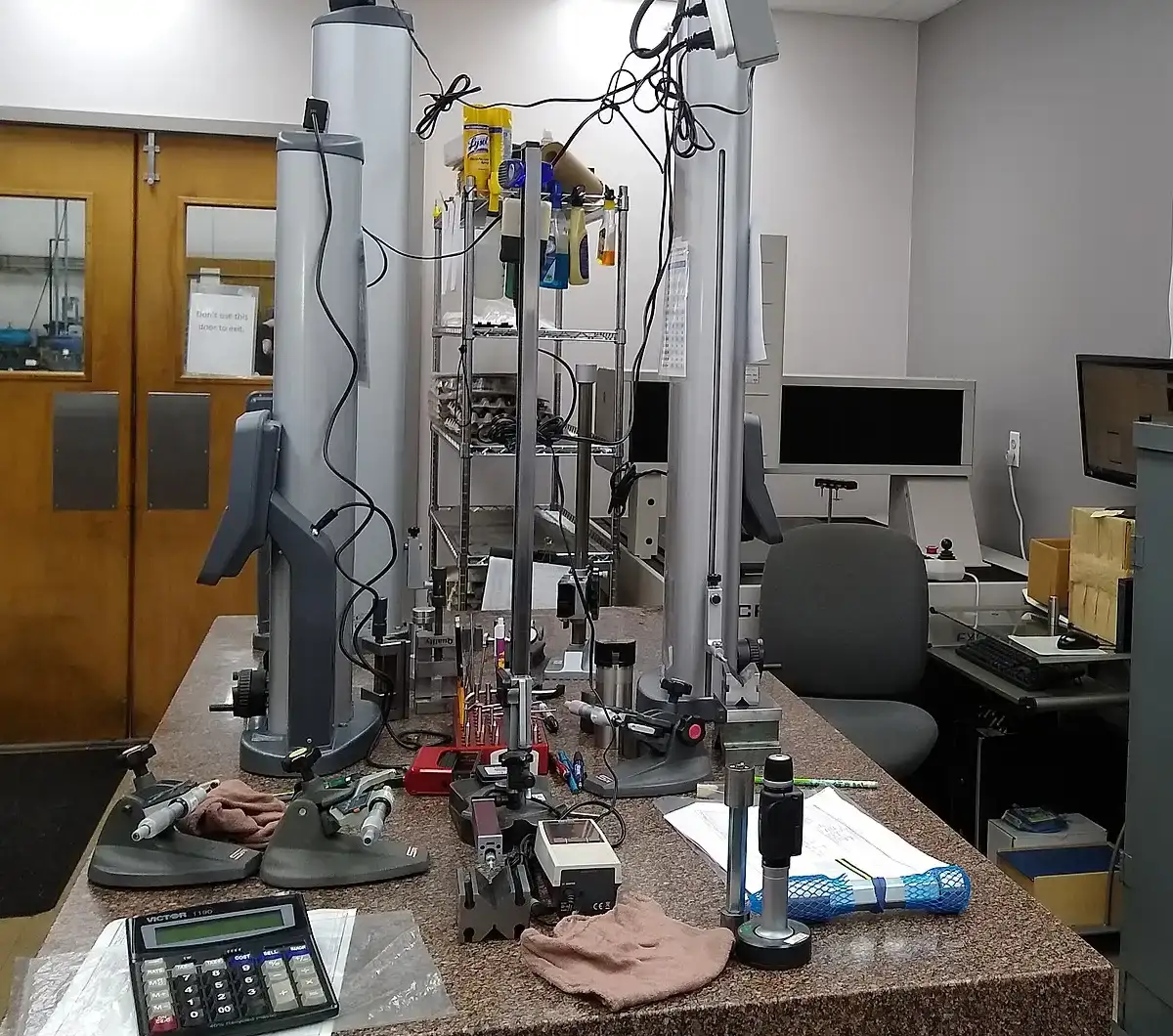
Moving a running jig program to a Vietnam shop is a project with gates, not a purchase order. What moves is more than a drawing: it is the drawing at the right revision, the evidence of what good looks like, the route the old shop used, the customer-owned gauges and the paperwork that lets your own customer accept a change. The way to avoid a gap in deliveries is to run both shops in parallel until the new one has delivered, and only then retire the old source. No public source gives a standard timeline for this, so the steps below are built from published quality rules and our reading of how transfers go wrong.
Which jigs to move first
Do not start with the jig that stops a line when it is late. Rank the program by risk and move the quiet ones first.
| Move first | Move later | Why |
|---|---|---|
| Spares and wear parts with a frozen drawing | New-model jigs still in revision | A frozen drawing is easy to hand over and easy to compare |
| Plates and fixtures with simple finishes | Parts with a hard-to-replace outside finisher | A new finishing route is the longest gate |
| Parts with a stable first article report | Parts with open concessions | Concessions need written agreement before they move |
| Jigs you can stock ahead | Single-source line-down parts | Bridge stock from the old shop covers the gate |
If the real motive is risk rather than price, a second source may be a better answer than a move, see second sourcing a critical machined part.
Build the transfer package
A new shop that receives only a STEP file and a PDF rediscovers every lesson the old shop already paid for. Build one package per part number and send the same package to every shop you ask to quote.
- Drawing at the current revision, with the revision history and any open engineering change. Revision discipline is covered in drawing revision control with a supplier.
- Native CAD and, if you own them, the accepted CAM programs. Ownership of programs and fixtures at the old shop is a contract question, so check it first.
- The accepted first article report, with the ballooned drawing and measured values. See first article inspection reports.
- Inspection plan, gauges and masters. If you supply check gauges, they travel with a record of their calibration. One equipment maker’s guideline says gauges it provides remain its property and must not be altered, and that damaged or unusable ones are reported.
- Material and finish specification, including the grade, the standard, the finisher and the masking. If the old shop used a specific finisher, say so, and say whether it is exclusive.
- Packing specification and any handling restriction, see packing and shipping machined parts to a fab.
- Concessions and special releases previously granted. The same guideline requires a written special release before a deviating part is delivered, so the new shop must know where the real tolerance sits.
- A golden sample, if you hold one, and a note on how it was measured.
Protect the package. Send it under an NDA that names the drawings, see NDAs when drawings cross borders.
Tell your own customer before the first order
The shop is not the only party that has to agree. A change of machining source is a change to the process that makes your part, and your own customer may have a right to review it.
- One equipment maker’s published quality guideline states that product or process changes are subject to approval and must be reported to it.
- ISO 9001:2015 clause 8.5.6 asks that changes to production or service delivery are reviewed and controlled to prevent unintended consequences, with evidence such as change requests, risk assessments and approval records.
- Production part approval process (PPAP) documents, where your customer uses them, are required when a new or modified component or a changed process enters production, and may be required when external subcontractors process the components. Whether a change of shop counts is for your customer to say.
We found no OSAT that publishes its change notification rule for jigs. Read your own quality agreement and ask your quality engineer before you release the first order to the new shop. A move that your customer learns about later is a harder conversation than one it approved up front.
Run both shops in parallel
The core of the plan is an overlap. The old shop keeps shipping while the new shop makes a first article and a trial lot of the same part at the same revision.
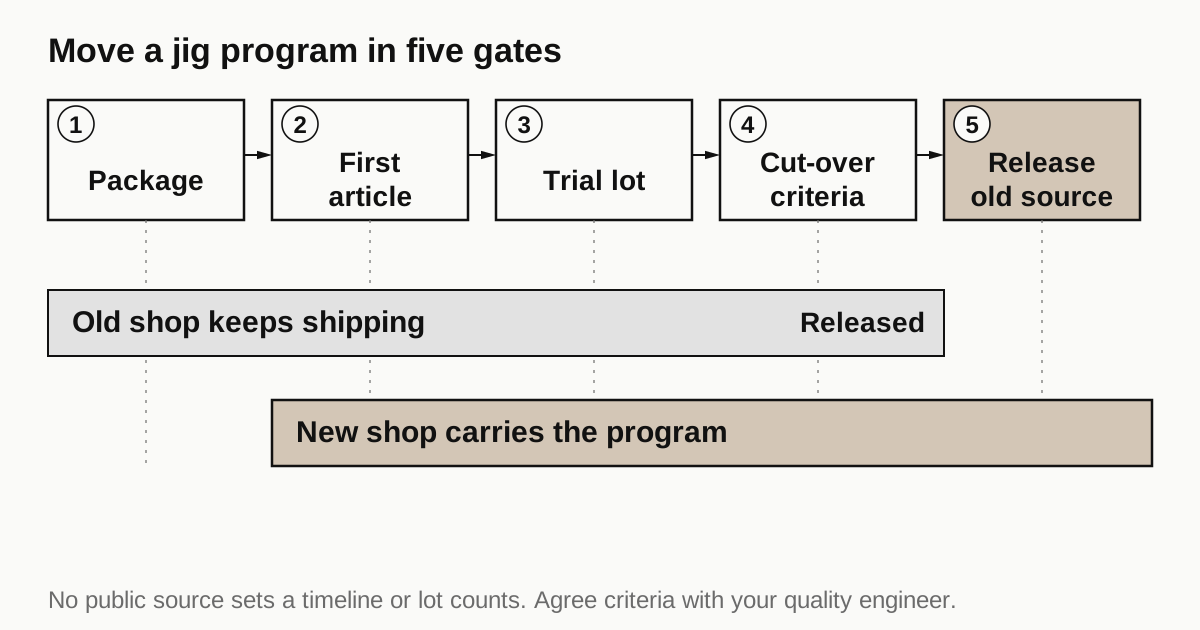
- First article. The new shop makes one or a few pieces on its production route and reports measured values against the ballooned drawing. Compare them to the accepted report from the old shop. Public descriptions of first article inspection say it validates the process, not only the dimensions.
- Correlation. Measure at least one piece from each shop on one instrument, yours or a third party’s. A new shop’s CMM and the old shop’s gauge may read the same feature differently. Gauge R&R on machined fixtures explains why.
- Trial lot. A small lot on the production route, packed as production will be packed, with the full document set. The shop-side view is in what a first sample must prove to a new semiconductor customer.
- Cut-over criteria, written in advance. Agree with your quality engineer what must be true to move the next order: the first article passes, a stated number of lots arrive on time and complaints are closed. We do not publish a number because no source sets one.
- Release the old source last. Keep the old shop on a small retained-stock arrangement until the new shop has delivered a production lot, not just a sample.
If your plant needs approved vendor status for the new shop, start that early. The steps are in getting a Vietnam shop onto your approved vendor list.
Need a quote for this part? Get a quote
What can go wrong
| Symptom | Likely cause | What to do |
|---|---|---|
| New first article passes, trial lot drifts | The sample ran on a special route | Ask for the route in writing and make the trial lot on it |
| Measurements disagree between shops | Different instruments, fixtures or temperature | Correlate on one instrument before blaming a shop |
| A feature fits at the old shop but fails at the new one | An undocumented concession | Ask the old shop for the concession list, write it into the package |
| Gap in deliveries at cut-over | The old shop stopped too early | Keep it on bridge stock until the new shop has shipped a production lot |
| New finish does not match | A different finisher or masking | State the finisher, the standard and the masking, and ask for a finish certificate |
| Your customer rejects the change | It was not notified | Check the quality agreement and notify before the first order |
Records, duty and calendar
Records. Ask the old shop for copies of the inspection records for the parts you are moving. One equipment maker’s guideline demands a minimum retention of ten years for process and quality relevant specification and proof documents against the background of product liability limitation periods. Your own agreement may differ, but the point holds: the history does not live in the new shop.
Duty and origin. A new origin changes the duty layers and the origin paperwork. For Vietnam as origin the stack is in US tariffs on machined parts from Vietnam and the origin forms are in origin proof for machined semiconductor parts. Use the rate your broker assigns for the entry date.
Calendar. Do not schedule the cut-over across the Tet holiday, see Tet holiday lead time for machined parts. After the move, ask for a weekly report against dates, as described in weekly progress reports from a Vietnam jig shop.
Start with one part
Pick one stable part from the move-first column, build its package and ask for a quote on it. If you want shops that will take a transferred jig and show their first article route, send the RFQ with the package, the quantities and the date your old source stops, and we reply within 24 business hours with a quote or a plain no.
Sources
- Semsysco, Quality Assurance Guidelines TE_0030 revision 03, hosted on Lam Research’s site (section 12 retention period, section 17 customer-owned gauges, section 20 product or process changes, section 21 special releases; one equipment maker’s rules)
- NQA, ISO 9001:2015 Clause 8: Operation (summary of 8.4 external providers, 8.5.3 customer property and 8.5.6 control of changes; a certification body’s guide, not the standard text)
- Wikipedia, Production part approval process (when PPAP is required, submission levels and elements)
- Wikipedia, First article inspection (purpose, process validation; carries citation warnings, so directional)
Frequently asked questions
How long does it take to move a jig program to a new supplier?
No public source gives a typical duration, and it depends on the jig, the finishing route and how fast your quality engineer approves. Plan the move as a sequence of gates, first article, trial lot and cut-over, and keep the old source shipping until the new one has passed each gate.
Do I have to tell my OSAT or equipment customer when I change the shop that makes a jig?
It depends on your quality agreement. One equipment maker's published guideline says product or process changes are subject to approval and must be reported, and ISO 9001 clause 8.5.6 asks for changes to be reviewed and controlled. Read your own agreement before the first order goes out.
Who owns the fixtures, programs and gauges at the old shop?
Whatever the contract says, so check it before you give notice. If nothing is written, ask in writing. One equipment maker's guideline states that gauges it supplies stay its property. Ask for the same clarity on programs, fixtures and any customer-owned gauges.
Should I move everything at once?
Usually not. Start with a stable part with a frozen drawing, prove the new shop on it, then move the rest in groups. A parallel run on the first group costs some duplicated work and removes the risk of a gap in deliveries.
Need a quote for this part?
Send the drawing. We quote the finished parts, place the work with a partner shop in Vietnam and reply within 24 business hours.
Get a quoteMore on choosing a supplier
- How to Check a Vietnam Shop's Real Capacity and Backlog
- Weekly Progress Reports From a Vietnam Jig Shop: What a Useful One Contains
- Reading the Job Board in a Vietnam Jig Shop: Visual Management Signs a Buyer Can Check
- OEM Change Kits vs Locally Made Tooling: What to Buy From Whom
All guides and the sourcing glossary.