Guides / Quality
What a First Sample Must Prove to a New Semiconductor Customer
November 21, 2026
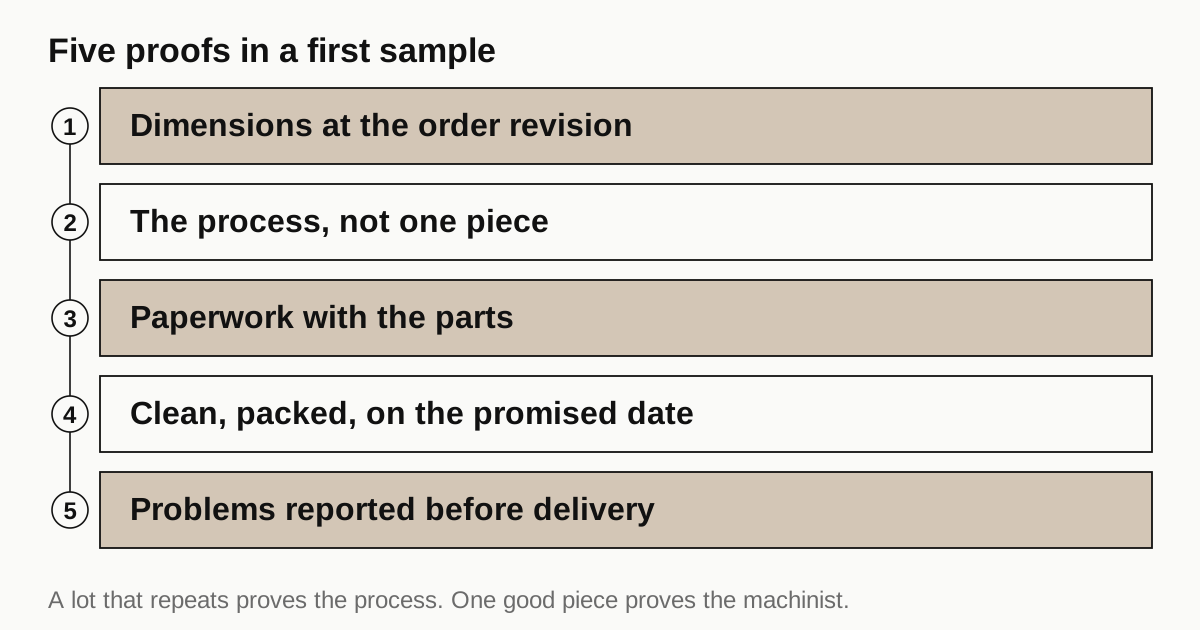
A first sample or trial lot has to prove five things to a semiconductor buyer. The parts meet the drawing at the revision on the order. The process that made them is the process that will make the next lot. The paperwork arrives with the parts. The parts arrive clean and on the promised date. And any problem is reported by you before the buyer finds it. No OSAT or tool maker we found publishes how many pieces a first lot must contain or how it is approved. This guide is therefore built from one equipment maker’s published quality guidelines, public descriptions of first article inspection and PPAP and our reading of what they mean for a Vietnamese shop. Confirm the rules with each buyer’s supplier quality engineer.
Sample, first article and trial lot are three different requests
Buyers use these words loosely, so ask which one is meant before you quote. The meanings below come from public descriptions, not from any buyer’s contract.
| Request | What it usually means | What it asks of the shop | Basis |
|---|---|---|---|
| Sample | A few pieces so the buyer can judge fit, finish and handling | A prompt, honest quote and clean parts | Our reading |
| First article inspection | Validation that a new or modified process produces conforming parts, run on the first part or on a sample from the first batch | A report that ties every drawing characteristic to a measured value | Wikipedia. AS9102 is the aerospace form, with Forms 1 to 3 |
| Trial or pilot lot | A small run made the way production will be made | Evidence that the process repeats, not that one piece can be made | Our reading. PPAP level 3 asks for a warrant, product samples and complete supporting data |
Amkor lists an IATF 16949 certificate among those held at its Vietnam site, so some buyers there will know PPAP vocabulary. Ask the buyer what it wants in its own words and write the answer into the quote: the number of pieces, the drawing revision, whether every piece is measured, the date and who pays freight. We found no public rule that sets any of these.
Proof 1: the dimensions, at the right revision
One equipment maker publishes what its inspection report must contain, and it is a sound minimum for any first report. Semsysco’s quality guidelines say a test report for its check dimensions lists the part name, the part number, the serial number where applicable, the number of parts measured, the check dimension number, the inspection equipment used, the tolerance, the measured values or result, the date and the inspector’s confirmation. The protocols travel with the delivery without being asked. The same guideline allows random sample inspection after coordination with the buyer, so do not assume a sampling plan on a first lot.
Put the drawing revision on the report, the packing list and the part label, and check that all three match the order. The habit is covered in drawing revision control with a supplier. The report format and the ballooned drawing behind it are in what a useful first article inspection report contains.
Proof 2: the process, not one good piece
Public descriptions of first article inspection say its purpose is to verify the whole production process rather than only the critical dimensions, and to verify the tooling. For a shop that means the sample is made on the machine, fixture, program and finisher that the repeat lot will use. A sample hand-finished by your most experienced machinist on a spare machine proves the machinist, and the next lot will show the difference.
Write the route down while you make the sample: machine, fixture number, program revision, tool list, material lot, finisher and measurement method. After approval a change to any of them is a change you report. Semsysco’s guidelines say product or process changes are subject to approval and must be reported to the buyer. A shop that holds its route on one sheet can show it at once.
Proofs 3 and 4: the paper, the packing and the date
The paper. Send what the order requires and what the buyer will ask for next: the material certificate for the lot, see mill test certificates, the finish certificate if a finisher was used, the packing list and the report. Semsysco’s guidelines require all testing and measuring equipment to be verifiably calibrated against national or international standards, with the documents sent on request. They also require the guideline’s requirements to flow down to subcontractors, with a list of subcontractors on request. Have the calibration certificates for the instruments on the report ready, see calibration certificates inside a shop, and know who your finisher is.
The packing. Pack the sample the way the production lot will ship. A buyer who receives a stained or scratched sample has already learned how production will arrive. The rules are in packing and shipping machined parts to a fab and what cleanroom machining actually requires.
The date. Semsysco’s guideline says deviations from the schedule must be communicated immediately to the buyer’s project manager, supplier engineer or buyer. It also asks suppliers to keep contingency plans, and the list includes interruption of supply of externally provided processes. For a shop with no finishing line of its own, that item is the finisher. Tell the buyer on the day the finisher slips, not on the due date.
Proof 5: how you handle a problem
Semsysco’s guidelines ask the supplier to judge producibility as part of quality planning, tolerances and materials included. Read that as permission to ask your drawing questions before you cut metal, in writing, with the drawing page and feature number. A question before the sample costs a day. A wrong assumption in the sample costs the lot.
If a feature comes out of tolerance, do not ship it and hope. The same guideline says a deviation from the specification needs a written special release from the buyer before delivery, and that without one the delivery is not allowed. Send the measured value, your cause and a proposal, and let the buyer decide. The structured reply a buyer expects after a complaint is described in what an OSAT expects from a new local jig supplier.
Need a quote for this part? Get a quote
Plan the trial lot in seven steps
- Get the request in writing. Pieces, drawing revision, whether every piece is measured, the date, who pays freight and whether the sample is chargeable.
- Review the drawing for gaps. Datums, finish, cleaning, packing and inspection scope. The usual holes are listed in drawing mistakes that make a part unquotable.
- Quote the sample in lines. Setup and programming, machining, finishing, inspection and report, packing, freight. A buyer who sees the lines can compare your production quote with it later, as in reading a machining quote.
- Run it on the production route and log the real time of each step. The log is the base of your repeat quote.
- Measure every piece of a small lot in a stable room, with instruments inside their calibration date. Conditions are covered in building a measurement room that passes a semi audit and gauge R&R on machined fixtures. Keep the raw data.
- Pack, label and ship with the documents. Email the report the day the parcel leaves.
- Ask for the result in writing. Keep the approved report as your master for that part number. Whether to keep a retained piece is our suggestion, so ask the buyer.
Where first samples go wrong
These rows are our reading of common failure points, not statistics.
| Symptom | Likely cause | What to do |
|---|---|---|
| The report shows ticks, not values | A template habit | Report measured values with the instrument, as in the Semsysco list above |
| The sample is perfect and the repeat lot drifts | The sample ran on a special route | Make the sample on the production route and write the route down |
| The sample arrives late with no warning | The finisher slipped and nobody was told | Name the finisher in the quote and report the slip on the day |
| A feature is out and the part ships anyway | Fear of rejection | Ask for a written special release before delivery |
| Certificates are missing | They were never requested at purchase | Order the material and finish certificates with the material and the finishing |
| Parts arrive stained or scratched | Packed like shop parts, not production parts | Pack to the production specification |
What a good sample does not do
It does not put you on an approved vendor list. Amkor’s quality page lists a supplier quality system assessment made of a quality system audit and a manufacturing process audit, then supplier qualification, then a supplier rate and ranking. A sample is one step on that path. Semsysco evaluates suppliers at least once a year on on-time delivery, quantity accuracy, number of complaints, PPM, pricing, customer service, QMS status and audit results, and a class C supplier is blocked for new orders. A first lot is therefore the start of a delivery record. The approval steps are set out in getting a Vietnam shop onto your approved vendor list.
If you want to talk it through
Shops that want to see how we place semiconductor work with partner shops, by their machines, can read how that works on the for suppliers page. If you are not sure your shop is ready for a first sample, talk to us before you register. Nothing in this guide promises an order, and a buyer’s approval is its own decision.
Sources
- Semsysco, Quality Assurance Guidelines TE_0030 revision 03, hosted on Lam Research’s site (report contents, calibration, subcontractors, schedule deviations, special release, supplier evaluation; one equipment maker’s rules)
- Wikipedia, First article inspection (definition, first part or first batch sample, purposes, AS9102; the article carries citation warnings, so directional)
- Wikipedia, Production part approval process (AIAG scheme, submission levels, list of elements)
- Amkor, quality management (supplier quality system assessment, qualification, rate and ranking, certificates for the Vietnam site)
Frequently asked questions
How many pieces should a first sample or trial lot contain?
We found no OSAT or tool maker that publishes a number. Public descriptions of first article inspection say it covers the first part or a sample from the first batch. Ask the buyer in writing, with the drawing revision, and size the lot to what it wants measured, not to the few pieces you would choose to show.
Who pays for the sample?
No source we read sets a rule. Agree it in writing before you cut metal, and quote setup, machining, finishing, inspection, packing and freight as separate lines so the buyer sees what the sample includes. A clear quote also gives you a base for the production price later.
What if one feature is out of tolerance on the first sample?
Do not ship it quietly. One published equipment maker guideline requires a written special release before delivery when a part deviates from the specification, and says delivery is not allowed without it. Send the measured value, your cause and a proposal, and let the buyer decide.
Does a good first sample put a shop on the approved vendor list?
No. Amkor's public quality page describes a quality system audit and a manufacturing process audit, then qualification and a supplier rate and ranking. A sample is one input to that. A good sample does not promise further orders, and approval is the buyer's decision.
Need a quote for this part?
Send the drawing. We quote the finished parts, place the work with a partner shop in Vietnam and reply within 24 business hours.
Get a quoteMore on quality
- Handling an OSAT Customer Complaint on Jigs: From Return to Closed Report
- How to Test ESD Fixture Materials on Receipt: Surface Resistance, Ground Path and the Record Sheet
- Why Jigs and Fixtures Fail on the Line: Warpage, Wear, Loosening and Contamination
- Which Quality Certificates Semi Buyers Ask Shops For
All guides and the sourcing glossary.