Guides / Choosing a Supplier
What an OSAT Expects From a New Local Jig Supplier
November 13, 2026
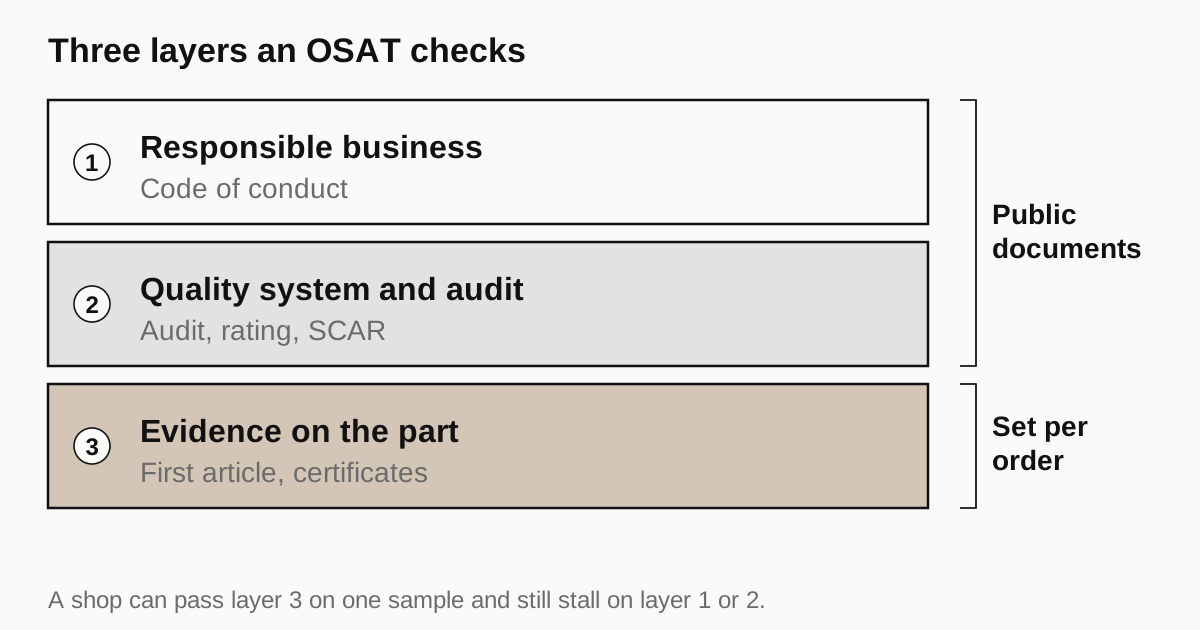
A new local jig supplier is judged on three layers. First comes responsible-business compliance, then the quality system and audit, then evidence on the part itself. The first two are described in public supplier documents from ASE and Amkor. The third is set order by order. No OSAT we found publishes a requirement list for jig and fixture suppliers, so this guide is built from what ASE and Amkor publish about supplier management, plus our reading of what that means for a Vietnamese machine shop. Confirm the detail with each buyer’s supplier quality engineer, and do not read qualification as a promise of orders.
Layer 1: responsible business and minerals
This layer sits outside machining, and shops tend to meet it for the first time in a questionnaire.
ASE’s supplier management framework makes compliance with its Supplier Code of Conduct a prerequisite for evaluating a supplier as qualified and for purchasing decisions. The code covers five areas: labor, health and safety, environment, business ethics and management systems. It is based on the OECD Guidelines, the UN Guiding Principles and the RBA Code, and suppliers are encouraged to pass it on to their own suppliers.
Amkor says its practices are designed to comply with the RBA Code of Conduct, a set of social, environmental and ethical standards for the electronics industry. The current version is 8.0, effective 1 January 2024. Amkor also sets the expectation that conflict minerals (tin, tantalum, tungsten and gold) and cobalt from conflict-affected and high-risk areas are sourced responsibly, and its page links the standard reporting templates, the CMRT and the EMRT. The Responsible Minerals Initiative describes the CMRT as a free template that passes information on mineral country of origin and the smelters and refiners used along the supply chain.
For a machine shop, three practical points follow:
- Have a short written policy and a record for each of the five areas. Working hours, safety training and incident logs, waste handling, an ethics or complaint channel and a named owner for each. Paper that exists only in the owner’s head does not pass a questionnaire.
- Ask your metal suppliers for their minerals declarations early. A shop cannot answer a CMRT about the metals it buys without them. This is our reading of how the template works, and the answer for a shop that buys stainless and aluminum bar is only as good as the mill’s declaration.
- Do not skip the form because the part is a jig. ASE ties code compliance to qualification itself, so a gap here can stop an evaluation before anyone looks at a drawing.
Layer 2: quality system, audit and rating
Amkor describes its supplier quality work in plain terms. Global supplier quality teams work with suppliers. Requirements include supplier system requirements and purchase order specifications per material type. Incoming inspection follows specifications per material type, and excursions go through MRB and SCAR processes. Suppliers are assessed through quality system and manufacturing process audits, qualified before use and ranked and rated in performance reviews.
ASE assesses suppliers on delivery, quality, cost, service, technology and sustainability, and feeds the result into purchase decisions. It coaches suppliers that fall short and replaces them with an alternative supplier if they still do. It states a strategy of keeping at least two suppliers for the same material.
| What the OSAT does | What it means for a jig shop |
|---|---|
| Audits quality system and process before use | Have a process flow, an equipment list and a control plan ready. Use the same script as supplier audit questions |
| Issues purchase order specifications per material type | Quote and build to the PO revision, and confirm the revision on every order, see drawing revision control |
| Runs incoming inspection to its own specification | Make your inspection report answer that specification, in the buyer’s format where it gives one |
| Handles excursions through MRB and SCAR | Be ready to answer a corrective action request with a structured reply, see below |
| Rates suppliers in performance reviews | Track your own on-time delivery and reject rate, because the buyer is tracking them |
| Keeps at least two suppliers for a material | A second-source slot is a realistic first entry, see second sourcing a critical machined part |
Answering a SCAR
A supplier corrective action request asks for a structured reply. Our recommended shape, not a published OSAT form, is four parts: what you did to contain suspect parts, the root cause stated as a process failure rather than a person, the corrective action that stops it recurring and how you will verify it worked. “Operator error, retrained” is the reply buyers distrust most, as covered in getting a Vietnam shop onto your AVL.
Certificates: say what you hold, and nothing more
Amkor lists IATF 16949, ISO 9001 and ISO 14001 certificates for its own factories, including Vietnam. That shows which systems the OSAT runs. It does not say they are required of a jig supplier, and no source we found says so. If you hold a certificate, state the issuer, the scope and the expiry. If you do not, say so plainly and show the documented controls you do have. Claiming a certificate you do not hold ends a qualification faster than not having one.
Layer 3: evidence on the part
This is where the order-by-order requirement sits. These are the records a quality group can ask for on a first jig lot, and each has its own guide:
- a first article inspection report against a ballooned drawing;
- a mill test certificate tied to the material lot, and laser marking and traceability on the part;
- calibration certificates for the instruments that signed off the tight features;
- a gauge R&R study or at least a repeatability check on the critical dimensions;
- packing and handling that fits the buyer’s cleanliness and ESD rules, see also ESD materials and coatings;
- an NDA in place before drawings move.
Need a quote for this part? Get a quote
Before you ask for an audit
- A one-page company profile: address, equipment list, headcount range, main processes, subcontracted steps and who does them.
- A written answer for each of the five code areas, with a named owner.
- A minerals declaration from each metal supplier on file.
- A process flow and control plan for one representative jig.
- Calibration certificates for every instrument on that jig’s inspection plan.
- One real first article report, with measured values and the instruments used.
- A revision control procedure, even one page.
- A corrective action log with at least one entry written the structured way.
- A tracked delivery and reject record, even if it is a spreadsheet.
If you cannot tick them all, that is a plan, not a verdict. Supplier-side material on this site is in what it takes to qualify for semiconductor work and on the supplier page. Partner shops do not deal with the buyer, and nothing on this site is a promise of orders. Qualification is the buyer’s decision.
See also: RBA, VAP and Pulse assessments for Vietnam shops.
Sources
- ASE, supply chain management framework (code of conduct prerequisite, risk assessment, coaching and replacement, at least two suppliers per material)
- Amkor, quality (supplier quality management, audits, qualification before use, MRB and SCAR, performance rating, certificates)
- Amkor, responsible minerals sourcing (RBA Code, conflict minerals and cobalt, CMRT and EMRT)
- Responsible Business Alliance, RBA Code of Conduct (Version 8.0, effective 1 January 2024)
- Responsible Minerals Initiative, reporting templates (CMRT)
Frequently asked questions
Do OSATs require ISO 9001 from a jig supplier?
No OSAT we found publishes a requirement list for jig suppliers. Amkor lists ISO 9001 and IATF 16949 certificates for its own sites, and says suppliers are audited on quality system and manufacturing process before use. Whether a certificate is required for your part is set by that buyer, so ask the supplier quality engineer.
What is the RBA Code of Conduct and does a machine shop need it?
The RBA Code is a set of social, environmental and ethical standards for the electronics industry, currently Version 8.0 from 1 January 2024. Amkor says it follows the code and ASE's own supplier code is based on it. A shop selling to these buyers should expect to be asked to comply and to show evidence.
What is a CMRT and who fills it in?
The Conflict Minerals Reporting Template is a free standard form from the Responsible Minerals Initiative that passes information on mineral origin and the smelters and refiners used along the supply chain. Amkor links it on its minerals page. A shop completes it with declarations from its own metal suppliers.
How long does it take to qualify with an OSAT?
No public figure exists, and timelines depend on the buyer's audit schedule, the part's risk and the first article and pilot lot results. Plan for the sequence, not a date: documents, audit, first article, then a pilot lot. Qualification also does not promise orders.
Need a quote for this part?
Send the drawing. We quote the finished parts, place the work with a partner shop in Vietnam and reply within 24 business hours.
Get a quoteMore on choosing a supplier
- How to Check a Vietnam Shop's Real Capacity and Backlog
- Weekly Progress Reports From a Vietnam Jig Shop: What a Useful One Contains
- Reading the Job Board in a Vietnam Jig Shop: Visual Management Signs a Buyer Can Check
- Moving an Existing Jig Program to a Vietnam Machine Shop
All guides and the sourcing glossary.