Guides / Choosing a Supplier
Reading the Job Board in a Vietnam Jig Shop: Visual Management Signs a Buyer Can Check
November 21, 2026
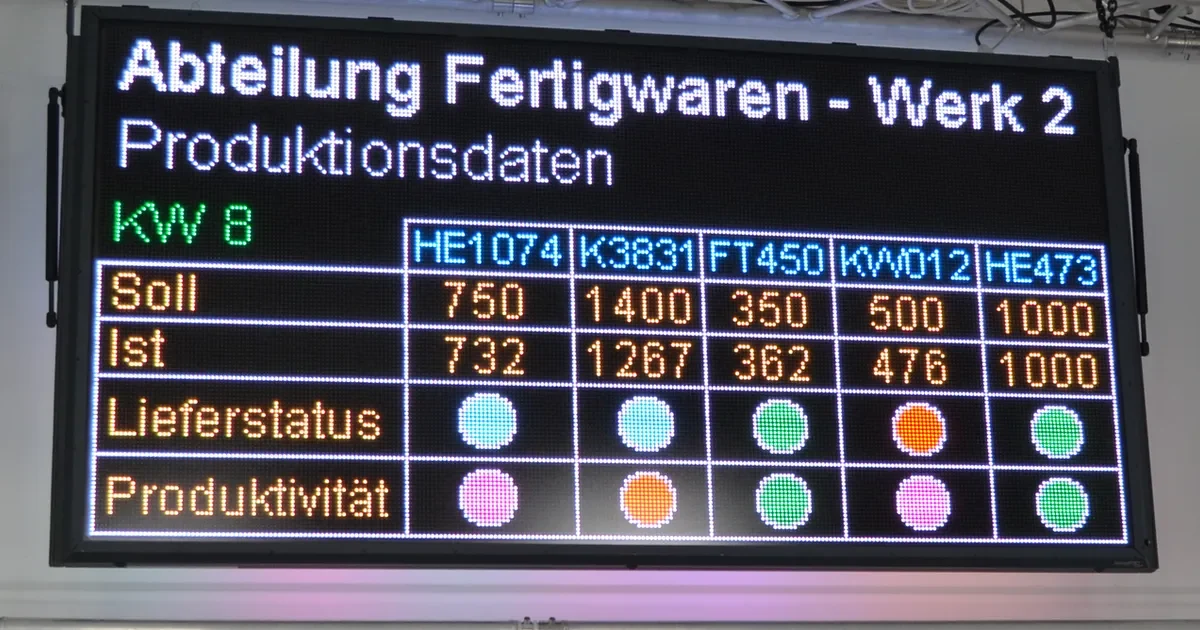
A job board is the cheapest evidence a jig shop can show that your order is really scheduled. A promise costs nothing. A board that shows your order, its current step, its due date and a named owner has to be kept up to date every day, so a buyer who visits (or takes a video tour) can read it and see how the shop actually runs. This guide shows what a live board contains, what is only decoration and gives a checklist for a visit. It is written for OSAT and back-end equipment buyers. It does not assume that anyone from this site visits or audits a shop.
Why a job board says more than a promise
The Lean Enterprise Institute defines visual management as openly displaying tools, materials, ongoing work and performance measures so that anyone in the workplace can quickly see how the system is doing, without a detailed explanation. For a buyer the useful part is the last clause. If you can read the state of your order from the wall, you do not depend on the person who happens to be on the phone.
A promised date is a claim. A board is a record that is hard to fake for a week, because it has to change every day to stay believable. That is our reading, not a published rule.
What a live board shows: order, step, due date, owner, problem flag
A working jig shop board has five things per job, and you can check each one in a few minutes.
| Item | What a live board shows | What a dead board shows |
|---|---|---|
| Order | PO or job number, your part number and drawing revision | A customer name with no revision |
| Step | The current operation (for example CAM, wire EDM, jig grinding, outside finish, inspection) | “In process” |
| Due date | The date promised to the customer, plus the date the shop now forecasts | One date, never changed |
| Owner | A person or a machine, for each job | No names |
| Problem flag | A mark, magnet or note on any job that is stopped or at risk, with the reason | No flags at all |
The last row deserves a second look. A board with no problem flag on any job in a shop that runs many small orders is not a good sign. It more likely means problems are kept off the board. Ask what the last flagged job was and how it was resolved.
One change kit order traced across a board
Figure 1 sketches a simple board with the lanes a jig shop typically uses. One order, a test handler change kit, is traced from material to packing. The order and dates are invented for the sketch.
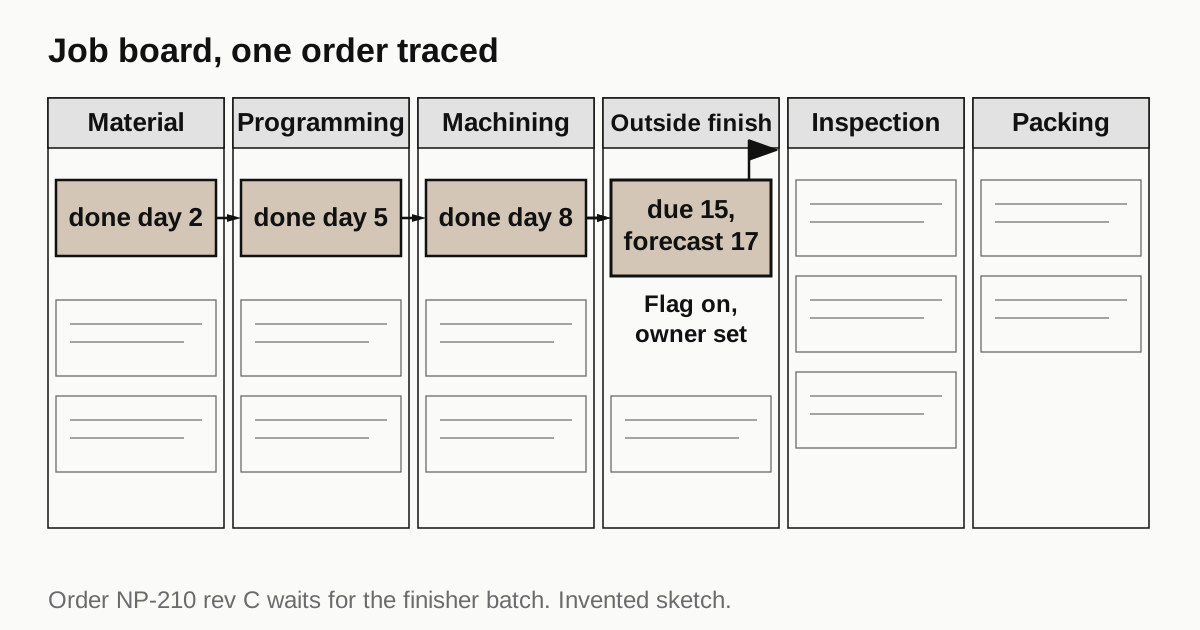
If the lane names differ, that is fine. What you are looking for is that every lane has a time stamp or a date, so you can see how long a job has waited in that lane.
Andon and problem flags: how a stopped job is raised
The Lean Enterprise Institute describes an andon as a visual display that shows the status of an operation at a glance and flags abnormalities as they happen. In the standard example a light on a board turns on when a sensor trips or an operator presses a button, and a team leader responds quickly. A jig shop with a handful of machines rarely has lights on every spindle. A whiteboard and a red magnet can do the same job.
What a buyer should check is the response, not the hardware:
- Who is allowed to raise a flag. If only the owner can, flags will be rare.
- How fast someone responds. Ask for the last flag and the time between raising and the first action.
- Where the flag is recorded after the job restarts. A flag that disappears leaves no record to learn from.
For a stopped order, ask the shop to tell you the same day the flag goes up. That ties the board to your weekly report, covered in weekly progress reports from a Vietnam jig shop.
Hold and waiting-for-material areas
A board shows jobs. The floor shows parts. Walk or watch the areas where work waits:
- Waiting for material. The job is on the board, the material is not on the shelf. Look for a tag with the expected arrival.
- Waiting for outside finish. Parts leave for anodize or heat treatment. A tray or shelf with a tag naming the processor and the date out is the physical twin of the board entry.
- Waiting for an answer. A job stopped on a drawing question should carry a tag with the question and the date asked.
- Held for nonconformity. A marked area, separate from good work, with the order, the reason and the person who decides.
Two published sources show how far status marking can go. ISO 9001:2015 clause 8.5.2 on identification and traceability asks for outputs to be identified when that is needed to trace issues, and a certification body’s summary calls it conditional. Semsysco’s guideline TE_0030 requires measuring equipment to be marked by status (usability) and parts delivered under a written special release to be marked on every load carrier. Neither tells a jig shop how to build a hold shelf. They show that status marking is an everyday expectation for a semiconductor buyer.
Need a quote for this part? Get a quote
Board signs that are only decoration
Ask these questions fast, because decoration is easy to spot:
- Every due date is in the past, or every date is the same.
- The board looks identical in two photos a week apart.
- There are no names, only job numbers.
- Colors are explained on a poster but not used on the board.
- Stopped jobs are not marked, or the marks have no reasons.
- A big screen shows an overall performance chart that nobody on the floor can explain.
The last point matters. A chart that the person at the machine cannot read is for visitors. A good board is used by the people who run the machines, which is also why it stays accurate.
Visit checklist and follow-up questions
Use the table on a visit or a live video call. Ask the shop to show your order, not a sample job.
| What to see | What to ask | Live or poster? |
|---|---|---|
| Your order on the board | What step is it in today? Who owns it? | Live if the answer matches the board |
| Due and forecast dates | When did the forecast last change and why? | Live if the shop can name the change |
| A flagged job | What stopped it, who was told and when did it restart? | Live if the shop can tell the story |
| Waiting-for-material and outside-finish areas | Which processor, which date out, which date back? | Live if tags match the board |
| Hold area | What is in it today and who decides? | Live if its contents match the board and every item has a tag |
| Inspection area | Which instrument is for my order? Is its calibration status marked? | Live if status marks are on the instrument |
| Board a week later | Photo of the same board, after one week | Live if it has changed |
Follow-up questions to send by email after the visit: which lanes the board has, how often it is updated, who updates it, how the board connects to the weekly report and what happens to a job that misses its forecast date. Ask for the answers in writing. They go into the same file as the supplier audit questions so you can compare shops.
For jigs you buy repeatedly, such as change kits, ask the shop to show where a repeat order of the same kit would sit. See test handler change kits for what goes into the kit and why the schedule matters.
A good board does not make a shop good. It makes problems visible earlier. If you would rather start with shops that run their jobs this way, send the RFQ with your drawing, quantity and needed-by date and we reply within 24 business hours with a quote or a plain no.
Sources
- Lean Enterprise Institute, Visual Management (definition used in this guide)
- Lean Enterprise Institute, Andon (status display and abnormality flag)
- NQA, ISO 9001:2015 Clause 8: Operation (summary of 8.5.2 identification and traceability; a certification body’s guide, not the standard text)
- Semsysco, Quality Assurance Guidelines TE_0030 revision 03, file hosted by Lam Research (section 17 status marking of measuring equipment, section 21 special release markings; one equipment maker’s rules)
Frequently asked questions
Do small jig shops use andon lights?
Some use a light or a stack lamp, many use a whiteboard and a red magnet. The Lean Enterprise Institute describes an andon as a display that shows status at a glance and flags problems as they happen. The device matters less than whether a flag brings a named person the same day.
Can I check a job board on a video tour?
Partly. Ask the shop to show the board live, pick one of your orders and follow it across the board on camera. Then ask for a photo of the same board a week later. A board that has not changed in a week is a poster, not a tool.
What should a hold area look like?
Marked, separate from good work, and labeled with the order, the reason and the person who decides. A shelf of unlabeled parts is not a hold area. Semsysco TE_0030 asks that parts delivered under a special release be marked on every load carrier, which shows how seriously one buyer treats status marking.
Does a tidy board prove the shop will deliver on time?
No. It shows the shop tracks work in a way you can read. Combine it with a weekly report against agreed dates and with the first article and trial lot, not instead of them.
Need a quote for this part?
Send the drawing. We quote the finished parts, place the work with a partner shop in Vietnam and reply within 24 business hours.
Get a quoteMore on choosing a supplier
- How to Check a Vietnam Shop's Real Capacity and Backlog
- Weekly Progress Reports From a Vietnam Jig Shop: What a Useful One Contains
- Moving an Existing Jig Program to a Vietnam Machine Shop
- OEM Change Kits vs Locally Made Tooling: What to Buy From Whom
All guides and the sourcing glossary.