Guides / Quality
Which Quality Certificates Semi Buyers Ask Shops For
November 16, 2026
A buyer who asks a shop for “quality certificates” is usually asking four different things: is there a quality system audited by an outside body, are the measuring instruments calibrated by a competent lab, are the environmental and safety systems in order, and is there any special program for the part, such as ESD control. These are separate documents with separate issuers, and each proves something narrow. No OSAT or tool maker we found publishes a required list for machined-part suppliers, so this guide describes what buyers name in public, what each certificate shows and what it does not, and how to answer when you hold none. It describes certificates. It does not suggest you claim one you do not have.
What buyers say in public
Public documents mention certificates in three ways, and none of them is a requirement list for your shop.
- A guideline that aims for them. Semsysco, an equipment maker whose supplier quality guideline is hosted on Lam Research’s site, says an effective ISO 9001 quality system is aimed for in a long-term relationship. It adds that an ISO 14001 environmental system, an ISO 50001 energy system and an ISO 45001 safety system should be established in the long term. The supplier must tell it at least three months before a certificate expires without recertification, and must report a withdrawal without being asked.
- A request to pursue one. Tokyo Electron’s procurement policy supplement asks suppliers to pursue ISO 14001 certification and to keep management systems for safety, health, environment, quality and labor.
- A list of its own. Amkor’s quality page lists ISO 9001, IATF 16949, ISO 14001 and ISO 45001 among the certificates its Vietnam site holds, with others at other sites. That shows which systems the OSAT runs. It does not say they are required of a jig supplier, and we found no source that does.
Lam Research describes its supplier controls as quality management system audits, scorecards and, for its larger suppliers, RBA audit reports on request, rather than a certificate list. The same pattern appears in what an OSAT expects from a new local jig supplier and in getting into a tool maker’s supply chain from Vietnam. The usual pattern is an audit of your system, not a glance at a certificate.
The certificates, one by one
| Certificate | What it covers | Who issues it | What it does not show |
|---|---|---|---|
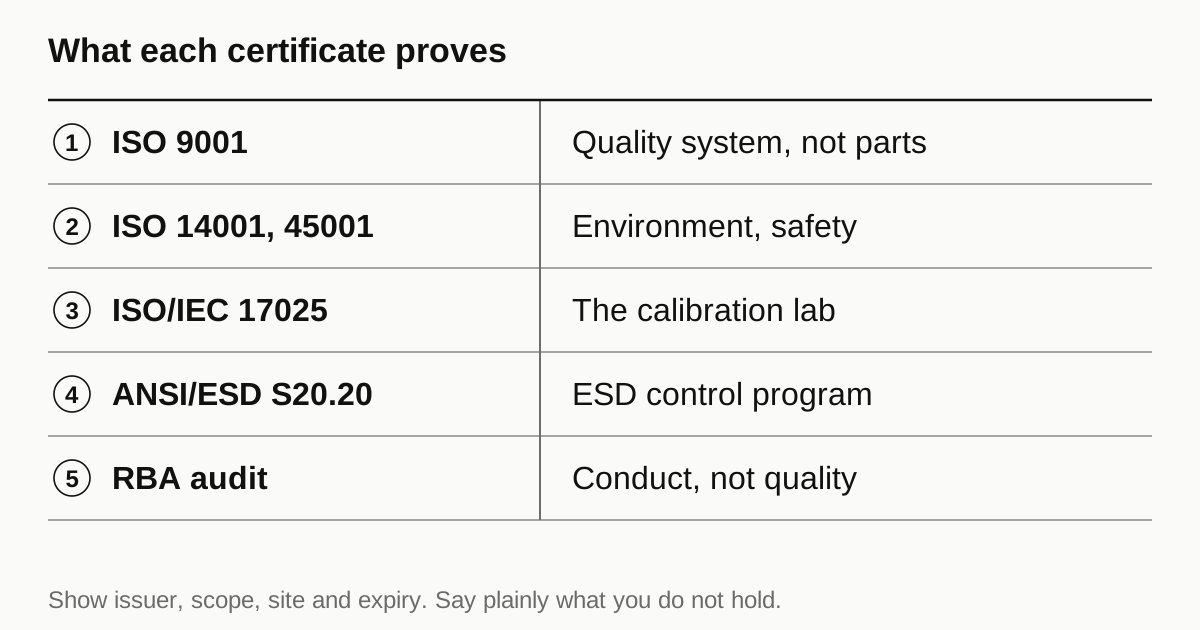
| ISO 9001 | A quality management system for a defined site and scope | An independent certification body, itself accredited | That any given part is good. The certificate attests to the system, not to a product |
| ISO 14001 | An environmental management system. It sets a framework, not performance targets | An independent certification body | How clean your coolant disposal actually is |
| ISO 45001 | An occupational health and safety management system | An independent certification body | Safety of any specific process |
| ISO/IEC 17025 | The technical competence of a calibration or testing laboratory, for a stated scope | A national accreditation body. This is accreditation, not certification | That your own shop is competent. It describes the lab that calibrates your gauges |
| ANSI/ESD S20.20 | A facility’s ESD control program | A certification body accredited by the ESD Association | That every part you machine is ESD-safe. It covers the facility’s program |
| RBA audit report | Conduct, labor, health and safety, ethics and environment at your site | RBA audit process, reported to the buyer | A quality system. It is a conduct audit |
IATF 16949 is the automotive quality standard and appears on Amkor’s list for its own sites. It is not a normal ask for a jig shop, in our reading.
ISO 9001 in detail
ISO does not certify organizations. It writes the standard, and independent certification bodies audit and issue certificates. The certificate attests to the quality management system, and it is limited to a scope such as one site and one set of processes. Certificates are not permanent and are usually renewed about every three years, per Wikipedia’s summary. Three checks matter on any certificate you show or receive: the scope (does it cover machining or only distribution?), the site address (is it the plant that makes the part?) and the expiry.
The standard itself is changing. ISO published ISO 9001:2026 on 16 September 2026. According to the ISO/TC 176/SC 2 committee page, new and initial accredited certifications can only be issued to the 2026 edition from 31 March 2028, and organizations certified to ISO 9001:2015 have until 30 September 2029 to complete their transition. Check your certification body’s own timetable, because the accreditation bodies set the details. A 2015 certificate you hold today remains valid during the transition.
ISO/IEC 17025 is about the lab, not the shop
ISO/IEC 17025 is the main standard for testing and calibration laboratories, and its 2017 edition is the current one. Laboratories are assessed by a national accreditation body, which is different from the third-party certification used for ISO 9001. In Vietnam the National Accreditation Bureau (BoA) says it has run its VILAS program since 1997, applying ISO/IEC 17025 to testing and calibration laboratories, and that more than 1000 laboratories are accredited. This matters to a shop because the calibration certificate for your CMM artifacts and gage blocks should come from an accredited lab with the right scope. How to read one is in calibration certificates inside a Vietnamese shop and the room that uses them in building a measurement room.
ANSI/ESD S20.20 only where it fits
The ESD Association runs a facility certification program in which accredited certification bodies audit a facility’s ESD control program against ANSI/ESD S20.20 or IEC 61340-5-1. The audit covers documentation, ESD control element selection and function, training, purchasing, calibration, and nonconforming product and documentation control. A certificate covers one facility or several nearby buildings under the same management, and the Association says recertification needs a complete audit every year. All facility certifications must be to the 2021 edition of S20.20 as of 1 July 2023. A machine shop that makes ESD-protected parts is rarely asked for it, but a shop that handles ESD-sensitive devices may be. See ESD materials and coatings for fixtures.
How a buyer verifies a certificate
ISO points to three routes: the IAF CertSearch database, direct contact with the certification body, the accreditation body or the IAF, or the national accreditation body that holds records of certification bodies in its country. CertSearch consolidates data from the IAF, accreditation bodies and certification bodies, and can check certificates one by one, in bulk or by API. Its limit is stated on ISO’s help page: it includes only accredited certificates. A certificate missing from it is not necessarily invalid, so expect a buyer to write to the certification body. A shop can save time by putting the certificate number, the issuer’s name and the accreditation body’s mark on one page.
Need a quote for this part? Get a quote
What to say if you do not hold one
Many capable shops hold no certificate. The honest answer is stronger than a vague one.
- Say what you hold. Issuer, standard, edition, scope, site and expiry. If you hold none, write “no certified management system”.
- Show the documented controls instead. A process flow, control plan, calibration records, a revision procedure and a corrective action log, as in supplier audit questions and getting onto an approved vendor list.
- Show evidence on a real part. A first article report and a mill test certificate tied to the lot answer more of a quality engineer’s questions than a logo.
- Do not stretch the words. “ISO 9001 compliant” or “working to ISO 9001” invites an audit against the full standard. “Certified” without an accredited body behind it ends a qualification faster than having no certificate at all.
- State your plan if you have one. Naming a certification body and a target date is credible. Inventing a date is not.
We have no public price or timeline for certification in Vietnam, and none is quoted here. Fees and audit days depend on the body and the size of the shop, so get quotes from accredited bodies.
What a certificate does not replace
A certificate does not replace part evidence. The buyer still wants a first article report, a traceable material certificate, calibrated instruments and a stable cleanroom-compatible process where the part needs one. Certificates reduce the questions in an audit. They do not answer the question about the part in front of the buyer.
Supplier-side material on this site is in what it takes to qualify for semiconductor work, and the supplier page explains how partner shops receive work. Partner shops do not deal with the buyer, and nothing here promises an order. Buyers who want to describe a part to shops can use the RFQ form.
See also: certificates and documents for semiconductor parts made in Vietnam.
Sources
- Semsysco, Quality Assurance Guidelines TE_0030 revision 03, hosted on Lam Research’s site (ISO 9001 aimed for, ISO 14001, ISO 50001 and ISO 45001 in the long term, certificate expiry notice)
- Tokyo Electron, Supply chain management (ISO 14001 pursued, management systems, Supplier Total Quality Assessment)
- Amkor, Quality (certificates held at its own sites, supplier audits and ratings)
- Lam Research, Responsible supply chain (quality management system audits, scorecards, RBA audit reports on request)
- ISO help, How to verify an accredited certification (ISO does not certify, IAF CertSearch holds only accredited certificates, other ways to verify)
- ISO/TC 176/SC 2, ISO 9001:2026 has been released (published 16 September 2026, transition dates; page dated 28 September 2026)
- Wikipedia, ISO 9001 (certification by independent bodies, certificate scope, renewal about every three years; directional)
- Wikipedia, ISO/IEC 17025 (laboratory competence, accreditation compared with ISO 9001 certification, 2017 edition)
- BoA Vietnam, VILAS (ISO/IEC 17025 accreditation of testing and calibration laboratories)
- ESD Association, ESD facility certification (S20.20 audit scope, facility coverage, annual recertification, 2021 edition requirement)
Frequently asked questions
Do semiconductor buyers require ISO 9001 from a machine shop?
No buyer we found publishes a certificate list for machined-part suppliers. One equipment maker's quality guideline says an ISO 9001 system is aimed for in a long-term relationship. Another supplier's pages describe audits and scorecards. Whether a certificate is required for your part is the buyer's decision, so ask its supplier quality engineer.
Is an ISO 9001:2015 certificate still valid?
Yes, for now. ISO published ISO 9001:2026 on 16 September 2026. The ISO committee page says organizations certified to the 2015 edition have until 30 September 2029 to transition, at a surveillance or recertification audit or through a separate audit. Confirm the dates with your certification body.
How does a buyer check that a certificate is real?
Through IAF CertSearch, or by contacting the certification body or the national accreditation body. ISO states that the database holds only accredited certificates, so a certificate missing from it is not proven invalid. Check the issuer, the scope, the site address and the expiry date.
What should a shop say if it holds no certificate?
Say so plainly, then show the documented controls you do have: a process flow, a control plan, calibration records, a revision procedure and a first article report. Never use a certificate logo or the word certified for a standard that no accredited body has audited you against.
Need a quote for this part?
Send the drawing. We quote the finished parts, place the work with a partner shop in Vietnam and reply within 24 business hours.
Get a quoteMore on quality
- Handling an OSAT Customer Complaint on Jigs: From Return to Closed Report
- How to Test ESD Fixture Materials on Receipt: Surface Resistance, Ground Path and the Record Sheet
- What a First Sample Must Prove to a New Semiconductor Customer
- Why Jigs and Fixtures Fail on the Line: Warpage, Wear, Loosening and Contamination
All guides and the sourcing glossary.