Guides / Quality
Handling an OSAT Customer Complaint on Jigs: From Return to Closed Report
November 21, 2026
An OSAT plant judges a jig shop on how it behaves when something goes wrong more than on how it behaves when nothing does. A nest that jams the handler, a pin that wears out in a week or an ESD fixture that reads out of range will reach the shop as a complaint. A shop that replies fast, contains the problem, finds a real cause and closes the report with evidence keeps the account. This guide describes a routine for a Vietnam jig shop that an OSAT quality engineer is likely to accept, with a complaint log and a reply email you can copy. It is not a full 8D course. That method is taught everywhere, and this guide covers what is specific to jigs.
What an OSAT plant expects after a jig fails on the line
No OSAT we found publishes a complaint procedure for jig suppliers, so this section uses the best public example we could open. Semsysco, an equipment maker for the semiconductor industry, publishes Quality Assurance Guidelines for its suppliers (TE_0030). They are one company’s rules, not an industry standard, but they show how an experienced buyer thinks.
- Defects are notified within 14 days after receipt of goods, and warranty claims for hidden defects stay valid beyond that.
- After a complaint arrives, fault elimination measures must be started immediately, documented and sent in structured form.
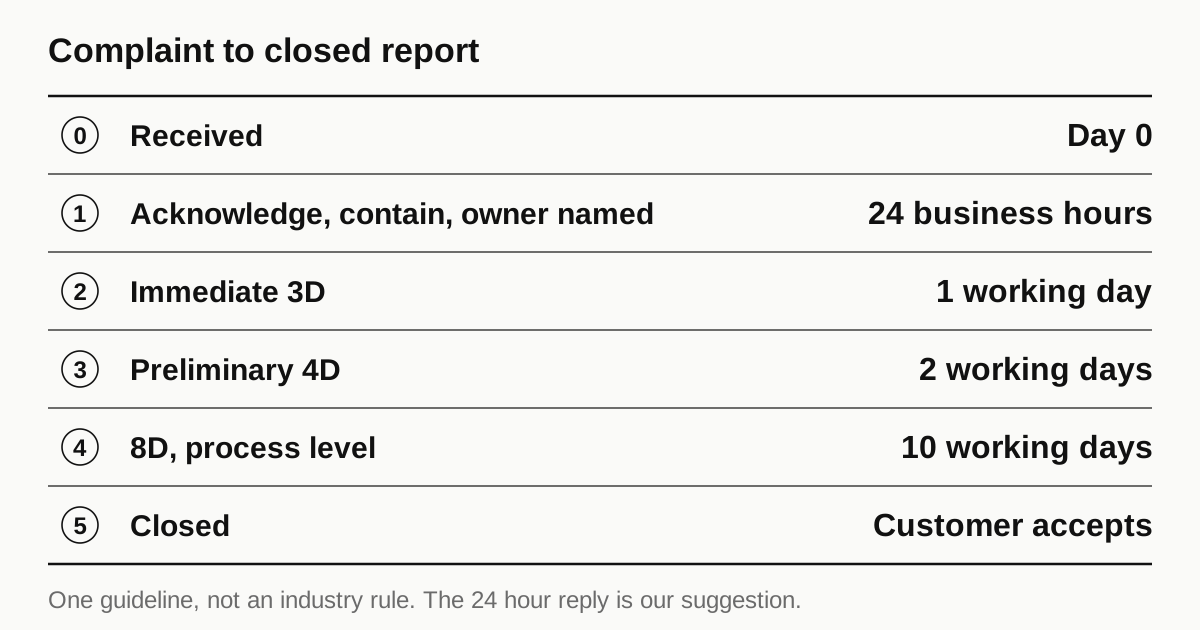
- If the customer asks for it, an 8D report must follow its template, with deadlines of one working day for immediate measures (a formless 3D report), two working days for a preliminary 4D report and ten working days for an updated 8D with long-term corrective actions.
- Retraining and instructions are not accepted as the corrective action unless agreed. Fixes must sit at product, process or system level.
- The complaint is closed only when the customer accepts the report.
The same guideline says supplier performance is evaluated at least once a year on criteria that include on-time delivery, quantity accuracy and the number of complaints. A complaint is therefore two events: a defect and a data point on a scorecard. How you answer it shapes the second. The wider picture of what an OSAT checks is in what an OSAT expects from a new local jig supplier, which also has a short section on answering a corrective action request.
ISO 9001:2015 points the same way. Clause 9.1.2 is about monitoring customer satisfaction, and customer feedback is one of its usual inputs. Clause 10.2 covers nonconformities, including those that arise from customer complaints: react and deal with the consequences, evaluate whether to remove the cause, carry out the action, review whether it worked and keep documented information on all of it. ISO 10002 is a guideline for complaints handling that nobody certifies against, because it contains no requirements. Its stages are a handy checklist for a small shop: tracking, acknowledgement, initial assessment, investigation, response, communicating the decision and closing the complaint.
First reply: acknowledgement and containment
Reply within 24 business hours, even when you know nothing yet. The first reply has three jobs:
- Confirm receipt, the part number, revision and lot you understand to be affected.
- Say who owns the complaint at your shop and how to reach that person.
- Say what you are doing now to stop more bad parts reaching the line.
Containment means checking the stock you still hold, parts in the packing area, parts at an outside finisher and the next shipment. For a repeat jig, it also means holding any parts of the same lot and the same program. Do not propose a cause in the first reply. A wrong cause sent in haste is harder to retract than a right one sent a few days later.
Subject: Complaint [number], [part number] rev [x], PO [number]
Thank you for the report received on [date]. We understand the issue as [one sentence in the customer’s words]. [Name] owns this complaint and can be reached at [address].
Containment started on [date]: we are checking [stock, packed parts, outside finisher, next shipment] for the same lot and program. Result by [date].
We will send a preliminary report by [date] and an updated report with the corrective action by [date]. Please send the returned part, photos of the failure and the line data if you have them.
The dates are your commitment. Use the customer’s deadlines if it has a template, and take care not to promise a date you cannot keep.
Collecting the returned part and line data
Ask for four things before touching a drawing: the returned part (or a good photo and a measurement if it cannot be returned), the lot and date code, how long it ran and under what conditions, and what the line did when it failed. Tag the returned part with the complaint number and keep it separate from stock. Photograph it as received, before cleaning.
Measure the returned part against the drawing revision on the order, with an instrument that is in calibration. If the buyer’s measurement and yours differ, find out why before arguing: temperature, datum, fixture or instrument. Gauge R&R for machined fixtures covers how to know whether a measurement can be trusted.
Finding the cause: drawing, machining, material or handling
Sort the cause into one of four groups before looking for a root. It keeps the investigation honest and helps the buyer see the pattern.
| Group | Question | Typical evidence |
|---|---|---|
| Drawing | Did the part match the drawing and was the drawing right? | Measured values, drawing revision on the order |
| Machining | Did the process produce what the drawing says? | Program, setup sheet, first article, in-process records |
| Material or finish | Was the material or the coating as ordered? | Mill certificate, finish certificate, lot record |
| Handling | Was it damaged after it left the machine? | Packing record, transport, line handling |
Our general catalog of jig failures, with who normally bears the cost, is in why semiconductor fixtures fail. Three worked examples show how the routine plays out. The numbers are left as brackets because only the order and the drawing can fill them.
Nest pocket too tight. Devices jam at the high end of the package tolerance. Check the pocket against the drawing at both limits. If it is within the drawing, the pocket was sized to the nominal package, and the cause sits in the drawing. Reply with the measured values, the package tolerance used and a proposal for a revised pocket, and ask the buyer to release the revision. If the pocket is out of the drawing, the cause is in your process, usually tool wear or a program offset, and the action is a process check at that feature on every lot.
Locating pin wear failure. The pin or its bore wore early. Compare the material, hardness and fit class with the drawing. If they match, check whether the drawing named a wear test, because without one nothing in the order defined wear life. Ask the buyer for the duty (cycles, load, temperature). If the finish or hardness was off, the cause is yours, and you add a final check of hardness or finish thickness to the lot record. See jig grinding for locating pin holes for fit classes.
ESD fixture out of range. The surface resistance on a nest or carrier does not meet the drawing. Measure with the method the drawing names, at the same humidity if it states one. Check the material grade against the certificate and whether a finish or a cleaning step changed the surface. If the drawing gave a range, the shop owns it. If it only said “ESD safe”, the cause is a missing specification, and the fix is a range and a test method written into the order. ESD materials and coatings explains the ranges.
In each case write the cause as a process or specification gap, not as a person. “Operator error” is the reply buyers distrust most.
Need a quote for this part? Get a quote
Closing the report and proving the fix
A report is closed with evidence, not with a promise. For each corrective action, name the change, the date it was made and how you will know it worked. Typical proof for a jig shop:
- a changed work instruction or setup sheet, with the date and revision;
- a new inspection step on the lot record and the first lot measured under it;
- measured values on the next shipment for the affected feature;
- a changed drawing revision, accepted by the buyer, when the drawing was the cause.
Send the updated report by the agreed date. If the corrective action takes longer than a month, send a progress version, as the Semsysco guideline asks. Then wait for the customer to accept the report. Until it does, the complaint is open on the customer’s side, whatever your internal log says.
Keeping a complaint log the next audit will ask for
A log is a table you keep for every complaint, however small. ISO 9001 clause 10.2 asks for documented information on the nonconformity, the actions taken and their results, and an OSAT auditor will ask to see yours. Start with the table below.
| Field | Example entry |
|---|---|
| Complaint number | C-001 |
| Date received | |
| Customer and contact | |
| PO, part number, revision, lot | |
| Description in the customer’s words | |
| Quantity affected | |
| Acknowledged on (within 24 business hours) | |
| Containment done on, result | |
| Returned part received on | |
| Cause group (drawing, machining, material or finish, handling) | |
| Root cause | |
| Correction (what was done to the parts) | |
| Corrective action (what changed in the process) | |
| Effectiveness check, date and result | |
| Customer accepted on | |
| Days from receipt to customer acceptance |
Review the log every quarter. A pattern is worth more than any single report. Three complaints on pocket size say the drawing review is the problem, not the machining, and the fix belongs at quotation, where a shop can ask for package tolerances before it cuts.
Talk to us
If your shop makes jigs and fixtures for semiconductor customers and wants to see how we place work with partner shops that can answer complaints this way, read for suppliers. Tell us which jig families you make and we will tell you plainly whether we have work that fits.
Sources
- Semsysco, Quality Assurance Guidelines TE_0030 revision 03, file hosted by Lam Research (sections 6, 10 and 11: supplier evaluation, notification of defects, complaints, 3D, 4D and 8D deadlines; one equipment maker’s rules)
- ISO 9001 Auditing Practices Group, Customer complaints, edition 1, 2016 (clause 10.2.1 and complaints, ISO 10002 outline and its status as guidelines; the paper carries a disclaimer that it is not endorsed by ISO or IAF)
- The Core Solution, ISO 9001:2015 Clause 10.2 explained (react, evaluate, implement, review effectiveness, retain documented information; a consultancy summary, not the standard text)
- ISMS.online, ISO 9001 Clause 9.1 (customer satisfaction information from direct feedback and customer interactions; a consultancy summary)
Frequently asked questions
How fast must a jig shop reply to an OSAT complaint?
It depends on the buyer. One equipment maker's guideline, Semsysco TE_0030, asks for immediate measures within one working day, a preliminary 4D report within two working days and an updated 8D within ten working days. Ask each customer for its deadlines before the first order and acknowledge every complaint within 24 business hours.
Is retraining the operator an acceptable corrective action?
Often not. The same guideline says personal measures such as instruction and training are not accepted unless agreed, and that corrective action must sit at product, process or system level. Write the cause as a gap in the process, for example a missing check, and fix the process.
When is a complaint closed?
When the customer says so. TE_0030 states that a complaint is only closed once the customer accepts the feedback or the 8D report. Your own log may close the internal action earlier, but keep the complaint open on the customer side until you have the acceptance.
Does ISO 10002 apply to a jig shop?
ISO 10002 is a guidance document on complaints handling. It contains no requirements, so an auditor cannot raise a nonconformity against it. Its stages, from acknowledgement and investigation to response and closing, are a useful frame for a shop's own routine.
Need a quote for this part?
Send the drawing. We quote the finished parts, place the work with a partner shop in Vietnam and reply within 24 business hours.
Get a quoteMore on quality
- How to Test ESD Fixture Materials on Receipt: Surface Resistance, Ground Path and the Record Sheet
- What a First Sample Must Prove to a New Semiconductor Customer
- Why Jigs and Fixtures Fail on the Line: Warpage, Wear, Loosening and Contamination
- Which Quality Certificates Semi Buyers Ask Shops For
All guides and the sourcing glossary.