Guides / Quality
How to Test ESD Fixture Materials on Receipt: Surface Resistance, Ground Path and the Record Sheet
November 21, 2026
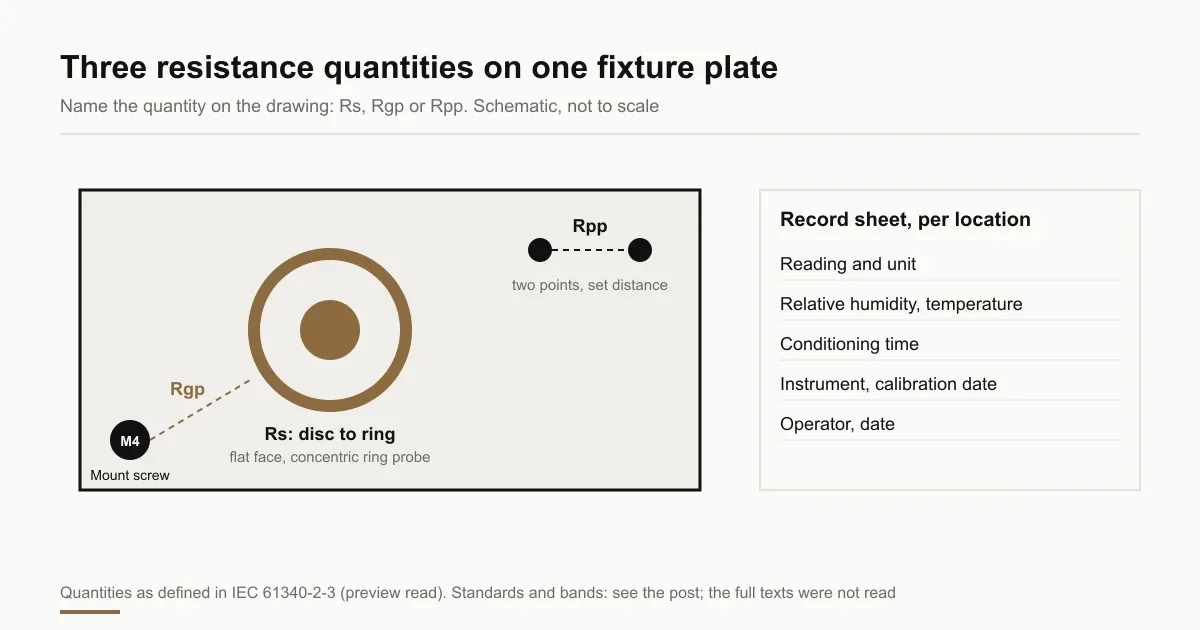
The incoming test for an ESD fixture material is a measured surface resistance, taken at stated humidity on the areas that touch a device or carry the ground path, written on a sheet and compared with the band the customer’s spec sets. This post is part of our guide to semiconductor tooling materials. It covers what to test, in what order, what the standards say and what a drawing note can look like.
The ESD materials and coatings post covers what to choose. This one covers how to prove the choice on receipt.
What you need before you start
- The customer’s resistance band and the standard it comes from. The values differ between sources, see the table below.
- A meter and probe set that the standard allows. The shop or the receiving lab owns this; the buyer should ask for the instrument and its calibration date on the record sheet.
- A way to hold and record humidity and temperature. A climate chamber is what the maker’s report we opened used. A hygrometer is the minimum.
- Time. The same report conditioned its samples for 48 to 72 hours before testing.
- Who does it. The shop tests before shipping, the receiving lab tests again or a third party does. Say which on the order.
We did not read the ESD Association or IEC texts. They are paywalled, and what follows is taken from the store pages, a published newsletter, an open forum answer, a maker’s test report and the IEC preview. Where a detail is only in a standard, we say so.
The standards and where the bands differ
| Source | What it says about the band | Edition and caveat |
|---|---|---|
| Static-control maker’s S20.20 qualification report | Acceptance ≥ 1.0 x 10^4 to < 1.0 x 10^11 ohms | Report for a packaging material, cites ANSI/ESD STM11.11 |
| IEC 61340-2-3 | Scope: resistance from 10^4 to 10^12 ohms | 2016 edition, redline preview read, not the full text |
| ESD ADV1.0-2004, as quoted in a US patent | Dissipative: below about 10^12 and at least about 10^5 ohms per square | Resistivity, not resistance; second-hand quote |
| Distributor glossary | Dissipative: between 10^5 and 10^12 ohms | Secondary source |
| Older posts on this site | A target of 10^6 to 10^9 ohms for dissipative composites | A maker-style target inside the wider band; your customer’s number wins |
Caption: no single number is “the” ESD band. The bands above disagree at both ends and mix resistance in ohms with resistivity in ohms per square. Take the band, unit and edition from the customer’s document. ANSI/ESD S541 is the packaging materials standard; the ESD Association store lists the 2026 edition and says IEC 61340-5-3 is technically equivalent. We did not read it.
Which resistance you measure
IEC 61340-2-3 defines several quantities, and a fixture drawing should say which one it wants:
- Surface resistance (Rs): between a central disc electrode and a surrounding concentric ring on the surface.
- Resistance to a groundable point (Rgp): between an electrode on the surface and a groundable point fitted to the part, such as a mounting screw.
- Point-to-point resistance (Rpp): between two electrodes placed a set distance apart on the same surface.
- Resistance to ground (Rg): between an electrode on the surface and a local ground.
The ESD Association publishes STM11.11 for the concentric ring surface method and STM11.13 for two-point resistance where the ring electrodes cannot be used. STM11.12 covers volume resistance. The ESDA store lists the editions as 2022, 2021 and 2021.
A flat nest face suits the ring probe. A small contact tip, a slot wall or a curved surface needs the two-point method. For a plate that must drain charge to its mount, Rgp is the quantity that tests the ground path, which is the failure our ESD post describes as an anodized plate assumed grounded through its screws.
The steps
- Fix the standard, the quantity and the band. Failure point: a drawing that says “ESD safe” and nothing more. Write the standard, edition, quantity (Rs, Rgp or Rpp), band and the humidity it applies at.
- Choose the test points. Cover every area that contacts a device, the mounting faces and any masked or coated zones separately. Failure point: testing only the easy flat face, then finding the pocket wall is uncoated.
- Condition the samples. The maker’s report conditioned for 48 to 72 hours at 23 °C and tested at both 12 and 50 percent relative humidity. The IEC contents list a clause on conditioning and test environment. Failure point: measuring a plate that came out of a cold truck.
- Check the instrument. Use a meter and probe from the standard’s list and a calibration or verification record. The IEC contents list a system verification annex. Failure point: an unverified meter that nobody can trace.
- Apply the test voltage the standard names. The maker’s report used 100 V. We did not read the voltage clause, so take it from the standard. Failure point: an instrument whose test voltage you have not checked against the standard.
- Read and wait. IEC 61340-2-3 notes that plastics can show a charging current that decays with time and changes the apparent resistance. If you see drift, it suggests repeating after a set time with reversed polarity and averaging the two values. Failure point: recording the first number that flashes.
- Record every reading. Humidity, temperature, date, who, which instrument and each location. Failure point: a pass stamp without numbers.
- Decide and react. Inside the band, pass. Outside, quarantine the lot and agree who pays before retesting, because a coating can pass at 50 percent humidity and fail at 12.
What good output looks like: a sheet with a reading per location, all inside the band at the stated humidity, a named instrument and a signature.
Need a quote for this part? Get a quote
What the humidity effect looks like
The static-control maker’s report on its shielding bag material gave these means at 23 °C and 100 V, conditioned for 48 to 72 hours:
| Surface | Mean at 12 % RH, ohms | Mean at 50 % RH, ohms |
|---|---|---|
| Interior | 9.41 x 10^9 | 3.59 x 10^8 |
| Exterior | 1.44 x 10^10 | 5.07 x 10^8 |
Caption: from one maker’s qualification report for a bag material, not for a fixture. It shows the size of the humidity effect, about 26 to 28 times between the two conditions. We found no public humidity data for a machined plate, so test your own.
At 12 percent humidity the exterior mean of 1.44 x 10^10 ohms was only about seven times below the 10^11 limit, and the largest single exterior reading, 2.05 x 10^10, about five times below. A material with less margin than this one can cross the limit in a dry room that it cleared in a humid shop.
When coated parts drift
Three events move a reading after the first test: wear through a coating at a contact area, cleaning with an agent that attacks the coat and a change of material lot. Our ESD post lists a coating specified with no contact area and a quiet change of grade by the shop. The practical rule is to retest at the first article, once per lot, after any process change and after the first cleaning cycle in the plant. The thermal expansion and cleaning chemical posts in this series cover other ways a plate changes after it is delivered.
Low charge generation is a separate property from resistance. The ESD Association open forum answer says dissipative and conductive materials may not be low charging and often are not, and that testing is always necessary to verify both. A resistance test alone does not prove low charging.
A drawing note
Surface resistance Rs per ANSI/ESD STM11.11, edition as stated in PO, 10^4 to 10^11 ohm at 12 % RH and 23 °C after 48 h conditioning. Measure on pocket floor, pocket wall, top face and mounting face. Resistance to groundable point Rgp at the M4 mount screw to be within the same band. Record each reading with instrument and calibration date. Retest at first article and once per lot.
The band, edition, humidity, locations and screw size are placeholders. Replace them with your customer’s values.
Checklist to copy
- Standard, edition, quantity and band named on the drawing.
- Test points listed, including masked and coated areas.
- Conditioning time and humidity stated.
- Instrument, probe and calibration date on the sheet.
- Voltage as the standard names it.
- Every reading recorded with humidity and temperature.
- Retest triggers written down.
- Who pays when a lot fails.
Send the note with the drawing through the RFQ form and we reply within 24 business hours. For the full selection guide see semiconductor tooling materials.
Sources
- ESD Association store, ANSI/ESD STM11.11-2022 (scope line; editions of STM11.12 and STM11.13 in the menu)
- ESD Association, Threshold, September/October 2015 (STM11.11, STM11.12, STM11.13 descriptions)
- ESD Association Open Forum 2008, D. Swenson (packaging, S541, low charging against dissipative)
- ESD Association store, ANSI/ESD S541-2026 (scope; IEC 61340-5-3 equivalence). Text not read
- Desco Industries (SCS brand), S20.20 qualification report, DS 2700 series (conditions, band, results)
- IEC 61340-2-3:2016 RLV, preview pages (scope, definitions, introduction on drift). Full text not read
- US 8,875,717 B2 (quotes ESD ADV1.0-2004 dissipative limits in ohms per square)
- Hoffmann Group, ESD glossary (dissipative 10^5 to 10^12 ohms; distributor source)
Frequently asked questions
Which standard measures surface resistance of an ESD fixture material?
ANSI/ESD STM11.11 is the ESD Association method for surface resistance of planar materials, and the store lists the 2022 edition as current. IEC 61340-2-3 covers resistance from 10^4 to 10^12 ohms. We did not read either text. Use the edition your customer names, because conditioning and probes are set by the standard.
Why do readings change with humidity?
Many dissipative materials conduct partly through absorbed moisture. One static-control maker's report on a packaging material measured a mean of 9.41 x 10^9 ohms at 12 percent relative humidity and 3.59 x 10^8 at 50 percent, about 26 times lower. Record humidity with every reading and condition samples as the standard says.
What if the part is too small for a concentric ring probe?
The ESD Association lists a separate method, STM11.13, for two-point resistance where the concentric ring electrodes of STM11.11 cannot be used. IEC 61340-2-3 also defines resistance to a groundable point and point-to-point resistance. Name the quantity on the drawing so the shop and the buyer measure the same thing.
How many readings should I take per plate?
We found no published count for fixtures. The maker's report we opened tested 6 to 10 specimens per condition. For a plate, take at least one reading on each area that touches a device or a ground path, record each one and say on the order how many parts per lot are tested.
Need a quote for this part?
Send the drawing. We quote the finished parts, place the work with a partner shop in Vietnam and reply within 24 business hours.
Get a quoteMore on quality
- Handling an OSAT Customer Complaint on Jigs: From Return to Closed Report
- What a First Sample Must Prove to a New Semiconductor Customer
- Why Jigs and Fixtures Fail on the Line: Warpage, Wear, Loosening and Contamination
- Which Quality Certificates Semi Buyers Ask Shops For
All guides and the sourcing glossary.