Guides / Materials
Thermal Expansion of Fixture Materials: Aluminum, Steel, Laminates and Plastics Against Silicon
November 21, 2026
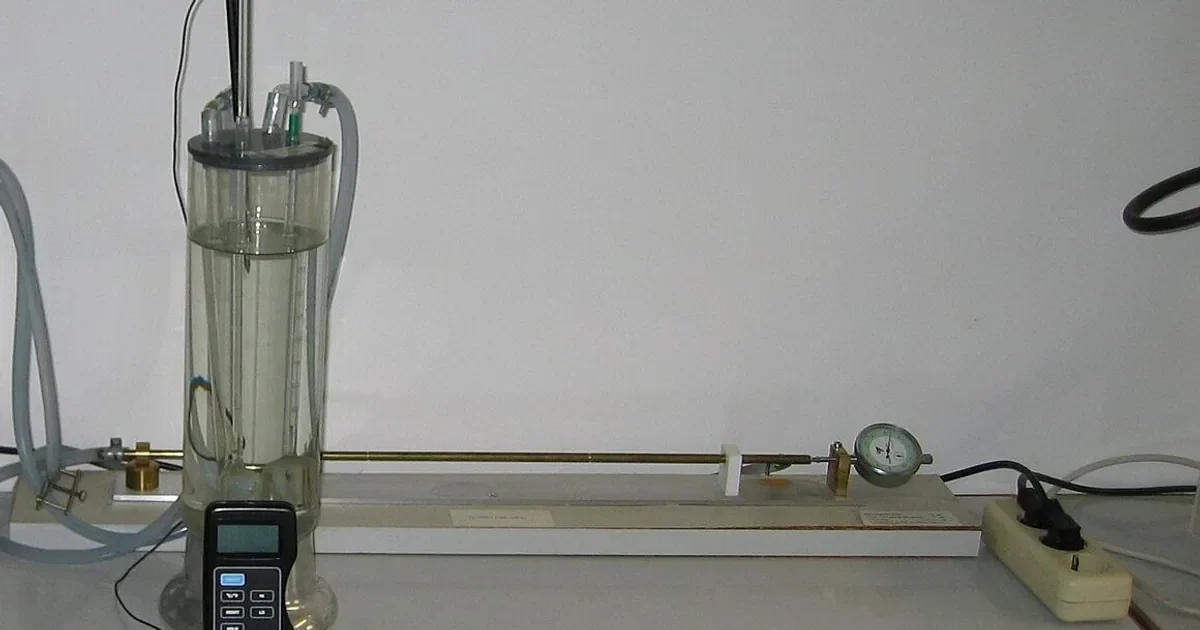
Silicon barely moves with temperature, aluminum moves about nine times as much and POM about fifty times as much, so a fixture that holds a package within a few hundredths of a millimeter at room temperature can lose that hold in a test cell. This post is part of our guide to semiconductor tooling materials. It lists coefficients from maker data sheets, works one plate through a temperature rise and says which material to use for which job.
We found one data sheet or reference page for each material below. They quote different temperature ranges, so the table says which. We found no maker figure for phenolic laminate or cast nylon in this pass and leave them out.
The coefficients side by side
| Material | Coefficient, ppm per kelvin | Range or direction | Source note |
|---|---|---|---|
| Silicon | 2.6 | table value, varies with temperature | Ioffe Institute semiconductor reference |
| Glass-epoxy laminate, PCB grade | 11 in the sheet plane, 55 through the thickness | below Tg of 180 °C | Isola IS410 data sheet |
| Durostone sheets, polyester and epoxy grades | 10 to 30 in the sheet plane | parallel to the layers | Röchling sheet brochure |
| Tool steel, H13 type | 12.6 | 20 to 400 °C mean | Uddeholm Orvar Supreme sheet |
| Stainless 316L | 16.5 | 20 to 100 °C mean | Fagersta 316L sheet |
| Aluminum 6061-T6 | 23.6 | 20 to 100 °C mean | Proto Labs material sheet |
| PEEK | 50, then 70 | 23 to 100 °C, then 100 to 150 °C | Angst+Pfister PEEK sheet |
| POM-C | 130, then 140 | 23 to 60 °C, then 23 to 100 °C | Angst+Pfister POM-C sheet |
Caption: datasheet values, not guarantees. The laminate row is a copper-clad PCB grade; a plain sheet from another mill will differ, and we found no sheet-maker figure for plain FR4. The Durostone brochure lists many grades and gives ranges. Older posts on this site use 23.1 or 23 for aluminum in general; 23.6 is the 6061 sheet value from 20 to 100 °C.
Two things in the table matter before any calculation. The ranges differ, so a 316L value taken to 100 °C and a tool steel value taken to 400 °C are not strictly comparable. And plastics sit in a different class: the datasheet figures for PEEK and POM-C are about four to eleven times that of the tool steel.
Why the temperature range matters
A coefficient is the slope of growth against temperature, averaged over a range. Metals change slowly with temperature, so a mean to 100 °C is close to one to 200 °C. Plastics change faster. The PEEK data sheet lists a glass transition of 150 °C and gives 50 ppm per kelvin up to 100 °C and 70 between 100 and 150 °C. A calculation that reuses the lower number all the way to 150 °C understates the growth.
The POM figures show the same drift on a smaller scale: 130 for 23 to 60 °C and 140 for 23 to 100 °C. The POM-C sheet gives nothing above 100 °C, so any estimate above that is a guess.
Our older post on POM, MC nylon and bakelite lists POM at about 100 to 120 ppm per kelvin, below the 130 to 140 of the sheet we opened here. We did not trace the reason; grades and makers differ. Its worked example, a 100 mm POM nest warming by 20 °C, comes to 0.20 mm at 100 and 0.26 mm at 130. Use the maker’s sheet for the grade you order.
A worked example: a 150 mm plate from 25 to 150 °C
Assume a plate 150 mm long that goes from 25 to 150 °C, a rise of 125 K. Growth is length times coefficient times rise. The calculation treats each quoted mean as constant over the whole rise, which is approximate.
| Material | Growth over 150 mm, mm | Growth beyond silicon, mm |
|---|---|---|
| Silicon (reference) | 0.05 | 0 |
| Glass-epoxy laminate, in plane | 0.21 | 0.16 |
| Tool steel, H13 type | 0.24 | 0.19 |
| Stainless 316L | 0.31 | 0.26 |
| Aluminum 6061-T6 | 0.44 | 0.39 |
| PEEK, at 50 to 100 °C and 70 above | 1.09 | 1.04 |
| POM-C | not estimated | not estimated |
Caption: our arithmetic on the datasheet values above; an example, not a measurement. PEEK uses 50 for the first 75 K and 70 for the last 50 K. POM-C is left out because its sheet stops at 100 °C; to 100 °C alone (a 75 K rise) it would reach about 1.6 mm using 140.
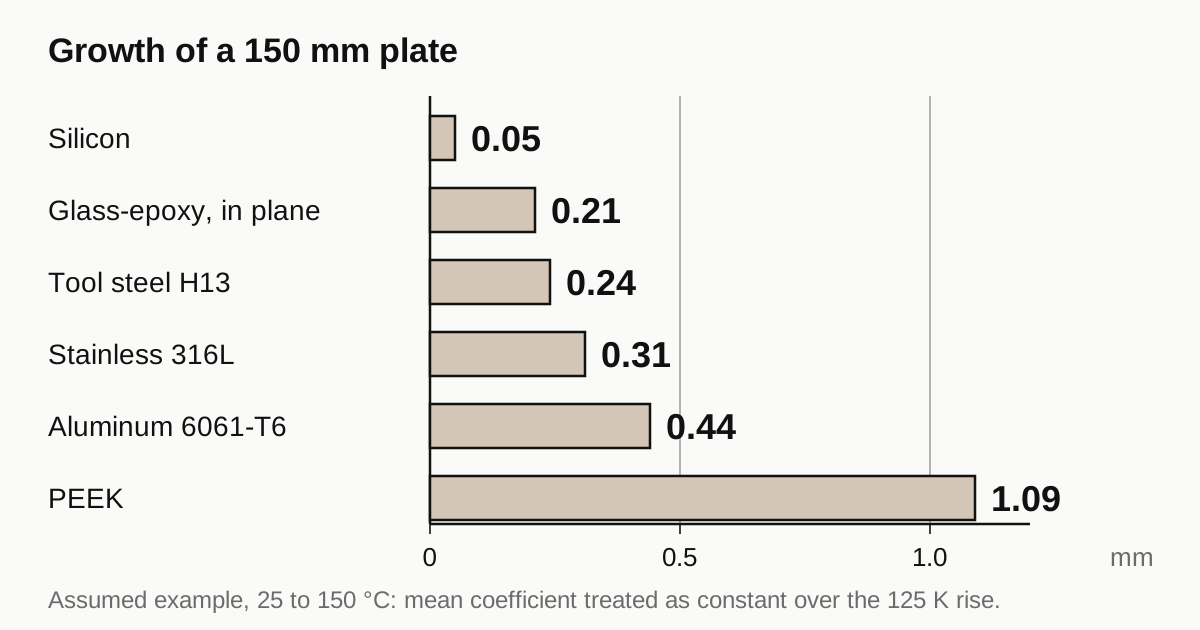
For a package nest this is the number that matters. An aluminum plate and a part with silicon’s coefficient move apart by about 0.026 mm over each 10 mm of distance in this example, 0.39 mm over the whole 150 mm. That gap is why a plate of nests keyed to one corner drifts at the far end. The package nest design post gives the clearance method, and the usual cure is to carry the locating features on one stable base and keep each plastic insert small.
Need a quote for this part? Get a quote
Laminates are two materials in one
A glass-epoxy sheet expands differently along its layers than through them. The Isola PCB laminate sheet lists 11 ppm per kelvin in the plane and 55 through the thickness below its glass transition, then 250 above it, with total thickness growth of 3.5 percent from 50 to 260 °C. For a probe plate the practical meaning is that hole position in the plane stays close to steel’s, while the plate thickness, and so the probe stroke, moves more.
The Durostone and FR4 post covers temperature rating, which comes before expansion for solder pallets: a laminate that delaminates at the process temperature never gets as far as growing. The Röchling brochure puts in-plane expansion for its sheet grades between 10 and 30 ppm per kelvin. That is a grade-level range, so read the sheet of the grade you order.
Choose by use
- Choose aluminum when the plate stays near room temperature or the part and plate are meant to grow together, such as an aluminum part held on an aluminum plate. It is light, easy to machine and moves the most of the metals here.
- Choose tool steel or stainless when the plate runs hot and carries tight pockets, or when thermal mismatch with a low-expansion part costs yield. Steel moves about half as much as aluminum.
- Choose a laminate when you need an insulating plate close to steel’s in-plane growth, and check its temperature rating and through-thickness movement.
- Choose PEEK or POM when the plastic is a small insert, pinned to a stable base, and the clearance budget covers its growth. Do not use a large plastic plate where position matters across its length.
- Choose by data sheet, not by name, for anything that sees more than 100 °C.
What wrong costs
A wrong choice shows up late. A plate that fits at room temperature binds when hot, a pocket opens until the package wanders or a test result drifts as the cell warms through a shift. The fix is a new plate.
What to write on the drawing
- The material grade and temper, by maker or standard, not “aluminum” alone.
- The temperature at which the dimensions apply, usually 20 °C.
- The working temperature range of the part.
- The clearance budget at both ends of that range.
- Which feature is the datum the thermal growth is measured from.
- For plastics, the maker data sheet to use.
Send the drawing and these lines through the RFQ form and we reply within 24 business hours. For the other material choices around a plate, see semiconductor tooling materials.
Sources
- Ioffe Institute, silicon thermal properties (linear expansion 2.6 per °C)
- Proto Labs, aluminum 6061-T651/T6 material data sheet (23.6 micro m/m-K, 20 to 100 °C)
- Uddeholm, Orvar Supreme data sheet (AISI H13 type, expansion from 20 °C)
- Fagersta, 316L data sheet (thermal expansion from 20 °C)
- Isola, IS410 laminate data sheet (X/Y and Z expansion, Tg 180 °C), as hosted by a PCB maker
- Röchling, Durostone sheets brochure (expansion parallel, many grades)
- Angst+Pfister APSOplast, PEEK data sheet (23 to 60, 23 to 100, 100 to 150 °C)
- Angst+Pfister APSOplast, POM-C data sheet (23 to 60 and 23 to 100 °C)
Frequently asked questions
Which fixture material expands least?
Of the materials with a datasheet we opened, silicon is the lowest at 2.6 ppm per kelvin, then glass-epoxy laminates in the sheet plane at about 10 to 30, then tool steel at 12.6 and stainless at 16.5. Aluminum 6061 is 23.6 and POM-C is 130. Compare values over the same temperature range, because the figure changes with the range.
Why does the same material show two coefficients?
A coefficient is a mean over a stated temperature range, and it changes as the range moves. PEEK's data sheet lists 50 ppm per kelvin for 23 to 100 °C and 70 for 100 to 150 °C, up to its glass transition of 150 °C. Laminates also differ by direction: a PCB laminate sheet lists 11 in the plane and 55 through the thickness.
How much does a 150 mm aluminum plate grow when it heats up?
Using 23.6 ppm per kelvin and a rise from 25 to 150 °C, about 0.44 mm. A tool steel plate with 12.6 grows about 0.24 mm and a part with silicon's 2.6 about 0.05 mm. The gap between aluminum and silicon is about 0.39 mm over 150 mm, so locate pockets close to one datum.
Do I use the datasheet value or the one in a textbook?
Use the maker's data sheet for the grade you order and write the grade on the drawing. Our older plastics post lists lower figures for POM than the datasheet we opened, and grades differ by filler and maker. A handbook value is a starting point for a sketch, not for a clearance you will cut.
Need a quote for this part?
Send the drawing. We quote the finished parts, place the work with a partner shop in Vietnam and reply within 24 business hours.
Get a quoteMore on materials
- Cleaning Agents Against Fixture Materials: IPA, Acetone, Alkaline Flux Removers and Plasma
- RoHS, REACH and Halogen-Free Declarations for Jig and Fixture Materials: What a Shop Can Sign and What It Cannot
- Materials for Semiconductor Tooling: Pick the Metal, Plastic and Finish, Write the Callout, Prove It on Receipt
- Aluminum Plate for Semiconductor Parts in Vietnam: Local Stock or Imported
All guides and the sourcing glossary.