Guides / Materials
Cleaning Agents Against Fixture Materials: IPA, Acetone, Alkaline Flux Removers and Plasma
November 21, 2026
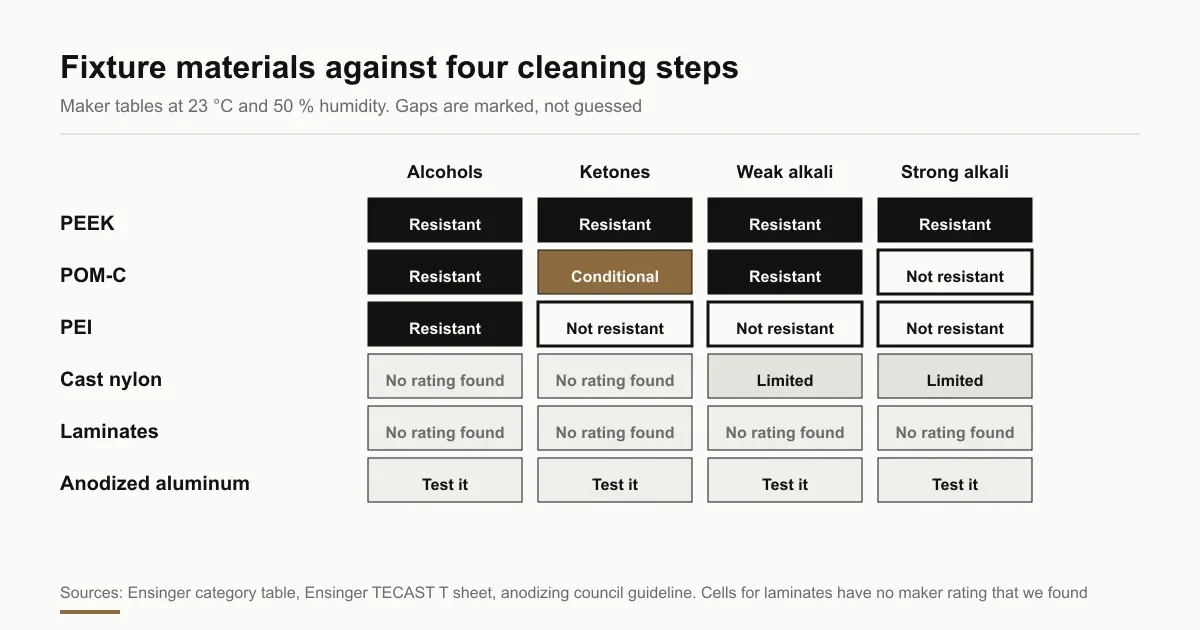
Alcohols are the safe default for most fixture plastics. Ketones such as acetone split them, strong alkaline flux removers attack materials that most plants think are safe, and for plasma we found no maker table at all. This post is part of our guide to semiconductor tooling materials. It sets out the maker ratings we could open, where the sources disagree and what to prove with a coupon before a cleaning step goes on a drawing.
The ratings are for a material in a named agent at a named temperature and time. A table cell is a starting point, not a pass.
The matrix in one table
| Material | Alcohols (IPA, ethanol) | Ketones (acetone) | Weak alkalis | Strong alkalis |
|---|---|---|---|---|
| PEEK | Resistant | Resistant | Resistant | Resistant |
| POM-C | Resistant | Conditional | Resistant | Not resistant |
| PEI | Resistant | Not resistant | Not resistant | Not resistant |
| Cast nylon (PA 6 C) | No maker rating found | No maker rating found | Limited (one rating for hot water and bases) | Limited (same rating) |
| Glass-epoxy laminate, Durostone type, phenolic | No maker rating found | No maker rating found | No maker rating found | No maker rating found |
| Anodized aluminum | See the alkaline section | See the alkaline section | Sensitive, test it | Sensitive, test it |
Caption: PEEK, POM-C and PEI rows are Ensinger’s category table at 23 °C and 50 percent relative humidity (DIN 50014), with its legend of resistant, conditionally resistant and not resistant. The nylon cell comes from an Ensinger TECAST T sheet that lists limited resistance for hot water and bases and says individual testing is mandatory. The anodized row is from the cleaning-agent maker paper and the anodizing guideline, not a rating table.
Ensinger’s table is by category (alcohol, ketone, weak alkali, strong alkali), not by named chemical. The company also says the chief tests are temperature, concentration, exposure time and mechanical load, and that its table does not guarantee a result for your application.
Alcohols: IPA and ethanol
For the three plastics with a maker rating, alcohols are the safe wipe: PEEK and POM-C and PEI are all rated resistant. That matches what plants do, which is why IPA is the default cleaner.
The gap is in cast nylon and the laminates. We found no maker rating in alcohols for MC nylon or for glass-epoxy and phenolic laminates. A distributor chart for PA66, which is not cast nylon, rates isopropyl alcohol as “severe effect” while it rates other alcohols such as ethyl and methyl alcohol as excellent or good. We could not match that to a maker table, so we treat it as an outlier that shows why a coupon beats a chart.
Ketones: acetone
This is where the plastics split. Ensinger rates PEEK resistant to ketones, POM-C conditionally resistant and PEI not resistant. The distributor chart rates acetone as excellent for PEEK and for POM and as “severe” for PVDF.
The two sources disagree on POM. Ensinger’s category table is the maker; the chart is a distributor’s generic table with temperature footnotes. Use the maker’s word when you can: acetone on POM is conditional, which means a short wipe at room temperature may be fine and a soak or a hot wash may not be.
The same Ensinger page warns that amorphous thermoplastics are prone to stress cracking in the presence of certain chemicals, where microcracks form and grow under mechanical load. A nest that is clamped or pressed while it is cleaned carries load. Cleaning an unloaded coupon can pass and cleaning a loaded part can crack.
Alkaline flux removers and anodized aluminum
Aqueous flux removers are alkaline. A cleaning-agent maker’s paper says engineered aqueous cleaners tend to have pH values from 8 to 14, because that range is needed to dissolve burnt-in flux. The same paper says components now carry more sensitive materials that alkaline agents can harm, and names anodized, alodine and iridite coatings, electroless nickel plating, aluminum and copper among the sensitive ones it studied. The maker sells pH-neutral agents, so read its comparison as directional.
For a hard-anodized plate the anodizing council guideline says the corrosion test should be application based, especially if the part is used in an alkaline environment. It names salt spray under ASTM B117 as the common test. For plastics, Ensinger’s table gives PEEK as resistant to both weak and strong alkalis, POM-C as resistant to weak alkalis only and PEI as not resistant. Cast nylon is limited.
A machine shop quoting an anodized fixture does not control the agent used on the line. Put the agent name, pH and temperature on the drawing as an operating condition, and ask the finisher what its sealed coating has been tested against.
Plasma
We found no maker table for how POM, PEEK, nylon or laminates behave under plasma cleaning. One 2024 review of cold atmospheric-pressure plasma, published by a plasma equipment maker, says that long exposure leads to erosion of polymers, noticeable after hours, days or weeks, with a rate that depends on the polymer and the plasma. It addresses atmospheric-pressure plasma, not the vacuum plasma of a chamber.
The honest position is a gap. If a fixture sits in or near a plasma step, test coupons of the plastic under the actual process for the actual time and measure mass, dimensions and surface.
Need a quote for this part? Get a quote
Choose by use
- Choose PEEK when the fixture meets acetone, alcohols and alkaline agents. PEEK and PPS are the only plastics in Ensinger’s table rated resistant in all four columns. Ask the shop for the price difference, because we found no public price comparison.
- Choose POM-C when the cleaning is alcohol only or a short ketone wipe at room temperature, and the part is a stable nest.
- Avoid PEI where ketones are used. Ensinger rates it not resistant.
- Do not assume for cast nylon and laminates. We found no maker rating, so test or ask the sheet maker.
- Treat anodized aluminum as agent-specific. Test the coating in the agent you use.
- Choose by coupon for any step with a heat or a load, because the table is at 23 °C and unloaded.
What picking wrong costs
The failure can be quiet on day one. A nest swells a few hundredths and stops fitting, a surface crazes and sheds particles, an anodized coat chalks and the ESD path changes. The cost is the plate and the days lost finding the cause. Our ESD resistance test post covers why a changed surface also changes surface resistance.
How to prove it with a coupon
- Cut a coupon of the actual grade, with the actual finish, from the same stock.
- Weigh and measure it, and photograph it.
- Expose it to the agent at the plant’s temperature for the plant’s contact time, and for a stressed case under clamp load.
- Dry as the plant dries.
- Reweigh, remeasure and look under magnification for crazing.
- Repeat the cycle the number of times the plant will clean before the part is replaced.
We found no published pass limit for this, so agree one with the customer: a mass change, a size change and no visible cracking.
What to write on the drawing
- The material grade and trade name, as a hard callout.
- The cleaning agent, concentration, temperature and contact time the part will see.
- Whether the part is loaded while cleaned.
- The coating and its test, such as the salt spray method and duration.
- The coupon test and its pass limit, if the customer wants proof.
Send these with the drawing through the RFQ form and we reply within 24 business hours. The related plastics and laminate choices are in POM, MC nylon and bakelite and Durostone and FR4. For the full selection guide see semiconductor tooling materials.
Sources
- Ensinger, chemical resistant plastics (category table for PEEK, PPS, PPSU, PEI, PPE, POM-C, PP, PC; stress cracking note)
- Ensinger, chemical resistance brochure (legend, test conditions 23/50, DIN 50014)
- Ensinger TECAST T MO data sheet, as hosted by a parts maker (cast PA 6 C: sensitive to stress cracking, limited resistance to hot water and bases)
- Distributor chemical compatibility chart for PA66, PEEK, PPS, PVDF and POM (directional; generic)
- Tosun and others, pH neutral cleaning agents, in an IPC proceedings (cleaning-agent maker paper; pH 8 to 14, sensitive materials)
- Aluminum Anodizers Council, application guideline for hard anodic oxide finishes (application-based corrosion test)
- relyon plasma, erosion of polymers in atmospheric pressure plasmas (Korzec and Trabold, 2024)
Frequently asked questions
Can I clean a POM nest with acetone?
Ensinger's category table rates POM-C conditionally resistant to ketones and fully resistant to alcohols, tested at 23 °C and 50 percent humidity. A distributor chart rates POM excellent for acetone. The sources disagree, so soak a coupon in your agent at your temperature and time before you clean parts with it.
Do alkaline flux removers harm anodized aluminum?
They can. Aqueous flux removers run alkaline, with pH values from 8 to 14 according to a cleaning-agent maker's paper, and that paper lists anodized coatings and aluminum among sensitive materials. The anodizing council guideline says corrosion tests should be application based, especially for alkaline use. Test your coating in the agent.
Which fixture plastic is safest with solvents?
Of the plastics in Ensinger's category table, PEEK and PPS are rated resistant to alcohols, esters, ethers and ketones, while PEI is rated not resistant to ketones. The table is category level, so confirm the exact agent. We found no maker rating for cast nylon or laminates in alcohols or ketones.
Does plasma cleaning damage plastic fixtures?
A 2024 review of atmospheric-pressure plasma says polymer erosion becomes noticeable after hours, days or weeks of exposure and depends on the polymer and the plasma. We found no maker table for POM, PEEK, nylon or laminates under plasma, and that review does not cover vacuum plasma. Test coupons under your own process.
Need a quote for this part?
Send the drawing. We quote the finished parts, place the work with a partner shop in Vietnam and reply within 24 business hours.
Get a quoteMore on materials
- RoHS, REACH and Halogen-Free Declarations for Jig and Fixture Materials: What a Shop Can Sign and What It Cannot
- Materials for Semiconductor Tooling: Pick the Metal, Plastic and Finish, Write the Callout, Prove It on Receipt
- Thermal Expansion of Fixture Materials: Aluminum, Steel, Laminates and Plastics Against Silicon
- Aluminum Plate for Semiconductor Parts in Vietnam: Local Stock or Imported
All guides and the sourcing glossary.