Guides / Materials
POM, MC Nylon and Bakelite: Plastic Jig Materials Compared
October 22, 2026
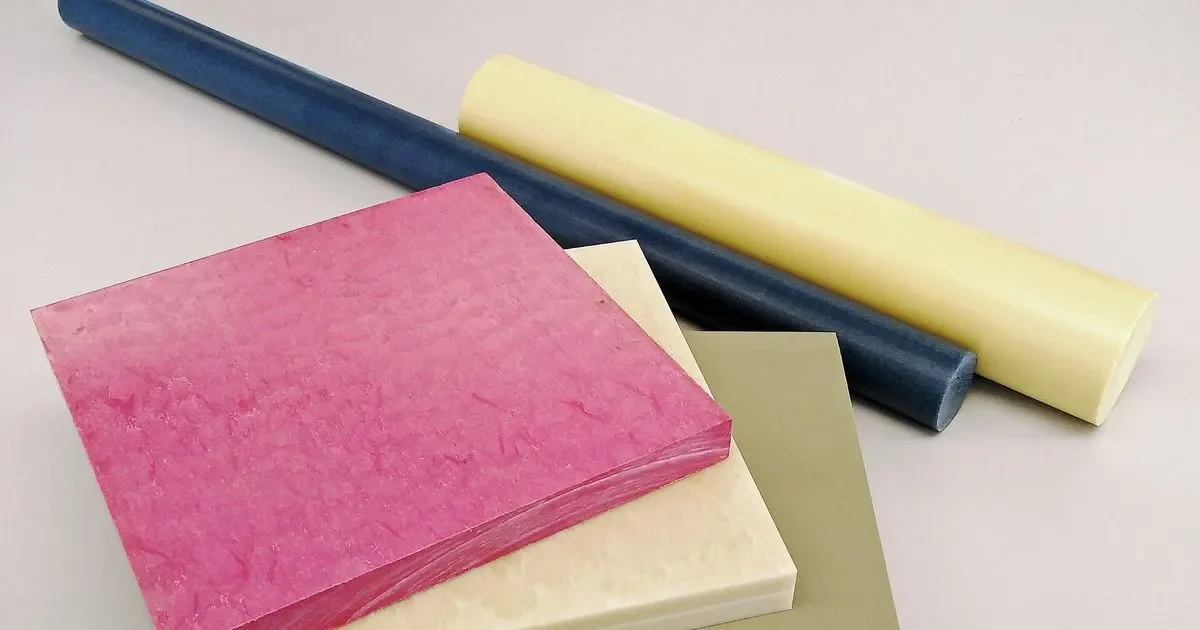
Not every jig part has to be steel. Nests, carriers, guides, covers and spacers are often plastic, because plastic is light, gentle on the product, quick to machine and cheap. Three families appear on semiconductor and electronics drawings more than others: POM, cast nylon sold as MC nylon and bakelite, meaning phenolic laminate.
They look alike on a shelf and behave very differently in a plant. This guide compares them on the properties that decide whether a jig part works and lists what to write on a drawing.
What each material is
POM, polyoxymethylene, also called acetal. A rigid, low friction engineering plastic with good dimensional stability. Sold as homopolymer and copolymer. The homopolymer is a little stiffer and stronger, and the copolymer resists chemicals and hot water better.
MC nylon. Cast nylon 6, produced by casting the monomer into a mold. Larger sections are possible, it is tougher than extruded nylon and it wears well. It also absorbs water.
Bakelite. The common name for phenolic resin laminates, such as paper phenolic and cotton fabric phenolic. Layers of paper or fabric soaked in resin and cured under pressure. Rigid and stable, and an insulator with good heat resistance.
Side by side
| Property | POM | MC nylon | Phenolic laminate |
|---|---|---|---|
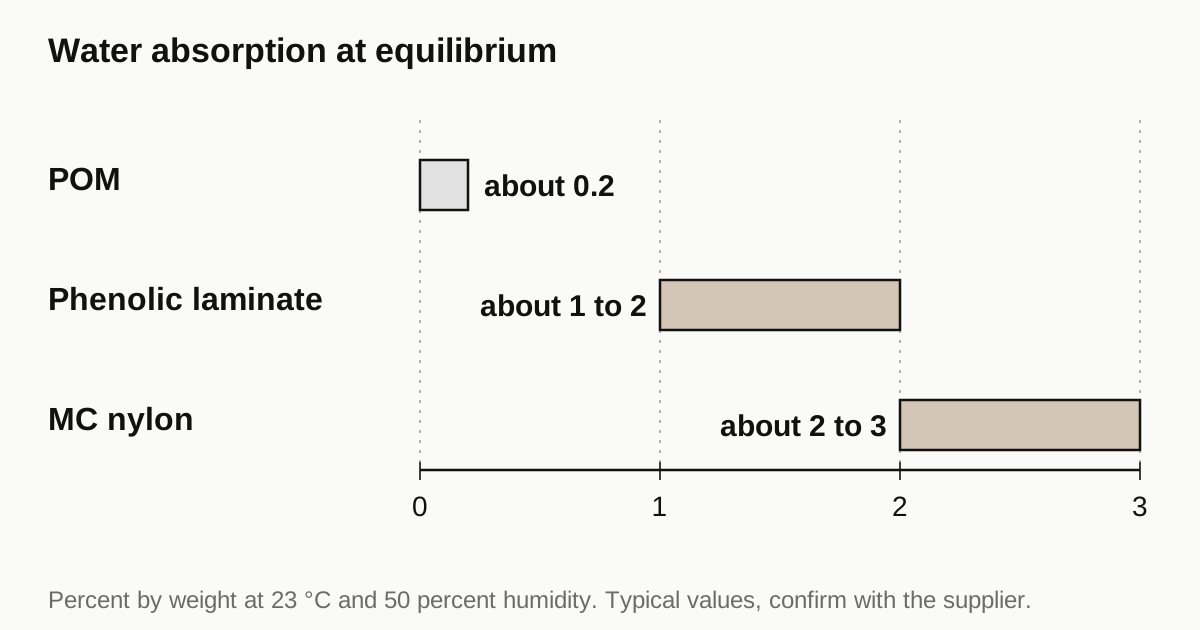
| Water absorption at equilibrium, 23 °C 50% RH | about 0.2 percent | about 2 to 3 percent | about 1 to 2 percent, grade dependent |
| Continuous use temperature | about 90 to 100 °C | about 100 to 110 °C | about 120 to 130 °C |
| Thermal expansion, ppm per kelvin | about 100 to 120 | about 80 to 100 | about 20 to 40, in plane |
| Dimensional stability | Good | Fair, moves with humidity | Good |
| Machining | Clean chips, tight tolerance | Good, may burr | Dusty, brittle edges |
| Wear on mating part | Low | Low | Higher, abrasive filler |
| Electrical | Insulator | Insulator | Insulator |
| Relative cost | Low to medium | Low to medium | Low |
Values are typical for general purpose grades. Check the data sheet for the supplier’s material.
Choosing by job
Nests and pockets for packages, boards or trays. POM. It holds a pocket size, does not scratch the product and machines to ±0.02 mm routinely. For a package that has to drop in without play and without sticking, the stability matters more than any other property.
Guides and wear strips under moving parts. MC nylon for toughness and low friction, if the humidity range is steady. For precise tracks, POM.
Heated fixtures and hot plates. Phenolic laminate, or a high temperature engineering plastic such as PEEK. POM and nylon soften too early. See PEEK, Vespel and Torlon parts.
Large flat plates. Phenolic sheet or a fiber reinforced laminate stays flatter and costs less per plate than thick cast blocks.
Electrical insulation under a test fixture. Phenolic laminate or a glass epoxy sheet, covered in Durostone and FR4 for test fixtures.
ESD sensitive product contact. Standard grades are insulators and collect charge. Use an ESD dissipative grade. See ESD materials and coatings for the resistance ranges.
Moisture and size
Water absorption is the property buyers overlook. POM absorbs about a fifth of a percent. A 100 mm POM part swells by roughly 0.1 mm between dry and humid conditions at most. A nylon part of the same size can swell by 1 to 2 percent when fully wet, around a millimetre or more. In a plant at stable humidity, a nylon part machined to size and left to condition stays close. Machined in a dry room and moved into a humid one, it drifts.
Tolerances on nylon should be set with the moisture state in mind. Ask the shop to machine from stabilized or conditioned stock, or to allow for the final moisture level. Where the tolerance is tighter than 0.1 mm on a long dimension, choose POM.
Thermal expansion
Plastics expand five to ten times more than steel. A POM nest at 100 mm that warms by 20 °C grows about 0.2 mm. If the nest pocket must hold a package to 0.05 mm across a plant that swings by 10 °C, the nest is already out of budget. For a heated test fixture, the same effect shifts positions as the fixture warms.
Two ways to deal with it: keep the nest small so the absolute growth is small, or carry the locating features on a stable base such as steel or ceramic and use plastic only for the contact surface.
Machining notes
POM machines like soft brass: sharp tools, light cuts, clean chips, good finish. Internal stress from the stock can relieve as material is removed, so long thin parts may bow. Stress relieved stock or a roughing, rest and finishing sequence reduces it.
MC nylon cuts well but pulls burrs, and cast blocks carry internal stress. It heats during cutting, so coolant or air helps.
Phenolic laminate machines dusty and chips at the edges. Carbide tools hold up better than HSS because of the abrasive filler. Dust control and operator protection matter, and the dust is not suitable for a cleanroom. Parts for clean areas need washing and sealing.
Need a quote for this part? Get a quote
Surface and finish
POM finishes smoothly, down to Ra 0.8 µm or better, and keeps a sharp edge. MC nylon finishes a little softer. Phenolic shows its laminate layers at the edge and the face is usually a laminated finish, not a polished one. If a specific roughness matters, name it. The surface finish Ra guide shows how.
A worked example: a nest for a small package
Consider a nest for a 5 mm square package with a 0.25 mm tolerance on its body. The nest pocket has to hold the package within about 0.1 mm of position, let it drop in by gravity and not scratch the mold compound or the leads. POM at 10 mm thick fits the case. The pocket is milled to the package size plus 0.1 to 0.15 mm total clearance, with a small lead-in chamfer so that the package self-centres. At 100 mm across a plate of such nests, thermal growth of 0.2 mm over a 20 °C swing would shift the outer pockets, so the nests are cut as individual inserts pinned to a steel base, which keeps the growth per nest to a few hundredths of a millimetre.
The same pocket in MC nylon would work in a stable plant and drift in a humid one. In phenolic laminate it would hold size but could chip the package at the edges of a sharp pocket. The material choice follows from the environment as much as the product.
Creep, clamping and screws
Plastic creeps under constant load. A screw tightened hard into POM loses clamp force over weeks as the plastic flows away from the head. Use a metal insert or a thread insert in any hole that will be assembled repeatedly, and a flat washer under the screw head to spread the load. Tapped threads in plastic strip easily and should be avoided for any fastener that carries a load. For the same reason, do not press a bushing into a plastic plate with heavy interference without checking that the wall can carry the hoop stress.
Storage and handling
Plastic stock and finished parts relax with time and temperature. Long thin parts stored on end bow. Parts left in a hot car or a hot warehouse take a set. Ask for flat packing in a rigid carton, with foam or soft separators, and for finished nests to ship with the same orientation they will see in use. Phenolic should stay dry. It takes up moisture along its edges and the layers can swell. These notes belong on the order sheet as much as the tolerance does.
What to ask a shop
- Which grade and which supplier: homopolymer or copolymer POM, cast or extruded nylon, paper or cotton phenolic?
- Is the stock stress relieved or annealed?
- How is humidity handled for nylon parts?
- Can you machine ESD grades, and do you check surface resistance afterward?
- What tolerance do you commit to on a pocket in POM at 100 mm?
- How are plastic parts stored and packed to avoid warping?
Which cleaning agents these plastics tolerate is in cleaning agents against fixture materials, part of our guide to semiconductor tooling materials.
Checklist before you send the RFQ
- Material, grade and colour if it matters
- Temperature range of use
- Humidity conditions and the moisture state for tolerance
- ESD requirement and the resistance range
- Tolerances on the pockets and the datum scheme
- Surface finish where it contacts the product
- Quantity and a spare allowance for each nest
- Packing and handling
Send them with the drawing through the RFQ form. We place it with a partner shop and send one itemised quote within 24 business hours. What drives the cost of a semiconductor test jig shows how material fits into the total.
Frequently asked questions
Why is POM used so often for jig nests?
It machines cleanly to tight tolerances, absorbs very little water, holds its size and is gentle on the parts it touches. It also slides well, so a package or a board drops in and out without scratching. The limits are temperature and static: ordinary POM is an insulator and softens above about 100 °C.
Does MC nylon change size in a humid plant?
Yes. Nylon absorbs moisture from the air and swells with it. A part machined in a dry shop can grow measurably when it sits in a humid plant. For parts with tight fits, ask for a conditioned, stabilized stock or choose POM, which absorbs far less.
Is bakelite still used in modern jigs?
Yes, mostly as a laminated phenolic sheet in cotton or paper grades. It is stable, strong in compression, a good electrical insulator and stands up to heat better than POM or nylon. It is dusty to machine and brittle at edges, which limits thin sections.
Need a quote for this part?
Send the drawing. We quote the finished parts, place the work with a partner shop in Vietnam and reply within 24 business hours.
Get a quoteMore on materials
- Cleaning Agents Against Fixture Materials: IPA, Acetone, Alkaline Flux Removers and Plasma
- RoHS, REACH and Halogen-Free Declarations for Jig and Fixture Materials: What a Shop Can Sign and What It Cannot
- Materials for Semiconductor Tooling: Pick the Metal, Plastic and Finish, Write the Callout, Prove It on Receipt
- Thermal Expansion of Fixture Materials: Aluminum, Steel, Laminates and Plastics Against Silicon
All guides and the sourcing glossary.