Guides / Materials
RoHS, REACH and Halogen-Free Declarations for Jig and Fixture Materials: What a Shop Can Sign and What It Cannot
November 21, 2026
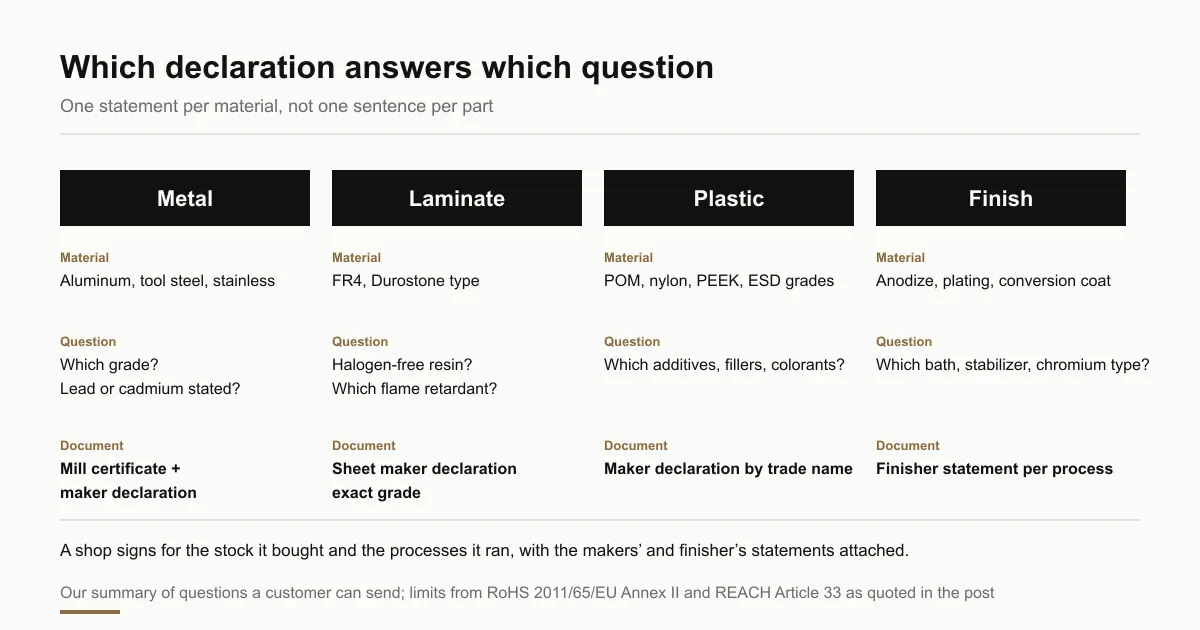
Ask for a declaration per material, not one blanket sentence per part: the plate, the laminate, the plastic and the plating each come with a different question and a different document. This post is part of our guide to semiconductor tooling materials. It sets out which limits come from RoHS and REACH, which come from industry practice such as halogen-free, where a plain jig sits against RoHS and what a machine shop can honestly sign.
We name no shop and we give no legal advice. The texts below are quoted from the versions we opened, and your customer’s compliance team decides what applies to your part.
Who sets which rule
Three different bodies are behind the three words people put on a purchase order.
RoHS is the European Union directive 2011/65/EU on hazardous substances in electrical and electronic equipment. REACH is the European chemicals regulation, number 1907/2006, run with the European Chemicals Agency. Halogen-free is not a law. An industry column by Doug Sober of Essex Technologies Group, published in 2015, says the limits come from the laminate standard IEC 61249-2-21, issued by the IEC. We did not read that standard, so every halogen figure here is the column’s.
The three also count differently. RoHS limits are by weight in each homogeneous material. REACH Article 33 speaks of an article and a concentration above 0.1 percent weight by weight. We did not read the guidance on how a multi-part article is measured, so do not assume the two use the same unit of measure.
Is a jig inside RoHS at all
The directive applies to electrical and electronic equipment in its Annex I categories. Article 3 defines that equipment as equipment that depends on electric currents or electromagnetic fields to work properly. A machined plate, a nest or a carrier needs neither, so on our reading it is not in scope.
An assembled test fixture with wiring, contact electronics or a control board can be a different case. The directive also excludes large-scale stationary industrial tools, defined as a large assembly of machines or equipment permanently installed in an industrial manufacturing facility. We found no public ruling that places semiconductor jigs in or out of RoHS. The European Commission’s RoHS page says all products with an electrical or electronic component are in scope unless specifically excluded.
In practice a plant or tool maker can put a restricted-substance clause in its supplier manual and apply it to everything it buys. A public declaration from a semiconductor equipment maker, SUSS MicroTec, lists the same ten substances and limits for its own equipment and treats its equipment components as articles under REACH, with a candidate list dated 19 January 2021. We found no public supplier-side specification for jig materials. That the maker needs the same statements from its suppliers is our inference, not something the document says.
The limits that show up on tooling materials
| Item | Limit or trigger | Where it comes from |
|---|---|---|
| Lead | 0.1 % by weight in a homogeneous material | RoHS Annex II |
| Cadmium | 0.01 % | RoHS Annex II |
| Mercury, hexavalent chromium, PBB, PBDE | 0.1 % each | RoHS Annex II |
| DEHP, BBP, DBP, DIBP (phthalates) | 0.1 % each | RoHS Annex II |
| Lead in steel for machining and in galvanised steel | up to 0.35 % by weight | RoHS Annex III exemption 6(a), expires 11 December 2026; 6(a)-I for machining steel expires 30 June 2027 |
| Lead in aluminum | up to 0.4 % by weight | RoHS Annex III exemption 6(b), expires 11 June 2027; 6(b)-II for machining expires 11 June 2027 (categories 1 to 7 and 10) or 30 June 2027 (categories 9 and 11) |
| Lead in copper alloy | up to 4 % by weight | RoHS Annex III exemption 6(c), expires 30 June 2027 |
| Candidate List substance in an article | above 0.1 % w/w: information duty | REACH Article 33 |
| Halogen-free laminate | chlorine 900 ppm, bromine 900 ppm, together 1,500 ppm | IEC 61249-2-21, as reported by an industry column, text not read |
Caption: Annex II rows are from the consolidated RoHS text of 1 January 2025 and REACH from the consolidated text of 23 June 2025. The Annex III rows are from Commission Delegated Directive (EU) 2025/2364 of 8 September 2025, published in the Official Journal on 21 November 2025, which replaces the exemption dates in that consolidation. It asks Member States to apply it from 1 July 2026. The dates are as of October 2026 and later acts may change them. The directive also splits some entries into sub-entries with their own dates and equipment categories, such as 6(a)-II for galvanised steel and 6(b)-III for casting alloys, so ask the customer which entry and which equipment category applies.
Annex III lists lead as an alloying element in steel, in aluminum and in copper alloys. That is a reason to ask which grade a shop will use when the drawing says only “aluminum” or “brass”, because a free-machining grade is where lead is most likely to appear.
Material by material: the question and the document
| Material | The question to ask | Document that answers it |
|---|---|---|
| Aluminum plate, tool steel, stainless | Which grade, and is the lead or cadmium content stated | Mill certificate, plus the maker’s declaration for the lot |
| Glass-epoxy laminate such as FR4 or a Durostone-type composite | Is the resin halogen-free, and what flame retardant is used | Sheet maker’s declaration for the exact grade |
| Engineering plastic: POM, nylon, PEEK, ESD grades | Which additives, fillers and colorants are in the grade | Maker’s declaration or data sheet, by trade name |
| Plating and anodize | Which bath, which stabilizers, which chromium type if a conversion coat is called | The plating or anodizing shop’s statement, per process |
| Packing and handling materials | Whether they are inside the declaration scope the customer wants | Customer’s manual |
Caption: our summary of questions a customer can send; there is no standard list. Annex II names flame retardants (PBB and PBDE) and phthalate plasticizers, which is why laminates and plastics get their own row.
For a laminate, the IEC halogen limits are read on the resin, and the column says the test results come from the epoxy components. Ask the laminate maker, not the machine shop, because the shop only cuts the sheet. The Durostone and FR4 post covers the sheet choice itself. For plating, the electroless nickel post notes that customer specifications can restrict lead-containing stabilizers and ask for a record of the bath chemistry; a compliance certificate is a document, so ask for it.
Need a quote for this part? Get a quote
What a shop can sign
A shop knows the stock it bought and the processes it ran. It can sign a statement that names the part and drawing revision, the material lot and its maker’s declaration and the processes applied. It can attach the stock maker’s declaration and the plating shop’s statement. It cannot sign for a substance it has no way to see.
Three limits are worth stating in the order. A declaration of the sheet maker covers the sheet; a plated or coated part needs the finisher’s statement too. A declaration that does not carry a date and the list or edition it was checked against ages quickly, because the Candidate List and the exemption dates change over time. And a statement is not an analysis: if the customer wants lab analysis, say so on the order, name the method and say who pays.
Common misreadings
- “RoHS compliant” stamped on a part that is not electrical equipment says little. Ask what rule the customer wants it checked against.
- An exemption is not a pass. The statement should name the exemption, such as 6(c), and the date it expires for the customer’s equipment category.
- The limit applies to a homogeneous material, not to the average of the part. A leaded washer inside an otherwise clean assembly still counts as its own material.
- A REACH declaration without a list date is incomplete. SUSS MicroTec’s states the date of the list it was checked against.
- Halogen-free has no legal threshold in the texts we opened. It is a customer or laminate-standard requirement, so quote the customer’s wording.
What to write in your spec
- The rule set the customer applies: RoHS 2011/65/EU with its Annex II limits, REACH Article 33 or the customer’s own restricted-substance list with its revision.
- The declaration form: statement, maker’s declaration attached or lab report.
- The date the Candidate List was checked.
- Which exemptions are accepted and their expiry for your equipment category.
- Halogen-free required or not, and the limits that define it.
- Material grade and trade name for every laminate and plastic, as a hard callout.
- Finishing shop statement for each plating or anodizing process.
- How long the shop keeps the records for the lot.
- Who pays for analysis when it is requested.
Send the spec with the drawing through the RFQ form and we reply within 24 business hours with a quote or a plain no. You deal with one contact and get one invoice. The wider selection guide is semiconductor tooling materials.
Sources
- RoHS Directive 2011/65/EU, consolidated text of 1 January 2025 (scope, definitions, Annex II limits)
- Commission Delegated Directive (EU) 2025/2364, Official Journal 21 November 2025 (Annex III exemptions 6(a), 6(b), 6(c) and their sub-entries, expiry dates, transposition by 30 June 2026)
- REACH Regulation (EC) 1907/2006, consolidated text of 23 June 2025 (Article 33)
- European Commission, RoHS Directive page (ten restricted substances, scope statement)
- iConnect007, Mr. Laminate Tells All, halogen limits 900, 900, 1500 (industry column, 2015; IEC 61249-2-21 text not read)
- SUSS MicroTec, RoHS and REACH declaration (a semiconductor equipment maker’s own declaration)
Frequently asked questions
Does RoHS apply to a machined jig or nest?
RoHS covers electrical and electronic equipment, defined as equipment that needs electric current or electromagnetic fields to work. A plain plate or nest has no such function, so on our reading it falls outside. Customers often ask for a declaration anyway, and an assembled test fixture with electronics may be different. We found no ruling on tooling, so ask the customer's compliance team.
What is the REACH Article 33 duty?
A supplier of an article that contains a substance on the Candidate List above 0.1 percent weight by weight must give the recipient enough information for safe use, at minimum the substance name. A consumer can ask and must get the answer free within 45 days. The text names suppliers of articles, so ask your buyer or compliance team how it applies to your shipment.
What does halogen-free mean on a laminate?
An industry column on the standard says IEC 61249-2-21 sets 900 ppm chlorine, 900 ppm bromine and 1,500 ppm for the two together. We did not read the standard itself. Ask the laminate maker for the grade's declaration, because the halogen comes from the resin and a sheet that is not stated halogen-free should be assumed not to be.
Can a Vietnamese machine shop sign a RoHS declaration for the part?
It can sign for what it knows: the stock it bought and the processes it ran, backed by the stock maker's declaration and the plating shop's statement. It cannot sign for a material it cannot trace. If your customer wants lab analysis rather than a statement, put that on the order as a test, with the method and who pays.
Need a quote for this part?
Send the drawing. We quote the finished parts, place the work with a partner shop in Vietnam and reply within 24 business hours.
Get a quoteMore on materials
- Cleaning Agents Against Fixture Materials: IPA, Acetone, Alkaline Flux Removers and Plasma
- Materials for Semiconductor Tooling: Pick the Metal, Plastic and Finish, Write the Callout, Prove It on Receipt
- Thermal Expansion of Fixture Materials: Aluminum, Steel, Laminates and Plastics Against Silicon
- Aluminum Plate for Semiconductor Parts in Vietnam: Local Stock or Imported
All guides and the sourcing glossary.