Guides / Process
Electroless Nickel on Machined Parts: Thickness, Phosphorus and Masking
October 15, 2026
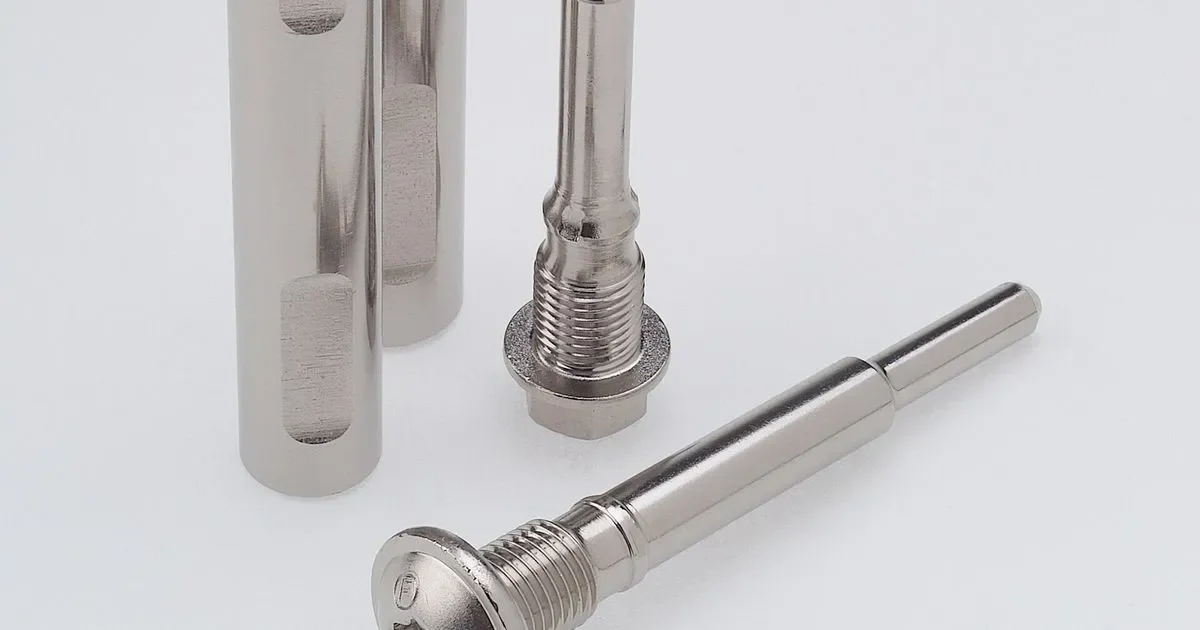
Electroless nickel is the finish on a large share of precision tooling. It gives a hard, even coating on a part, including inside holes and blind corners where an electroplated layer would thin out. It also changes dimensions, hardness and magnetism, which is why it needs more than the line “plate with nickel” on a drawing.
This guide covers the choices that matter, how thickness interacts with tolerance and what to ask a plating partner when the work is done in Vietnam.
What electroless nickel is
Electroless nickel is a nickel and phosphorus alloy deposited by a chemical reaction in a heated bath, with no electric current. Because there is no current, there is no current density to vary across the part. The layer grows at the same rate on every wetted surface, edges and bores included. That is the reason tooling buyers choose it over electroplated nickel or chrome.
The coating is an alloy, not pure nickel, and the phosphorus content sets most of its behavior.
The three phosphorus classes
| Class | Phosphorus | As plated hardness | Typical strengths |
|---|---|---|---|
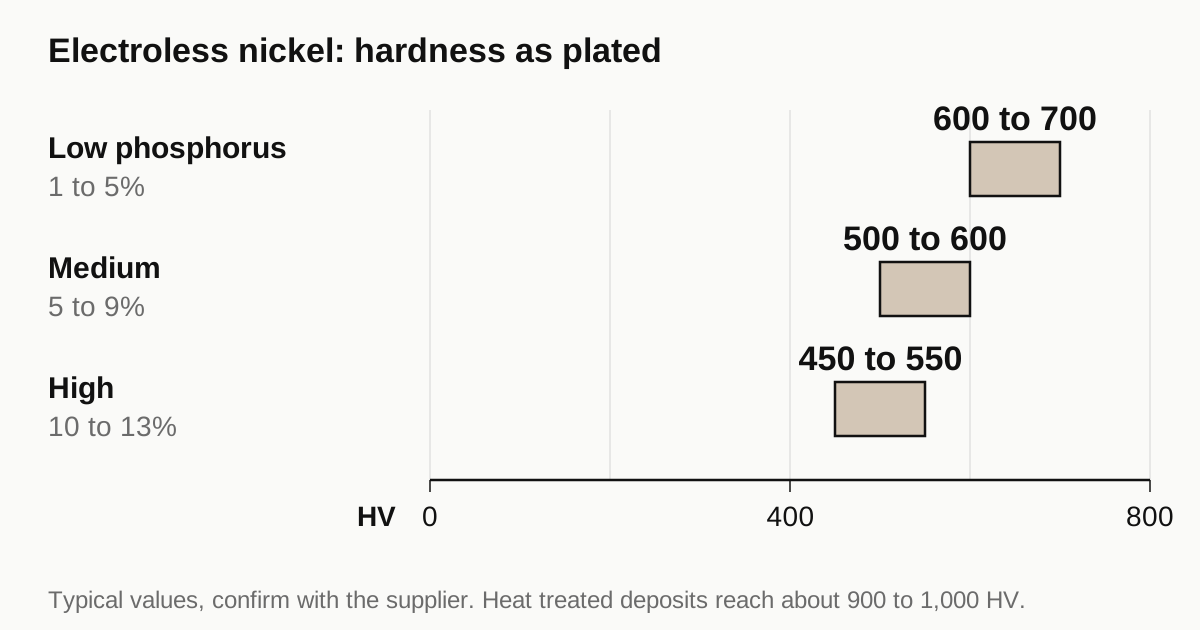
| Low | 1 to 5 percent | about 600 to 700 HV | Hardest as plated, good wear, lower corrosion resistance |
| Medium | 5 to 9 percent | about 500 to 600 HV | Balanced, the usual choice for general tooling |
| High | 10 to 13 percent | about 450 to 550 HV | Best corrosion resistance, non magnetic |
Figures are typical ranges and vary by bath and supplier. After a heat treatment at roughly 400 °C for an hour, hardness rises into the 900 to 1,000 HV range as nickel phosphide precipitates, at the cost of some corrosion resistance and a change in dimensions. Whether to heat treat is a design decision, not a default.
For most semiconductor fixtures and jigs, medium phosphorus gives the right balance. High phosphorus suits parts that must be non magnetic or live in a corrosive area. Low phosphorus is chosen when wear matters more than corrosion.
Thickness and what it does to dimensions
Plating thickness is stated per surface. A hole loses twice the thickness from its diameter, and a shaft gains twice the thickness. A 12 µm layer takes 24 µm off a bore.
| Thickness per surface | What it does | Typical use |
|---|---|---|
| 5 µm | Light protection, may be porous | Decorative or very tight fits, not for corrosion |
| 10 to 15 µm | General corrosion and wear | Most jig plates, brackets, covers |
| 20 to 25 µm | Heavy wear, better barrier | Sliding faces, tools in wet or abrasive areas |
| 50 µm and above | Build up for rework | Dimensional restoration of worn parts, requires grinding |
A rule that works for tight parts: if a feature has a tolerance smaller than twice the plating tolerance, plating changes it enough to matter. A bore toleranced at 0.01 mm that is plated with 10 to 15 µm per side moves by 0.020 to 0.030 mm. Either machine the bore oversize to a calculated pre plating size, mask it or plan a post plating operation. State which on the drawing.
See jig grinding for locating holes for how coated holes are handled in practice.
Masking
Masking keeps plating off selected surfaces: dowel holes, threaded holes, mating faces, electrical contact areas. The plating shop uses lacquer, tape or plugs. Masking is manual and has its own tolerance. A masked edge is rarely a clean line: expect a transition zone of a millimetre or so.
On the drawing, identify masked features by a clear note and a view, not a vague “do not plate threads”. If a mating face has to be plated and a neighbouring one does not, show the boundary. Keep masked features away from unmasked sharp edges where the lacquer can lift.
Adhesion, pretreatment and base metal
Plating bonds only to a clean, active surface. The pretreatment depends on the base:
- Carbon and alloy steels: alkaline clean, acid activation, direct plating. Hardened parts need a bake after plating (see below).
- Stainless steel: requires a strike or special activation, since the passive layer blocks adhesion. Mention the grade.
- Aluminum: zincate pretreatment, often double zincate. Cast and high silicon alloys need extra care.
- Copper and brass: straightforward, but brass with lead may contaminate baths. Some shops reject it.
If the base metal is not stated, the plating shop assumes carbon steel. That has produced more rework than any other assumption. Put the alloy on the drawing next to the plating note.
Hydrogen embrittlement and baking
Plating lines generate hydrogen at the surface. In high strength steels it can diffuse in and cause delayed brittle cracking. The usual rule of thumb treats parts above about 40 HRC as at risk. The protection is a bake at roughly 190 to 220 °C for several hours, started within a few hours of plating. Tool steel plates, hardened pins and springs fall in this class.
Specify the bake on the drawing, name the standard and ask the shop to record it. A drawing that says “plate per ASTM B733” and nothing else leaves room to skip the bake. For aerospace work AMS 2404 is the other common reference. Both describe classes by phosphorus content and thickness, and both should be cited on a drawing instead of paraphrased.
Need a quote for this part? Get a quote
Corrosion testing
Salt spray (ASTM B117) is the usual acceptance test, with a stated number of hours without red rust on the base. The number depends on thickness, phosphorus and base metal. A 25 µm high phosphorus layer on clean steel can pass hundreds of hours. A 5 µm layer on a porous cast base will not. Ask for the test result only if corrosion is the reason for plating, since each test run costs and takes days.
Plating in Vietnam: what to check
Plating is one of the narrow points in the Vietnamese supply chain. Capacity that holds a tool or semiconductor spec is concentrated in a few providers, and many machine shops send parts out. Where the weeks go on a machined part explains how that shapes lead time. Questions that separate a prepared plating partner from a general one:
- Which phosphorus class does the line run, and how is it verified?
- How is thickness measured: X-ray fluorescence or a cross section?
- Is a bake oven available, and is the bake logged?
- Are baths replaced on a schedule, and how is the nickel replenished?
- Is there a masking capability and a rack design for long thin parts?
- What is the process for non conforming parts: strip and replate, or reject?
Strip and replate on a ground bore can change its size, so the shop needs to say in advance what it does with a failed part.
Environmental and customer rules
Semiconductor plants often restrict materials. Electroless nickel is commonly accepted, but customer specifications may require RoHS compliance statements, a record of the bath chemistry and a restriction on lead containing stabilizers. Check the rule before the order. The plating partner can state compliance, but a certificate of compliance is a document, not a promise: ask for it.
Edges, threads and sharp features
Electroless nickel deposits evenly, but it does not hide poor machining. A burr under the plating becomes a sharper, harder burr after plating, and a sharp external edge can chip because the coating is brittle at a thin corner. Break edges with a small radius or chamfer before plating, 0.2 to 0.5 mm being typical, and say so on the drawing.
Threads need a decision of their own. A coating of 10 µm per side adds about 20 µm to the pitch diameter of an external thread and takes the same away from an internal thread, which is enough to stop a fine thread assembling. Either mask the thread, cut it to a plated size or choose a looser class before plating. Name the choice. The same logic applies to press fits and slip fits generally: the fit has to be defined as it will be assembled, not as it leaves the machine.
Reworking and stripping
Plated tooling gets damaged in use. A worn or scratched part can be stripped and replated, but stripping chemicals attack some base metals and the strip step can change dimensions. Parts that are expected to be refurbished should be designed with extra stock, enough to survive one strip and replate cycle with a small pre plating size allowance. Ask the plating partner whether it strips in house and what base metals it will not strip. If a part is a spare that returns every few years, the refurbishment route is part of its life plan.
The plating statement a customer may ask for is covered in RoHS, REACH and halogen-free declarations for jig materials.
Checklist before you send the RFQ
- Base metal and hardness
- Plating standard, such as ASTM B733 or AMS 2404, with class and type
- Phosphorus class: low, medium or high
- Minimum and maximum thickness per surface
- Bake requirement and conditions
- Masked features, shown on a view
- Whether tight dimensions apply before or after plating
- Acceptance test, if any: thickness method, salt spray hours
- Any customer restricted substance rules
Send the drawing with the RFQ. We place it with a partner shop and send one itemised quote within 24 business hours. For a stainless or nickel alloy part where plating may not be needed, stainless and nickel alloys covers the alternatives.
Frequently asked questions
How thick should electroless nickel be on a jig plate?
For wear and corrosion protection on tooling, 10 to 25 µm is a common range. Thinner layers, 5 µm or less, are often porous. Thicker ones cost more and can crack on sharp edges. The drawing should state a minimum and a maximum, because the plating shop controls a range, not a single number.
Does electroless nickel need a bake after plating?
Hardened steel, above roughly 40 HRC, can suffer hydrogen embrittlement from the plating line, so a bake soon after plating is the normal protection. A bake at about 200 °C also improves adhesion on many steels. The drawing should say whether a bake is required and cite the plating standard.
Can aluminum be plated with electroless nickel?
Yes, with a zincate or similar pretreatment so the nickel bonds to the oxide layer. It is a common finish on aluminum tooling that needs hardness, wear resistance or solderability. Say on the drawing if the base is a specific alloy, because cast and some high silicon grades need a different pretreatment.
Need a quote for this part?
Send the drawing. We quote the finished parts, place the work with a partner shop in Vietnam and reply within 24 business hours.
Get a quoteMore on process
- JEDEC Matrix Trays and Custom Carrier Trays: When Machined Replaces Molded
- Designing a Package Nest: Pocket Size, Clearance, Lead-In and Datum
- Planning Production When Urgent Spares and New Jigs Share the Machines
- Semiconductor Jigs and Fixtures: Which Part Family, What to Specify, What Fails and Who Makes It
All guides and the sourcing glossary.