Guides / Choosing a Supplier
Getting Into a Tool OEM Supply Chain From Vietnam
November 17, 2026
A tool maker does not run an open application for new machine shops, and you will not find a form that starts qualification. What the large equipment makers publish is the set of conditions a supplier must meet once a purchase is in view: a code of conduct, screening, self-assessments, audits and scorecards. For a Vietnamese shop the practical route is to prepare that file first, then reach the tool maker through the sourcing team or through a company that already supplies it. This guide sets out what Lam Research and Tokyo Electron say in public, what they do not say, and three routes we think are realistic, labelled as our reading where no source exists. None of it promises an order.
What two tool makers publish
We read the supplier pages of Lam Research and Tokyo Electron. The pages we tried for other large equipment makers either hold no onboarding steps or could not be read by us, so we do not generalize from two companies to the whole industry.
| Stage | Lam Research (responsible supply chain page) | Tokyo Electron (supply chain management page) |
|---|---|---|
| Before business starts | A newly contracted supplier agrees to the Global Supplier Code of Conduct. Direct suppliers sign a Supplier Sustainability Pledge and go through screening for human rights and business ethics risk, plus trade, sanctions and list-based screening | A new supplier completes a Supplier Total Quality Assessment, a self-assessment covering product quality, cost and information security, plus human rights, ethics, safety and the environment |
| Standards named | The UN Guiding Principles, UN Global Compact, ILO principles and the RBA Code of Conduct | The RBA Code of Conduct. Suppliers sign an agreement confirming they comply |
| Direct materials extras | A written certification on human trafficking and slavery risk from new direct materials suppliers | Management systems for safety, health, environment, quality and labor, with ISO 14001 pursued |
| Larger suppliers | The top 100 direct suppliers by spend, about 88% of direct spend, respond to a conflict minerals template (CMRT), environmental surveys and self-assessment questionnaires, and provide RBA audit reports and corrective actions on request | An annual sustainability assessment rates suppliers low, medium or high risk and requests corrective action |
| Quality oversight | Quality management system audits, scorecards, action plans and closure audits | On-site visits if the assessment finds quality risk, and on-site audits about every three years for important components and suppliers with quality issues |
| Other conditions | Code delivered through its supplier portal and written into the contract | Quality built in at design and change control, continuity plans, information security, market-competitive prices, disclosure of financial and company information |
Three things stand out for a machine shop.
The first filter is conduct and risk, not machining. Both companies tie the start of business to the RBA Code. The earlier guide on what an OSAT expects from a new local jig supplier walks through the same RBA and minerals layer, so a shop that prepared for a packaging plant has done most of this work already.
Cost and company health are named. Tokyo Electron says suppliers should offer market-competitive prices, keep business management sound and disclose necessary financial and company information. Expect questions about ownership, finances and capacity, and prepare answers you can write down.
Business continuity is on the list. Suppliers are asked for continuity plans for disasters and unforeseen events. A shop that closes for Tet should show how it plans around it, see Tet and lead times in Vietnam.
One equipment maker’s quality guideline
A document that shows what happens after the paperwork is the quality assurance guideline TE_0030, revision 03, from Semsysco, an equipment maker for the semiconductor industry. It is hosted on Lam Research’s website, and we do not state how the two companies are related. It is one company’s rules, so read it as an example of the genre, not as the industry standard.
| Clause | What it says |
|---|---|
| Management systems | An ISO 9001 quality system is aimed for. ISO 14001, ISO 50001 and ISO 45001 should be established in the long term. A certificate that will expire without recertification must be reported at least three months ahead, and a withdrawal reported without being asked |
| Evaluation | Suppliers are evaluated at least once a year on on-time delivery, quantity accuracy, complaints, PPM, pricing, customer service, quality system status and audit results. Class A is preferred, class C is blocked for new orders |
| Complaints | Immediate measures reported within one working day, a preliminary report within two working days and an updated 8D report within ten working days. Corrective actions that are only training or instruction are not accepted |
| Inspection | The supplier draws up an inspection plan. Reports for “check dimensions” list the part, quantity, equipment used, tolerance, measured values and date, and travel with the delivery |
| Measuring equipment | Must be verifiably calibrated against national or international standards, with documents sent on request |
| Records and changes | Process and quality records kept at least ten years. Product or process changes need approval, and a deviation needs a written special release before delivery |
| Continuity | A contingency plan for failed equipment, supply interruption, natural disasters, fire, labor shortage and transport disruption |
| Subcontractors | The requirements flow down to the supplier’s own subcontractors, with a list on request |
For a shop this reads as a checklist of habits more than a list of certificates. The complaint clock and the ten-year record rule are the two that surprise shops used to a looser regime, and both should be priced into the quote.
What none of them publish
No public page we read gives a part-level specification, a minimum shop size, a price benchmark, an approval timeline or a list of required certificates for machined parts. Treat any claim that “tool makers require X” without a source as unverified, and ask each buyer for its own supplier quality document.
Vietnam’s position
The figures on local supply are secondary and rough, so read them as direction only. A Vietnam Briefing report dated 30 April 2026 puts the localization rate in electronics at 5 to 10 percent and describes supporting industries as underdeveloped and dependent on imported inputs. It also gives a government target of 10 to 15 percent value added in electronics and semiconductors by 2030. A B&Company article dated 23 June 2026 reports a localization rate of 15 to 20 percent in mechanical engineering and refers to ultra-precision parts for chip packaging equipment, tied to Amkor Technology’s US$1.6 billion advanced packaging plant and Hana Micron’s planned US$930 million expansion. Neither names a tool maker buying machined parts from a Vietnamese shop, and we found no other source that does.
The reading is that nearby demand is mostly packaging and test, where jigs, tooling and change kits are the natural products. The wider picture is in Vietnam’s semiconductor buildout in 2026.
Need a quote for this part? Get a quote
Three routes in, our reading
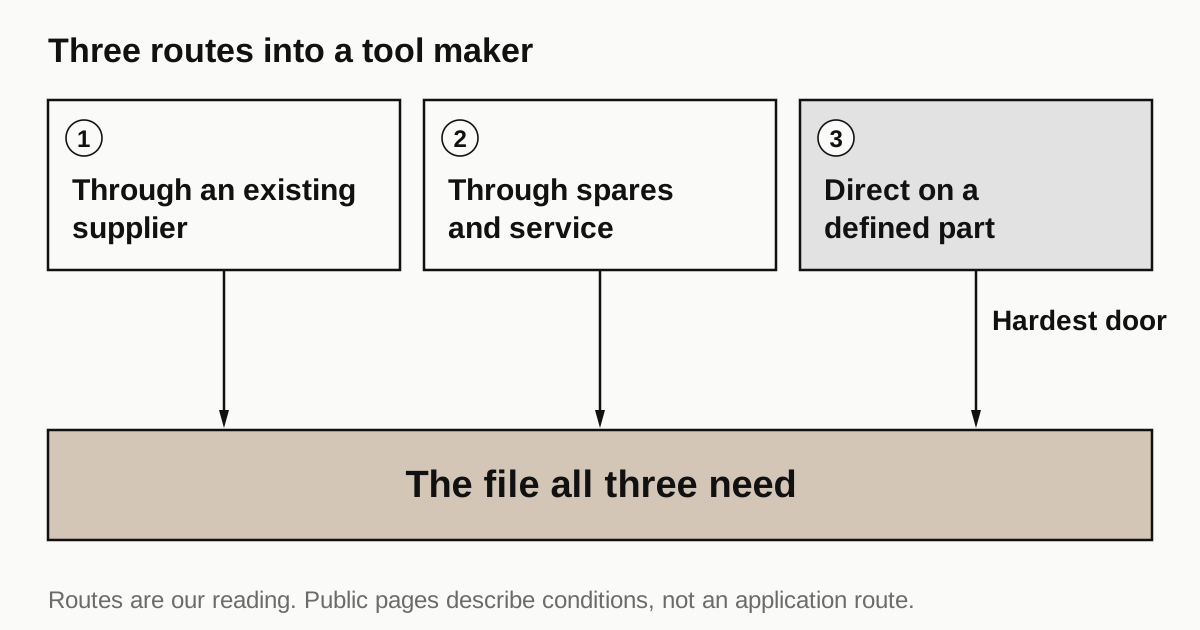
None of the sources above describes how a new shop reaches an equipment maker. The routes below are our own reading of how industrial supply usually works, and each is a hypothesis for you to test with a buyer.
| Route | How it works | What it asks of the shop | Typical first part |
|---|---|---|---|
| Through an existing supplier | A company that already supplies the tool maker subcontracts a build-to-print part or process to you | The prime’s audit and its customer’s flow-down requirements, plus first article and traceability | A bracket, plate or fixture inside an assembly the prime delivers |
| Through spares and service | The tool maker’s service or spares side buys wear and replacement parts, often in small lots | A quote process that handles one-off and repeat parts, clean packing, revision control | A wear part or change kit, see spares and consumable planning |
| Direct on a defined part | A sourcing engineer opens one non-critical part to a second source | The full dossier, since there is no prime to lean on | A part on an existing drawing where a second source is wanted |
For a shop with no history in the sector, the first two routes ask for less up front, because someone else carries part of the qualification. The third is the hardest door but the most direct. A shop can run all three at once, and should expect each to take longer than it hopes.
Build the file before you knock
The conduct and system layer is the same for most equipment and packaging buyers, so it is worth doing once.
- Conduct file. A short written policy and an owner for each area of the RBA Code: labor, health and safety, environment, ethics and management systems. Add a minerals declaration from each metal supplier so a CMRT can be answered, see the OSAT guide.
- Quality system evidence. A process flow, control plan and a revision procedure. The earlier guides on supplier audit questions and getting onto an approved vendor list give the script an auditor tends to follow.
- Measurement evidence. A measurement room that holds its conditions, calibration certificates and a first article report on one representative part.
- Information security. Tokyo Electron asks for systems that prevent leaks of confidential information and cyberattacks. Write down who can open drawings, how they are stored and how they are sent, and sign an NDA before any file moves.
- Company file. Ownership, years in operation, equipment list, headcount range and the finances you are willing to share. Do not inflate any item, because an audit checks them.
- Cost file. A price breakdown you can defend line by line, as in reading a machining quote from the buyer’s side.
What a realistic first order looks like
We cannot point to a published example, so this is an expectation, not a record. A new supplier is usually given a small, well-defined part, a first article and a pilot lot, and is rated on delivery and quality from the first order. Tokyo Electron and Lam both mention scorecards or ratings, so the first lot is the audition. Plan capacity for it accordingly, and do not stretch a quote to win a lot you cannot deliver.
Supplier-side detail is in what it takes to qualify for semiconductor work, and the supplier page explains how partner shops receive work. Partner shops do not deal with the buyer, and nothing on this site promises an order. Buyers describing a part to shops can use the RFQ form.
Sources
- Lam Research, Responsible supply chain (requirements for newly contracted suppliers, top 100 direct suppliers, audits and scorecards, supplier portal)
- Tokyo Electron, Supply chain management (Supplier Total Quality Assessment, RBA agreement, on-site audits every three years, procurement policy supplement)
- Semsysco, Quality Assurance Guidelines TE_0030 revision 03, hosted on Lam Research’s site (management systems, supplier evaluation, 8D timing, inspection reports, record retention)
- Responsible Business Alliance, RBA Code of Conduct (Version 8.0, effective 1 January 2024)
- Vietnam Briefing, Vietnam’s electronics industry 2026 (30 April 2026; localization rate of 5 to 10 percent in electronics, 2030 value added target; secondary report, directional)
- B&Company, As Vietnam’s supporting industries grow, demand rises for precision manufacturing know-how (23 June 2026; localization in mechanical engineering, packaging equipment parts; secondary report, directional)
Frequently asked questions
Can a Vietnamese machine shop apply directly to a tool maker?
We found no open application page at the tool makers we checked. Lam Research and Tokyo Electron publish what they expect of suppliers once a contract is in view: a conduct code, screening, self-assessments, audits and scorecards. Contact the sourcing team, or reach the tool maker through a company that already supplies it.
Do tool makers require ISO 9001 from a new supplier?
We found no tool maker that publishes a certificate list for machined-part suppliers. One equipment maker's published quality guideline says an ISO 9001 system is aimed for and ISO 14001 and ISO 45001 should follow in the long term. Tokyo Electron asks suppliers to pursue ISO 14001. Ask each buyer which certificates apply to your part.
How long does it take to become an approved supplier?
No public figure exists. Tokyo Electron says it audits suppliers of important components on site about once every three years after the relationship starts, but that is not an approval timeline. Plan the sequence: paperwork, assessment, first article and a small order. Do not plan around a date.
Are there tool makers or parts buyers in Vietnam?
Vietnam's electronics supply base is mostly assembly, and press reports put local content in electronics at 5 to 10 percent. We found no source that ties a named tool maker to a Vietnamese machining supplier. Packaging plants such as Amkor's are the nearer customers for jigs and tooling.
Need a quote for this part?
Send the drawing. We quote the finished parts, place the work with a partner shop in Vietnam and reply within 24 business hours.
Get a quoteMore on choosing a supplier
- How to Check a Vietnam Shop's Real Capacity and Backlog
- Weekly Progress Reports From a Vietnam Jig Shop: What a Useful One Contains
- Reading the Job Board in a Vietnam Jig Shop: Visual Management Signs a Buyer Can Check
- Moving an Existing Jig Program to a Vietnam Machine Shop
All guides and the sourcing glossary.