Guides / Cost
Tet and Machined Part Lead Times in Vietnam: Plan From the Calendar
October 29, 2026

A Tet closure takes at least seven calendar days out of the 2027 schedule, and an order that crosses it usually loses more than that, because work queues up before the break and restarts unevenly after it. No public survey measures the extra time. Plan from dates instead: work backward from the closure, forward from the restart and get both in writing from the shop.
This guide uses the 2027 calendar, which the government fixed on 2 October 2026, and the 2026 restart reports to show where the time goes. It applies to every Vietnamese machine shop, whatever the part.
What the 2027 Tet calendar looks like
Article 112 of the Labour Code gives employees five fully paid days for the Lunar New Year and leaves the exact days to the Prime Minister each year. For 2027 the government approved a seven day break from 4 to 10 February for civil servants and public employees. Tet itself falls on Saturday 6 February and public employees return on Thursday 11 February. The seven days are the five statutory days plus two compensatory days.
Private employers, which means almost every machine shop, set their own schedule as long as workers get at least the legal minimum. According to VnExpress, they may choose between 5 to 11 February, 4 to 10 February or 3 to 9 February.
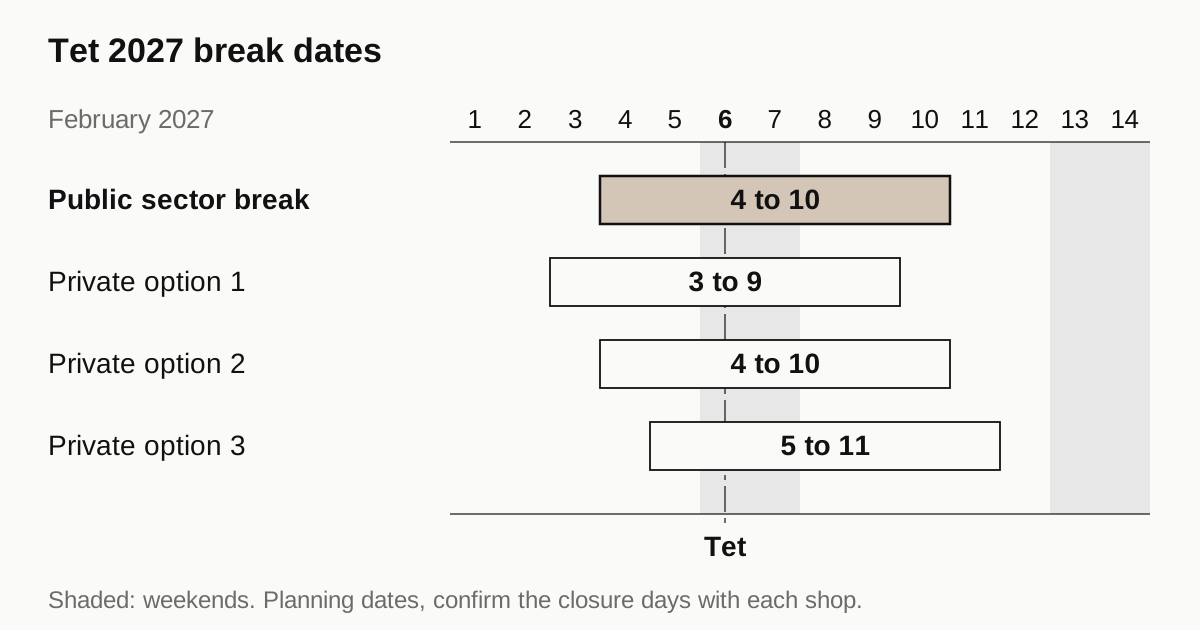
| Date in 2027 | What happens |
|---|---|
| Wednesday 3 February | Earliest closure start among the three private employer patterns |
| Thursday 4 February | Public sector break starts |
| Saturday 6 February | Tet, Lunar New Year’s Day |
| Wednesday 10 February | Last day of the public sector break |
| Thursday 11 February | Public employees back at work |
| Friday 12 February | First working day for a shop on the 5 to 11 February pattern |
A shop can also add leave on top of the legal days, so these are the earliest return dates, not the likely ones. Ask each shop which pattern it chose.
Where an order that crosses Tet loses time
Lead time on a machined part is a chain of short operations with waiting between them, covered stage by stage in where the weeks go on a machined part. A closure hits every link at once.
| Stage | What Tet does to it | What to ask |
|---|---|---|
| Material | A supplier closed for the same days cannot deliver, so bar or plate not already in the shop waits for the restart | Is the material in stock here today |
| Machine queue | Every buyer who wants parts before the break releases in the same weeks, and the backlog meets the restart | What is the last release date for the shop to finish before the closure |
| Outside finishing | Anodize, plating and heat treatment happen at another company with its own closure and its own batch queue | When does the finisher close and when is its first batch after the break |
| Inspection and documents | The person who signs the report has to be back | Who inspects the first week and is that person on the roster |
| Export and freight | Forwarders, couriers and customs offices run reduced schedules | Last collection date and first collection date |
One forwarder’s planning guide, a commercial source and directional only, puts rush order cutoffs three to four weeks before the Lunar New Year and says many facilities stop taking new orders six to eight weeks before it. That guide covers Asia broadly, not Vietnamese shops specifically, so treat it as a reason to ask early rather than as a rule.
Restart is not a switch
The 2026 reports show how a normal restart looks. The Ho Chi Minh City export processing and industrial zones authority reported on 24 February 2026 that about 95 to 96 percent of enterprises had restarted, that the rest were expected to follow after 25 February and that 98 percent of workers had returned. The Vietnam News Agency reported 95.99 percent attendance on the first working day in Hanoi high-tech parks and industrial zones, and about 95 percent in Dong Nai, with individual companies near 90 percent.
Those are state agency figures, which tend toward the upbeat, and they are averages across all industries. What matters for your part is narrower: whether the machinist, the programmer and the CMM operator who run your job are back, and whether the finisher is running. A shop at 95 percent headcount can still wait a week for one person.
Catching up by overtime is limited by law. The Labour Code pays work on public holidays at least 300 percent of the normal rate and caps overtime at 200 hours a year in general, with up to 300 hours allowed in listed fields. A shop that is behind after Tet cannot simply run extra shifts for weeks.
A backward calendar, with an assumed quote
The arithmetic is simple and still gets skipped. Suppose a shop quotes three working weeks from release for a plate with an outside finish, and says it closes on 3 February. Three working weeks back from that date is 13 January, so the purchase order, the frozen drawing and the finisher booking have to exist by then, and the material has to be in the building. If the same order is released on 20 January instead, the arithmetic puts the finished part after the break, and the honest schedule is the first week of production after the shop reopens plus the remaining weeks of the quote.
The numbers here are an assumption for illustration, not a benchmark. The method is what carries over: take the shop’s own quoted working weeks, subtract them from the closure date, then check that the material, the finisher and the inspection slot all fit inside that window. If any one of them does not, the part crosses Tet and should be planned as a post-Tet order from the start.
Need a quote for this part? Get a quote
Five ways to plan around Tet
- Fix two dates, not one. Put the shop’s last release date before the break and its first production day after it into the purchase order. A quote that says “four weeks” and ignores the closure is a guess.
- Release the long items first. Material and outside finishing slots are the first things to book, as in the four levers in the lead time guide.
- Freeze the drawing before release. A revision in the final weeks restarts setup in the busiest queue of the year. Agree the revision in writing, using the habits in the RFQ package checklist.
- Order the spare with the original. The second piece skips programming and first article, and it keeps a line running if the first batch slips past the break. See spares and consumable planning.
- Schedule a post-Tet start for parts that cannot finish in time. An agreed start date in the first week after the break is better than a rushed release in the last one. As a planning assumption, not a fact, count the first full production week as the week after the shop’s return date, not the return day itself.
Questions that make the shop’s Tet plan real
- Which closure pattern did the shop choose for 2027, and does it add leave
- What is the last day for material receipt, for machining release and for outside finishing
- Which finishers and carriers close, and for how long
- What is the first production day after the break, and who is on the roster that week
- Does the quoted price hold across the break, or does a repeat order reprice (see price changes between orders)
- Are the quoted weeks working days or calendar days
A shop that answers in dates has a schedule. A shop that answers “we will do our best before Tet” has a hope. If you have a part that has to land before or just after the break, send the RFQ with the needed-by date and say so, and we will come back within 24 business hours with shops that can commit to dates, or a plain no.
Sources
- VietnamPlus, holiday schedules approved, 2 October 2026
- VnExpress International, Vietnam picks 7-day Tet break for 2027, 3 October 2026
- Labor Code No. 45/2019/QH14, English translation (Articles 98, 107, 111, 112)
- SGGP, industrial firms across Ho Chi Minh City resume post-Tet operations, 24 February 2026
- VietnamPlus, post-Tet workforce returns in force, 24 February 2026
- SEKO Logistics, Lunar New Year 2027 planning guide for Asia sourcing (commercial, directional)
Frequently asked questions
How many days off is Tet in Vietnam in 2027?
The Labour Code sets five paid days for the Lunar New Year, and the Prime Minister fixes the dates each year. For 2027 the government approved February 4 to 10 for public employees, seven days with two compensatory days. Private employers choose their own pattern, so a shop may close from February 3 and reopen as late as February 12.
How long does it take Vietnamese factories to restart after Tet?
In 2026 the Ho Chi Minh City export zone authority reported about 95 to 96 percent of enterprises restarted by February 24, with the rest after February 25. Restart is quick on paper and uneven in practice. Plan the first full production week after the break rather than the first day back.
How much longer does an order take if it crosses Tet?
No public survey measures it. The closure removes at least seven calendar days, and the queue before it and the restart after it add more. The reliable method is to ask the shop for its last release date, its first production day after the break and the same two dates for its outside finisher.
Should I place orders before Tet or wait until after?
Release before Tet only if the whole chain can finish before the closure: material, machining, outside finishing and export documents. A part that cannot finish in time is better released with an agreed start date in the first week after the break than squeezed into the last week before it.
Need a quote for this part?
Send the drawing. We quote the finished parts, place the work with a partner shop in Vietnam and reply within 24 business hours.
Get a quoteMore on cost
- Sample Orders and Minimum Quantities for Semiconductor Jigs From Vietnam
- Writing a Machining Quote in English, Line by Line
- Landed Cost of Machined Parts From Vietnam: The Items Missing From the Quote
- Payment Milestones for Custom Jigs: Tie Each Release to a Document You Can Check
All guides and the sourcing glossary.