Guides / Cost
Sample Orders and Minimum Quantities for Semiconductor Jigs From Vietnam
November 21, 2026
A quantity of one is a normal request for a jig. We found no published survey of minimum order quantities at jig shops in Vietnam, and no OSAT or equipment maker that publishes a rule, so this guide explains how the cost works instead of promising what any shop will do. Jigs are bought by the piece: one per tool, one set per handler. That is our reading of how they are ordered, and it is why a minimum quantity is rarely the obstacle. The real question is what a one-piece order has to carry, and how to ask for a price that shows it.
What a minimum quantity really is on a jig order
On a catalog part a minimum is a stock rule. On a custom jig it is mostly a recovery rule: the shop spends the same effort to prepare one piece as to prepare ten, and it wants that effort paid for. The lines that do not change with quantity are programming, fixturing, machine setup, first article inspection, the finishing batch and packing. Fictiv’s explanation of cost by quantity puts it plainly: fixed costs do not shrink when you order more, they divide, so at a quantity of 1 one part carries all of the setup and at 50 each part carries one fiftieth.
That is why a shop that says “no minimum” and a shop that says “minimum 5” can be describing the same job. The first prices the one piece so that it carries the setup. The second would rather spread the setup over five. Compare them on the price per piece at the same quantity, not on the word “minimum”.
How price per piece falls with quantity
Fictiv publishes an illustrative model, not a quote: a 300 USD fixed setup and 20 USD of variable cost per part. The article says the figures are illustrative only and that actual costs vary by part, process, material, tolerances and supplier. Use it to see the shape of the curve, not the numbers.
| Quantity | Total cost | Cost per part | Saving against quantity 1 |
|---|---|---|---|
| 1 | 320 USD | 320 USD | none |
| 5 | 400 USD | 80 USD | 75 percent |
| 10 | 500 USD | 50 USD | 84 percent |
| 25 | 800 USD | 32 USD | 90 percent |
| 50 | 1,300 USD | 26 USD | 92 percent |
| 100 | 2,300 USD | 23 USD | 93 percent |
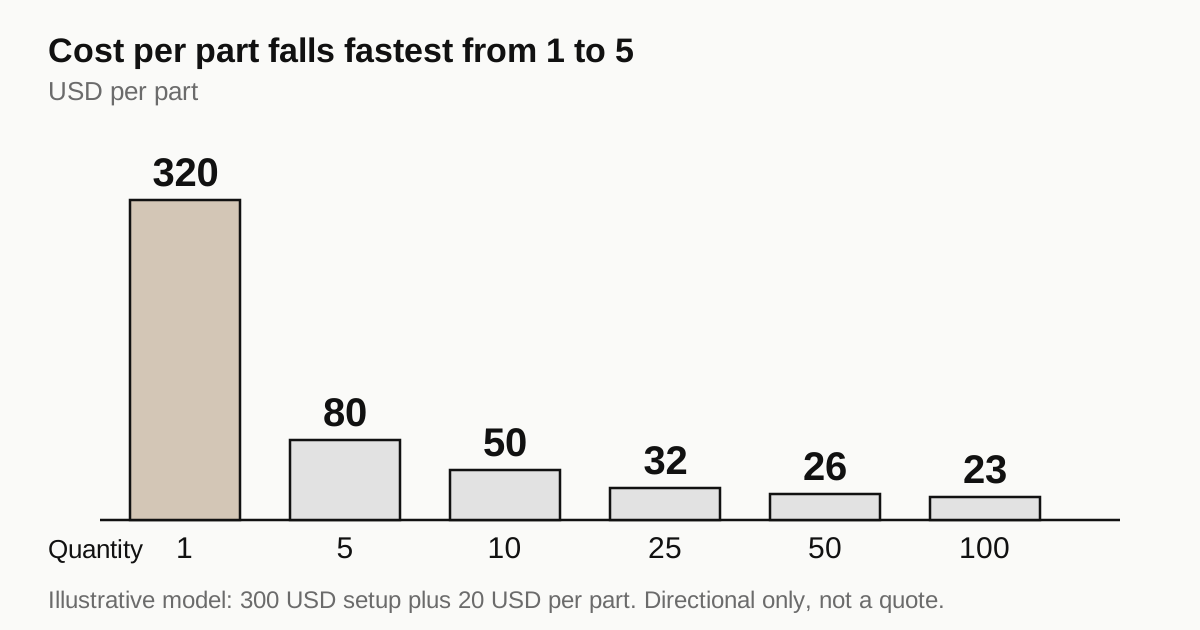
The same article notes that going from 25 to 100 parts saves only about 3 percent more per unit. For jigs the lesson is practical. The big step is from one piece to a handful, so the sensible questions are “what does the second piece cost?” and “what does a set of five cost?”, not “what is the cheapest volume?”. Our own test jig cost guide shows why a spare ordered with the original is usually cheaper than one ordered six months later.
Where a real minimum can hide
A shop may quote a quantity of one and still have a minimum somewhere in the chain. Ask about each of these lines, because a quote that hides them tends to change after the order.
- Finishing lot. Anodizing, plating and heat treatment are run in batches. A shop may hold your piece until a batch fills or charge you for a share of one. We found no public data on batch sizes at Vietnam finishers, so ask. The effect on schedule is covered in where the weeks go on a machined part and in anodizing in Vietnam.
- Material. Plate and bar come in stock sizes. A single jig plate may use part of a larger plate. Ask who keeps the offcut, and whether it is priced into your piece or credited. This is our reading of how shops buy material, not a published rule.
- Outside operations. Jig grinding, wire EDM or heat treatment done outside the shop may carry their own minimum charge per job.
- Revisions. A drawing revision after programming means a new program and, often, a new first article. Freeze the drawing before the order, see drawing revision control with a supplier.
- Packing and freight. A one-piece international parcel costs more per piece than a carton. Ask what packing level the quote assumes, see packing and shipping machined parts to a fab.
Three ways to structure a first order
| Structure | When it fits | What to settle in writing |
|---|---|---|
| One sample piece | You want to judge fit, finish and the shop’s paperwork before a program | Price of the piece, drawing revision, who pays freight, what documents come with it |
| Sample plus price breaks | You expect repeat or spare orders | Prices at 1, 5 and 20 pieces from the same quote, and how long they stay valid |
| Small set with spares | The jig will be used on several tools or wears out | Quantity, whether the pieces are made together, one first article report or one per piece |
Whatever the structure, ask for the same quote lines in every case so you can compare shops, as described in reading a machining quote properly. If the first order is a payment question as much as a quantity question, payment milestones for custom jigs covers how to tie each payment to a document.
Need a quote for this part? Get a quote
Ask for three quantities, not one
Quote platforms show the same pattern in public. Protolabs lists its production CNC range as 1 to 1,000,000 parts with no minimum, and says volume pricing lowers the price per part as quantity grows. Read that as evidence that one-piece orders are normal in machining. It is not a Vietnam shop quote, and a digital platform has a different cost structure from a small jig shop, but the way it prices is the way you should ask.
Send the shop one drawing and ask for three prices on it: 1 piece, 5 pieces and 20 pieces. The gap between them tells you how much of the price is setup. A shop whose price barely moves between 1 and 20 is either very lean on setup or is pricing the first piece low and the rest high. Either way you have learned something you could not see from one number.
What a sample order should prove
A sample is only useful if it was made the way production will be made. Public descriptions of first article inspection say its purpose is to validate that a process produces conforming parts, and that it is run on the first part or on a sample from the first batch. If a shop makes your sample on a spare machine with its best machinist and a special fixture, the sample proves the machinist. Ask for the sample to come from the production route and ask what the route is.
Ask for a report with measured values, not ticks. One equipment maker’s published quality guideline lists what a check-dimension report must carry: part name and number, number of parts measured, the check dimension, the instrument used, the tolerance, the measured value or result, the date and the inspector’s confirmation. It also says random sample inspection is allowed only after coordination with the buyer, so do not assume a sampling plan on a first lot. The layout of a useful report is in first article inspection reports. The shop-side view of the same lot is in what a first sample must prove to a new semiconductor customer.
What to put in the RFQ
A short, specific request gets a comparable answer. Include:
- The drawing at its current revision, the material and the finish with the standard named.
- The quantities you want priced: 1, 5 and 20.
- A request for separate lines: programming and setup, machining, outside finishing, inspection and report, packing, freight.
- A question on minimums: any minimum finishing lot, any minimum material purchase and who keeps the offcut.
- Two lead times: for the sample and for a repeat of the same part.
- The documents you expect with the sample: the measured report, the material certificate and the finish certificate.
- Whether the sample price is credited against a later order. Do not assume yes or no.
The RFQ package checklist covers the rest of what a drawing package needs. A sample is also an imported good, so ask your broker how it is declared: the duty rules in US tariffs on machined parts from Vietnam key on classification and origin, not on order size.
If you want shops that will quote a one-piece jig, send the RFQ with the drawing, the three quantities and the needed-by date, and we reply within 24 business hours with a quote or a plain no.
Sources
- Fictiv, manufacturing cost per quantity (fixed setup divided over the run, illustrative table, 25 to 100 parts; a vendor article with illustrative figures, so directional)
- Protolabs, production CNC machining (quantity range 1 to 1,000,000 with no minimum; a vendor page)
- Wikipedia, First article inspection (purpose, first part or first batch sample; carries citation warnings, so directional)
- Semsysco, Quality Assurance Guidelines TE_0030 revision 03, hosted on Lam Research’s site (section 16, check-dimension report contents and random sample inspection; one equipment maker’s rules)
Frequently asked questions
Will a Vietnam shop make a single sample jig?
Often yes, because jigs are bought by the piece, one per tool or one set per handler. We found no published survey of minimums at Vietnam jig shops, so ask each shop in writing. What changes with a quantity of one is the price per piece, not whether the order is possible.
Why is one piece so much dearer per unit than five?
Programming, fixturing, setup and the first article inspection are paid once per run, whatever the quantity. At a quantity of one the single piece carries all of it. An illustrative model from Fictiv puts the per-part cost at 320 USD for one piece and 80 USD for five on the same job.
Should I pay for the sample or expect it to be credited?
No public rule sets this, so agree it in writing before the shop cuts metal. Ask the shop to show the sample as separate lines (programming, machining, finishing, inspection, packing, freight) and say whether any line is credited against a later production order.
How many pieces should a trial lot contain?
No OSAT or tool maker we found publishes a number. Size it to what you want measured and to what the process must prove, then write the count and the drawing revision on the order. A lot of one proves the part. A small lot on the production route starts to prove the process.
Need a quote for this part?
Send the drawing. We quote the finished parts, place the work with a partner shop in Vietnam and reply within 24 business hours.
Get a quoteMore on cost
- Writing a Machining Quote in English, Line by Line
- Landed Cost of Machined Parts From Vietnam: The Items Missing From the Quote
- Payment Milestones for Custom Jigs: Tie Each Release to a Document You Can Check
- US Tariffs on Machined Parts From Vietnam: The Stack in October 2026
All guides and the sourcing glossary.