Guides / Cost
Landed Cost of Machined Parts From Vietnam: The Items Missing From the Quote
November 11, 2026
The landed cost of a machined part from Vietnam is the quoted price plus everything between the shop’s gate and your dock: freight, insurance, duty, customs fees, a broker, import tax and delivery. The size of that gap depends on the Incoterm on the quote, the duty stack on your classification and how the shipment is valued for customs. In the worked example below, a 10,000 USD parts order lands at about 12,600 USD, 26 percent above the quote, using placeholder freight and broker figures you should replace with your own. No public survey gives a typical uplift for machined parts, so treat any rule of thumb you read with suspicion, ours included.
Start with the Incoterm on the quote
The ICC describes the Incoterms rules as defining the tasks, costs and risks involved in delivering goods from seller to buyer. Incoterms 2020 has 11 rules. They do not set the price, the currency or the payment terms, and they do not decide when title passes. The quote’s term tells you which of the lines below are already in the price.
| Term | Export clearance | Main carriage | Insurance | Import clearance and duty |
|---|---|---|---|---|
| EXW | Buyer | Buyer | Buyer | Buyer |
| FCA | Seller | Buyer | Buyer | Buyer |
| FOB | Seller | Buyer | Buyer | Buyer |
| CIF | Seller | Seller | Seller | Buyer |
| DAP | Seller | Seller | Risk on seller, no duty to insure | Buyer |
| DDP | Seller | Seller | Risk on seller, no duty to insure | Seller |
The table follows the Wikipedia summary of Incoterms 2020. Check the named place and the exact rule text in your contract. EXW is common practice for the buyer to clear the goods through export too, but it is not strictly an obligation. Under DDP the shop or its agent must clear the goods through customs in your country and prices the duty in, so the quote looks higher and the landed number moves less.
The cost stack, line by line
Use this as the list of lines to ask about. For the freight, broker and inland lines, no public benchmark is stable enough to quote, so get a number per shipment.
| Line | Where the number comes from | Note |
|---|---|---|
| Parts price | The quote, per quantity break | Check what the unit price includes |
| Tooling, fixtures, programming | A separate line on the quote | Can be dutiable, see the next section |
| Packing | The quote | Cleanroom or ESD packing costs more than plain cartons, see packing machined parts for a fab |
| Certificates and inspection reports | The quote | Ask whether the first article report is in the price |
| Export-side charges in Vietnam | The shop or your forwarder | Under EXW these are yours; ask for them itemised |
| International freight and insurance | A forwarder quote for the actual weight and volume | Moves with the market, so quote validity matters |
| Import duty | Your broker, from your classification | The stack changed several times in 2026, see the tariff guide |
| US merchandise processing fee | 0.3464 percent of value, minimum 34.58 USD and maximum 670.86 USD from 1 October 2026 | Set by CBP, adjusted yearly |
| US harbor maintenance tax | 0.125 percent of the value of the cargo in a port use | Ask your broker whether your mode of transport is covered |
| Customs broker and bond | A per-entry fee from the broker | No public benchmark |
| Import VAT (EU and others) | Calculated on the customs value plus duty and certain costs | See below |
| Delivery from the port | A trucking quote | Depends on weight and distance |
| Payment and bank charges | Your bank and the instruction on the payment | Covered in payment milestones for custom jigs |
The two US fees are the only lines here set by a published schedule. The CBP notice for fiscal year 2027, published on 31 July 2026, keeps the rate at 0.3464 percent and raises the limits to 34.58 USD and 670.86 USD. The harbor maintenance tax rate of 0.125 percent comes from 26 U.S.C. 4461. CBP adjusts the processing fee limits for inflation each fiscal year, so check the current notice.
Customs value is not the invoice total
Duty is a percentage of customs value, and customs value is built by rule rather than copied from the invoice. The two big markets treat freight differently.
United States. The statute starts from the price actually paid or payable and excludes the costs of international transportation, insurance and related services. It adds the buyer’s packing costs, selling commissions the buyer incurs, the value of any assist and required royalties or license fees. On a CIF invoice, the freight and insurance lines therefore come out of the value used for US duty.
European Union. The customs value includes the cost of transport and insurance and the associated loading and handling up to the point where the goods enter the Union, according to the Irish Revenue valuation manual. Import VAT then starts from the customs value and adds duties, taxes and charges due because of the import, plus incidental costs such as commission, packing, transport and insurance up to the first place of destination in the Member State, as the European Commission states. Whether you can reclaim that VAT depends on your VAT registration, so ask your accountant.
Assists: why tooling can add duty
An assist is something the buyer supplies, free or at a reduced cost, for use in making the goods. The US definition names tools, dies, molds and similar items used in the production of the imported merchandise. The EU list in the Irish manual also names materials, components, parts and design work done outside the Union. The manual adds that tools may be added even when invoiced separately and never imported.
For a buyer of jigs and fixtures, the practical question is simple. If you supply a production fixture to the shop, or pay for tooling the shop uses to make your parts, tell your broker. Whether it is dutiable in your case is a classification and valuation question. A jig you import as the product is the goods, not an assist.
Need a quote for this part? Get a quote
A worked example on a 10,000 USD order
The numbers below are arithmetic, not market data. The freight, broker and inland figures are placeholders. The 12.5 percent duty is the rate in the first worked row of our tariff guide, used here only so the sum has a duty line. It is not a classification of any part.
| Line | Amount in USD | Share of parts price |
|---|---|---|
| Parts, FOB Vietnamese port (customs value) | 10,000.00 | 100.0% |
| Ocean freight and insurance (placeholder) | 860.00 | 8.6% |
| Import duty at an assumed 12.5% of 10,000 | 1,250.00 | 12.5% |
| Merchandise processing fee, 0.3464% of 10,000 | 34.64 | 0.3% |
| Harbor maintenance tax, 0.125% of 10,000 | 12.50 | 0.1% |
| Broker and entry (placeholder) | 150.00 | 1.5% |
| Delivery from the port (placeholder) | 300.00 | 3.0% |
| Landed cost | 12,607.14 | 126.1% |
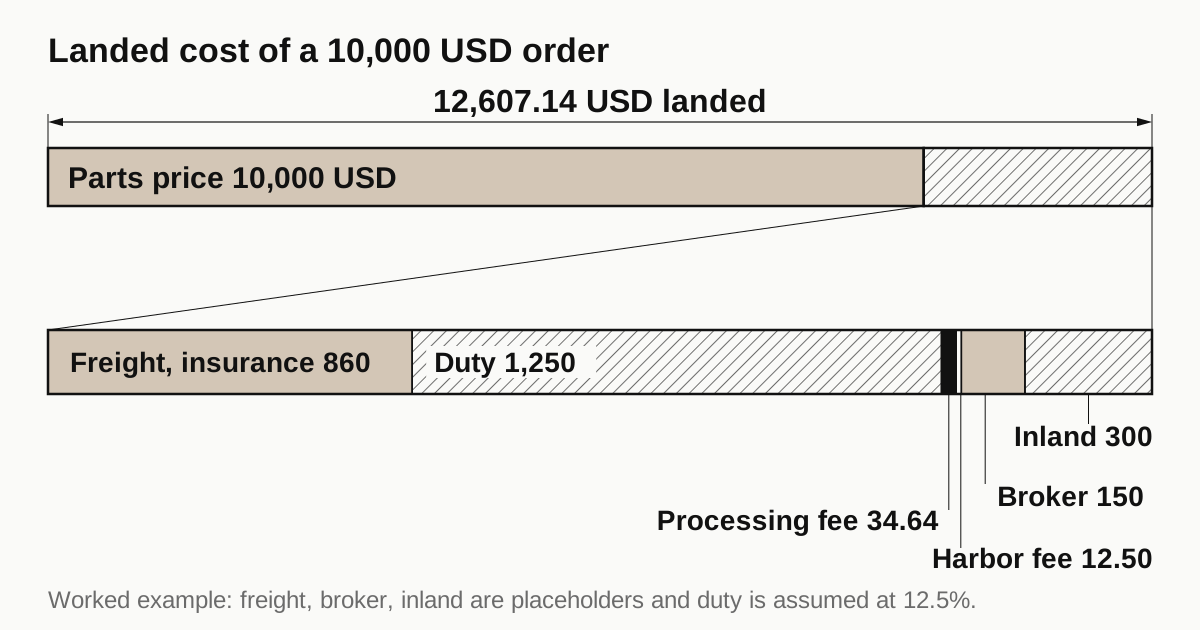
Duty is the largest add-on in this example, which is why classification matters more than the small fees. Now suppose 2,000 USD of fixtures the shop uses for the job were found to be dutiable assists. The customs value becomes 12,000 USD, duty at the same assumed rate becomes 1,500 USD, the processing fee becomes 41.57 USD and the harbor tax 15.00 USD. The extra cost is about 259 USD in duty and fees, on top of the 2,000 USD for the fixtures themselves.
Costs that sit outside the shipment
- Rate changes between order and entry. Write the assumed duty rate and entry date on the quote and decide who carries a change.
- Lead time. A delayed order that misses a shipping window costs more than the parts price difference. Tet closures are the usual cause.
- Rejected parts. Freight to ship a rework batch back, plus the second entry, is not in any quote.
- Currency. Incoterms do not set the currency. State one currency and say who carries the exchange rate.
- Buying inside Vietnam. If you are an export processing enterprise buying from a local shop, the customs mechanics differ, see buying from Vietnamese shops as an EPE.
What to ask the shop to write on the quote
- The Incoterms 2020 rule and the named place, for example FOB with the port of loading.
- Tooling, packing and certificates as their own lines.
- The customs classification the shop assumes, with the note that your broker decides.
- Gross weight and carton dimensions per shipment, so a forwarder can quote freight.
- Who is the importer of record, and who carries a duty change between order and entry.
- A validity date, since freight and duty move.
To get quotes on the same assumptions, send the RFQ with your destination, Incoterm and HTS line. Quotes are easier to compare when they all start from the same landed-cost lines, as covered in reading a machining quote line by line. Duty rates, fees and valuation rules change. As of October 2026 the figures above hold, but confirm them with a customs broker before you price an order.
Sources
- ICC, Incoterms rules (tasks, costs and risks of delivery; Incoterms 2020; eleven rules)
- Wikipedia, Incoterms (responsibilities by rule; what the rules do not cover)
- Federal Register, customs user fees adjusted for inflation in fiscal year 2027, 31 July 2026 (processing fee limits of 34.58 USD and 670.86 USD, rate 0.3464 percent)
- 26 U.S.C. 4461, harbor maintenance tax at 0.125 percent of cargo value
- 19 U.S.C. 1401a, transaction value: additions, assists and exclusion of international transport and insurance
- Irish Revenue, Customs Manual on Valuation (delivery costs to the EU border, assists including tools and moulds)
- European Commission, VAT taxable amount (importation of goods)
Frequently asked questions
What is landed cost for machined parts?
Landed cost is everything you pay to get the part to your dock: the parts price, tooling and packing, export-side charges, freight, insurance, import duty, customs fees, broker charges, taxes and delivery from the port. A quote at ex-works or FOB shows only the first lines, so the landed number is always higher.
Is international freight part of the US customs value?
Not for US duty. The statute excludes the cost of international transportation and insurance from the price actually paid or payable. Packing costs the buyer incurs, selling commissions, assists and required royalties are added. The EU works the other way: transport and insurance up to the point of entry into the Union are added to the customs value.
Are tooling and fixtures I pay a shop for dutiable?
They can be. US law adds the value of an assist, which covers tools, dies, molds and similar items used in producing the goods, when it is not already in the price. The EU rule is similar, even if the tool is invoiced separately and never imported. Your customs broker decides how it applies to your case.
What customs fees does the US charge besides duty?
The merchandise processing fee is 0.3464 percent of entered value, with a minimum of 34.58 USD and a maximum of 670.86 USD from 1 October 2026. The harbor maintenance tax is 0.125 percent of the value of commercial cargo in a port use. A broker adds its own fee for the entry.
Need a quote for this part?
Send the drawing. We quote the finished parts, place the work with a partner shop in Vietnam and reply within 24 business hours.
Get a quoteMore on cost
- Sample Orders and Minimum Quantities for Semiconductor Jigs From Vietnam
- Writing a Machining Quote in English, Line by Line
- Payment Milestones for Custom Jigs: Tie Each Release to a Document You Can Check
- US Tariffs on Machined Parts From Vietnam: The Stack in October 2026
All guides and the sourcing glossary.