Guides / Cost
Payment Milestones for Custom Jigs: Tie Each Release to a Document You Can Check
November 8, 2026
For a custom jig or fixture, split the price into a first payment at order and further releases tied to evidence you can check: a material certificate, an accepted first article report, a final inspection report and the shipping documents. Pay the balance against those documents, not against a promise. This guide covers how that works, how it compares with a letter of credit, which Vietnamese legal term to watch and what to write in the purchase order. It does not give percentages, because we have no sourced data on what is typical.
Why jigs are paid differently from catalog parts
A catalog part sits in stock, can be resold and ships when you pay. A custom jig is a one-off. The shop buys plate or bar for your drawing, sends it to heat treatment or a finisher and cannot sell the result to anyone else if you walk away. That is why a first payment at order is a normal request and not a warning sign.
The risk then runs the other way. Once you pay, the shop holds your money and you hold a promise. The exposure on your side is non-delivery, delay or a part made to the wrong drawing. Good payment terms do not remove those risks. They put a document between each release of money and the work behind it.
Public data on what Vietnamese shops ask for is thin, and we have no survey to quote. So this guide describes structures, not market rates. Agree the numbers per order, and read the cost guide for test jigs for what drives the price you are splitting.
Four structures compared
The table describes how each works and where the risk sits. Which fits depends on order size, the shop’s cash position and how well you know it.
| Structure | How it works | Who carries the risk | Fit for a single jig order |
|---|---|---|---|
| Open account | Shop ships, you pay a set number of days after delivery | The shop, until you pay | Rare for a first order with a new shop |
| Advance and balance | A first payment at order, the balance before shipment or on delivery | You, until the balance is released | Common and workable if the balance is tied to inspection |
| Milestones | Payments released at stages: order, material, first article, shipment | Shared, stage by stage | Best control on a complex or high-value jig |
| Documentary letter of credit | A bank pays the shop on presentation of compliant documents | The banks and the document set | Usually heavy for one small order |
On the last row, Wikipedia describes a letter of credit as payment against documents and not against goods. If the beneficiary presents compliant documents the issuing bank must pay, and the bank does not check the goods. Documents that do not comply are discrepant, and fixing them can cost time. Fees are generally paid by the applicant unless the credit says otherwise, and a confirming bank adds cost. Most letters of credit follow the ICC’s UCP 600, effective 1 July 2007. For a high-value order with an unfamiliar shop, that structure can make sense. For one plate it rarely does.
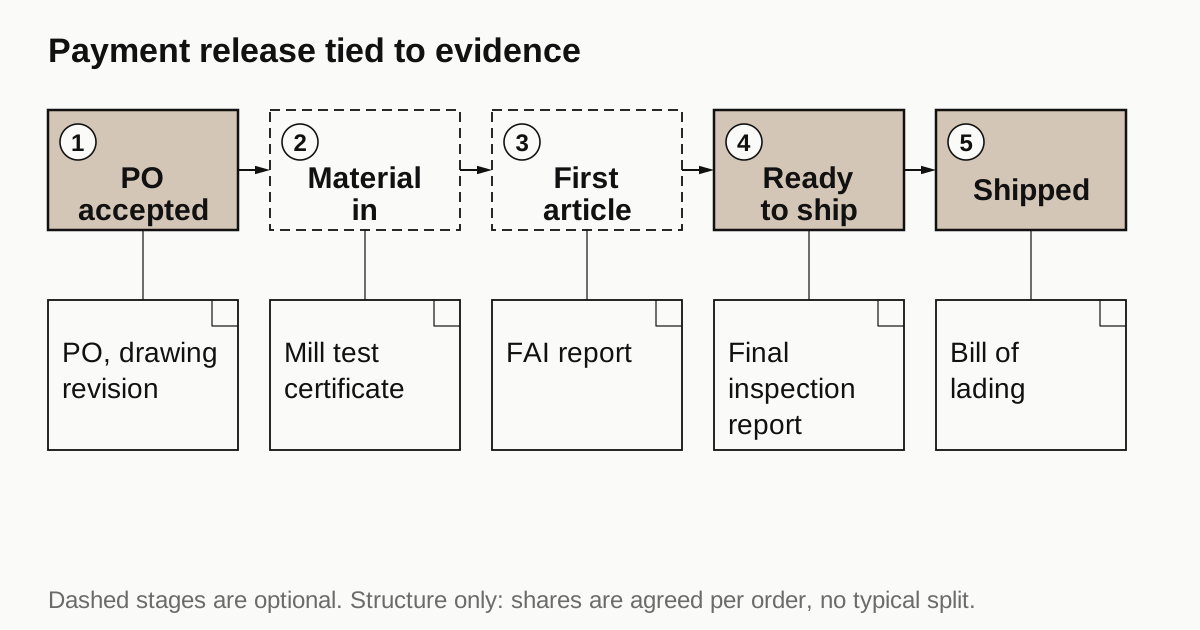
Tie each release to a document you can check
A milestone is only as good as the evidence behind it. Pick documents that a person who was not in the room can read.
- Order. The purchase order, with the drawing and its revision named. Drawing revision control covers why the revision belongs on it.
- Material in. A mill test certificate for the plate or bar. What a mill test certificate should show lists the fields.
- First article. An accepted first article inspection report. For tight positions, ask for the measurement proof too, as explained in gauge R&R on machined fixtures.
- Ready to ship. The final inspection report and the packing list. Packing machined parts for a fab covers what the packing list should carry.
- Shipped. A copy of the bill of lading or air waybill. Pay the balance against it, or against the final inspection report if you collect from the shop.
For a small jig, three of these are enough: order, final inspection and shipping documents. Add the material and first article stages when the part is expensive or the shop is new to you.
Incoterms do not settle payment
Do not assume that choosing FCA or EXW also settles when you pay. It does not. The ICC describes the Incoterms rules as clarifying the tasks, costs and risks of delivery, and Wikipedia notes they do not determine the price payable, the currency or credit terms, and they do not define where title passes. The delivery term tells you who bears risk in transit. The purchase order has to say when payment is due and when ownership passes. Ask counsel how retention of title works in your case, as the answer depends on the contracts and laws involved.
Need a quote for this part? Get a quote
“Deposit” is a defined term in Vietnam
In English a deposit is any money paid up front. In Vietnamese law, “đặt cọc” has a defined meaning. Article 328 of the 2015 Civil Code, as a Vietnamese legal commentary quotes it, defines it as one party handing the other a sum of money or precious metals, stones or other valuables as security for entering into or performing a contract. The same commentary says the consequences differ according to which party refuses to proceed.
The consequence for you: if the purchase order says “deposit”, you may be signing up for those consequences. If you mean an advance payment against work, say “advance payment” and state what happens to it on cancellation. We could not open an official English text of the article, so have counsel read the official Vietnamese version and word the clause. This is not legal advice.
Bank charges and currency
Two small items cause real arguments.
Who pays the bank charges. The SWIFT charge code in field 71A decides. OUR means all charges are borne by the sender. SHA means the sender pays its own bank and the beneficiary bears the rest. BEN means the beneficiary bears all charges. A shop that receives less than the invoice often met intermediary charges. On a small jig invoice the shortfall is visible, so write the code into the order.
Which currency. Write the invoice currency and the day the exchange rate is fixed, if it is not the same currency. Incoterms do not do it for you. Whatever foreign exchange rules apply on the shop’s side are the shop’s to follow. Ask your own bank how it handles the transfer.
Changes, cancellations and disputes
Decide before the order what happens to payments already made if you change the drawing or cancel. A change in revision restarts material, programming and often finishing, and why a repeat part changes its price explains the cost side. Write down whether stage payments already released are kept, credited to the revised order or refunded, and who pays for material already cut. Also say which inspection governs a dispute: the shop’s report, yours or a third party’s.
A clause list to adapt
Put these lines into the purchase order and ask the shop to confirm each in writing:
- Drawing number and revision this order covers.
- Total price, invoice currency and the Incoterms rule with its named place.
- Each payment, the document that triggers it and the days allowed to pay after the document arrives.
- The SWIFT charge code (OUR, SHA or BEN).
- Treatment of payments on cancellation or revision change.
- When ownership passes.
- Which inspection report governs in a dispute.
How this fits with a partner shop
Payment terms are confirmed on your quote, and you pay us, not the shop. State your preferred payment structure on the RFQ so the partner shop can quote with it in mind. We come back within 24 business hours with a quote or a plain no, and how an order runs explains the screening. If an order crosses the holiday, add the closure to the schedule too, as the Tet lead time guide describes.
Sources
- Wikipedia, Letter of credit (payment against documents, discrepancies, fees, UCP 600 effective 1 July 2007)
- ICC, Incoterms rules (tasks, costs and risks of delivery; Incoterms 2020)
- Wikipedia, Incoterms (what the rules do not cover: price, currency, credit terms, title)
- LSVN, đặt cọc and its subject under Vietnamese civil law, quoting Article 328 of the 2015 Civil Code (Vietnamese; commentary, not the official text)
- Xmldation knowledge base, SWIFT field 71A details of charges (OUR, SHA, BEN)
Frequently asked questions
Should I pay a custom jig supplier in full before shipment?
There is no rule, and we found no sourced survey of what is typical, so we publish no percentage. The sound structure ties each payment to a document you can check: purchase order, first article report, final inspection report, shipping documents. Paying everything before you have seen a first article leaves you with no leverage.
Is a letter of credit worth it for a single jig order?
Often not. A documentary letter of credit makes a bank pay on compliant documents, and fees fall on the applicant unless the credit says otherwise. Documents that do not comply are discrepant and can delay payment. For one small order the fees and document discipline can outweigh the protection. This is our judgment, so check the cost with your bank.
What is a deposit under Vietnamese law?
Article 328 of the 2015 Civil Code defines deposit (đặt cọc) as handing over money or valuables to the other party as security for entering into or performing a contract. The consequences differ depending on which party refuses. Have counsel word the first payment, and read the official Vietnamese text.
Who pays the bank charges on an international transfer?
The payment instruction decides. In SWIFT field 71A, OUR means the sender bears all charges, SHA splits them and BEN puts all charges on the beneficiary. A shop that receives less than the invoice usually met intermediary charges. State the charge code in the order.
Need a quote for this part?
Send the drawing. We quote the finished parts, place the work with a partner shop in Vietnam and reply within 24 business hours.
Get a quoteMore on cost
- Sample Orders and Minimum Quantities for Semiconductor Jigs From Vietnam
- Writing a Machining Quote in English, Line by Line
- Landed Cost of Machined Parts From Vietnam: The Items Missing From the Quote
- US Tariffs on Machined Parts From Vietnam: The Stack in October 2026
All guides and the sourcing glossary.