Guides / Cost
US Tariffs on Machined Parts From Vietnam: The Stack in October 2026
October 30, 2026
As of October 2026, a machined part of Vietnamese origin entering the United States pays its normal tariff-schedule duty plus an additional 12.5 percent Section 301 duty, unless the product is exempt by line or is a steel, aluminum or copper article already covered by Section 232 metals duties, which apply instead. The IEEPA country rate that buyers read about in 2025 is gone. This page is a dated snapshot: the stack changed several times in 2026, so confirm the rate on your entry date with a customs broker before you price a quote.
How the stack changed in 2026
| Date | What changed | Source basis |
|---|---|---|
| 20 February | Supreme Court holds that IEEPA does not authorize tariffs | Covington summary |
| 24 February | CBP stops collecting IEEPA duties on new entries. A 10 percent Section 122 surcharge starts, limited to 150 days | Covington summary |
| 6 April | Section 232 metals duties restructured: duty on the full customs value, 50 percent for Annex I-A articles, 25 percent for Annex I-B | White House proclamation of 2 April |
| 8 June | Further Section 232 changes to reduced rates for some derivative categories | Trade law firm summary, check CBP guidance |
| 24 July | Section 122 surcharge ends. USTR Section 301 forced labor action takes effect, 12.5 percent on products of Vietnam | USTR notice, 91 FR 47318 |
| 21 to 22 September | USTR says a US and Vietnam reciprocal trade agreement is “very close”. No signed agreement as of 22 September | Tuoi Tre report |
The Section 301 action is not about labor conditions in Vietnamese shops. USTR opened 60 investigations into whether each economy imposes and enforces a ban on importing goods made with forced labor. Vietnam landed in the 12.5 percent group.
What a part pays: the layers
| Layer | Applies to | Rate |
|---|---|---|
| General rate in the tariff schedule | Every part, by classification | Depends on the line. Examples below |
| Section 301 additional duty, heading 9903.05.84 | Products of Vietnam, except lines in Annex I and Annex II Part A of the notice | 12.5 percent of customs value, added to the general rate |
| Section 232 metals duties | Articles of steel, aluminum or copper and listed derivatives | 25 or 50 percent of full value, in place of the Section 301 duty |
The notice states that products subject to the Section 301 additional duties remain subject to the general rates of duty. It also states that the additional duties do not apply to articles of aluminum, steel or copper, nor to the derivative articles in the Section 232 headings 9903.82.02 and 9903.82.04 to 9903.82.26.
General rates differ widely by line. From the US tariff schedule searched on 10 October 2026: parts and accessories of semiconductor manufacturing machines (8486.90.00) are free, parts of test benches under 9031.90.91 are free, and work holders for machine tools under 8466.20.80, which has statistical lines for jigs and fixtures, carry 3.7 percent.
Worked example on a 10,000 USD customs value
These are arithmetic on published rates, not classifications. We have not checked any specific part against the Section 232 annexes.
| Case | General rate | Section 301 | Section 232 | Duty | Share of value |
|---|---|---|---|---|---|
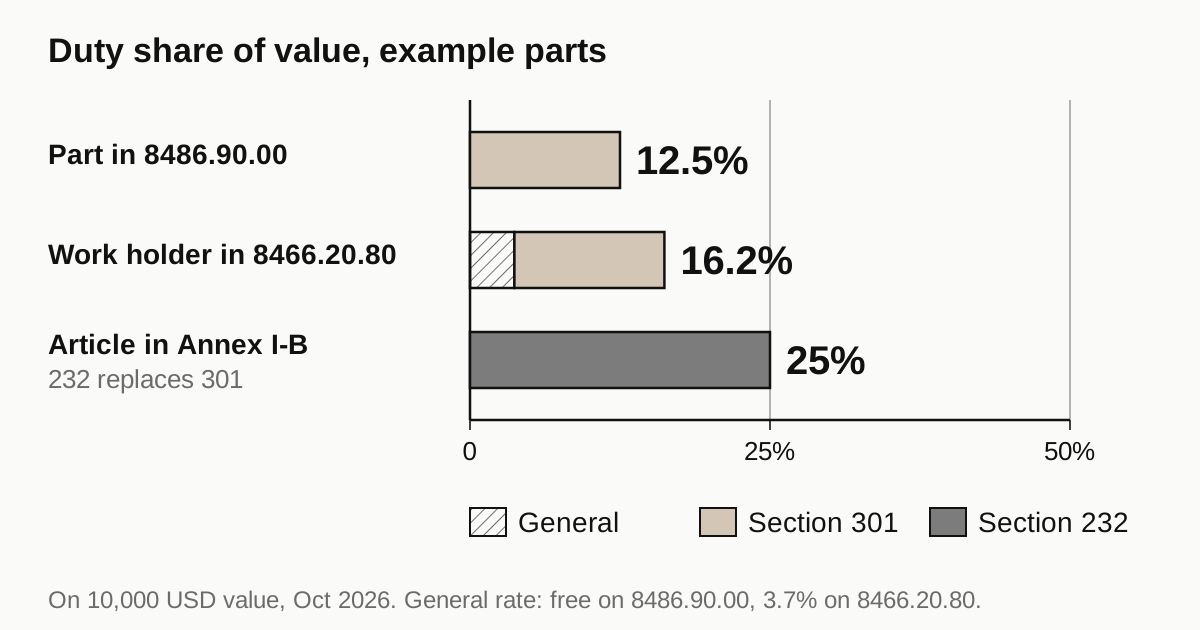
| Part classified in 8486.90.00 | 0 percent | 12.5 percent | none | 1,250 USD | 12.5 percent |
| Work holder in 8466.20.80 | 3.7 percent | 12.5 percent | none | 1,620 USD | 16.2 percent |
| Article listed in Annex I-B of the metals proclamation | n/a | not applied | 25 percent | 2,500 USD | 25 percent |
Which regime hits your part: classification decides
Machined parts are classified by what they are for, not only by the metal they are made of. Heading 8466 covers parts and accessories used solely or principally with metalworking and similar machines, and heading 8486 covers parts of machines used to make semiconductors. Two jigs that look alike on a drawing can sit in different lines, with different general rates, and only some lines of aluminum or steel articles sit in the Section 232 annexes.
Origin works the same way. The additional duty applies to products of Vietnam, and origin is settled under CBP’s rules from how the part was made, not from where the shop sits or where the box ships from. A broker applies those rules to your part. For a shop that cuts and finishes the part, the answer is usually simple. For a part that only passes through, it is not.
Where Vietnam sits against other origins in the same Section 301 action, per the notice:
| Origin | Section 301 forced labor duty |
|---|---|
| Vietnam | 12.5 percent |
| China | 12.5 percent, plus other US duties on China not covered here |
| Thailand | 12.5 percent |
| Malaysia | 10 percent |
| India | 10 percent |
| Taiwan | 10 percent, counted together with the normal rate |
| Japan, South Korea | 12.5 percent, counted together with the normal rate |
Read this as one layer, not a verdict. A full origin comparison needs the other duties, the freight and the qualification cost, which the Vietnam against China guide covers on the non-tariff side.
Need a quote for this part? Get a quote
Contract terms that keep a quote honest
- Say who is the importer of record. Under EXW, FCA or FOB the buyer normally enters the goods and pays duty. Under DDP the shop or its agent does and prices the duty in.
- Name the assumed rate and the entry date. “Quoted on 12.5 percent Section 301 plus 0 percent general rate, entry before 31 January” is a term. “Duties extra” is an argument waiting to happen.
- Decide who carries a change. The 24 July notice applied to goods entered from 12:01 a.m. Eastern time that day, with a carve-out for goods already loaded and in transit before it and entered before 12:01 a.m. on 28 July. Rules key on entry dates and transit dates, so ask for ship dates, not only ready dates.
- Keep the invoice and the customs value consistent. Duty is a percentage of the declared value, so a quote that splits tooling, parts and freight differently from the invoice causes questions at entry.
- Link repeat orders to the clause. A tariff change between orders is one reason a repeat price moves, a pattern covered in price changes between orders.
What could move next
- A reciprocal trade agreement. Talks continue. On 22 September USTR said the two teams were very close, and Vietnam’s leader asked Washington to take a comprehensive approach that includes the Section 301 investigations. Nothing was signed in the sources we read, and the terms are not public.
- A second Section 301 case. A separate investigation into Vietnam’s intellectual property enforcement was opened in 2026, with comments due on 2 July. Its outcome could add duties.
- Section 232 annexes. The April proclamation lets Commerce and USTR add derivative products on a rolling basis, so a part that is outside the annexes today can move in.
None of this changes the practical advice. Quote with the rate and the date written in, keep the HTS line the broker assigns on the file and rerun the number when any of the three items above moves. If you want a second source for a part where duty drives the decision, see second sourcing a critical machined part. To test a specific drawing with shops in Vietnam, send the RFQ and tell us the HTS line your broker uses, so the quote is built on those assumptions.
See also: HS codes for jigs and fixtures and origin proof for machined semiconductor parts.
Sources
- USTR, notice of actions in the Section 301 forced labor investigations (published as 91 FR 47318, 28 July 2026)
- USTR press release, 23 July 2026
- White House, Strengthening Actions Taken to Adjust Imports of Aluminum, Steel, and Copper, 2 April 2026
- US International Trade Commission, Harmonized Tariff Schedule search (headings 8466, 8486, 9031)
- Covington, IEEPA tariffs terminated and Section 122 tariffs take effect (law firm summary)
- Diaz Trade Law, June 2026 Section 232 proclamation (law firm summary)
- Tuoi Tre News, Vietnam and US very close to finalizing a reciprocal trade agreement, 22 September 2026
- Cassidy Levy Kent, Section 301 investigation of Vietnam’s IP protection, 8 June 2026
Frequently asked questions
What is the US tariff on machined parts from Vietnam in 2026?
As of October 2026, most products of Vietnam pay their normal tariff-schedule duty plus an additional 12.5 percent Section 301 duty on goods entered from 24 July 2026. Steel, aluminum and copper articles covered by Section 232 pay those duties instead. Confirm the rate for your classification with a customs broker.
Is the 20 percent reciprocal tariff on Vietnam still in force?
No. The Supreme Court held on 20 February 2026 that IEEPA does not authorize tariffs, and CBP stopped collecting IEEPA duties on goods entered from 24 February. A 10 percent Section 122 surcharge ran until 24 July 2026 and was replaced by the Section 301 duty described here.
Does the Section 301 duty stack with Section 232 steel and aluminum duties?
Not under the notice's own text. The Section 301 additional duty does not apply to articles of aluminum, steel or copper, nor to the derivative aluminum or steel articles listed in the Section 232 headings. Whether a given part is in those annexes is a classification question for a customs broker.
Who pays the tariff on parts bought from a Vietnamese shop?
The importer of record pays duties at entry. Under EXW, FCA or FOB terms that is normally the buyer. Under DDP the shop or its agent carries it and prices it in. Whichever term applies, write down the rate the quote assumed and who bears a change between order and entry.
Need a quote for this part?
Send the drawing. We quote the finished parts, place the work with a partner shop in Vietnam and reply within 24 business hours.
Get a quoteMore on cost
- Sample Orders and Minimum Quantities for Semiconductor Jigs From Vietnam
- Writing a Machining Quote in English, Line by Line
- Landed Cost of Machined Parts From Vietnam: The Items Missing From the Quote
- Payment Milestones for Custom Jigs: Tie Each Release to a Document You Can Check
All guides and the sourcing glossary.