Guides / Cost
Writing a Machining Quote in English, Line by Line
November 12, 2026
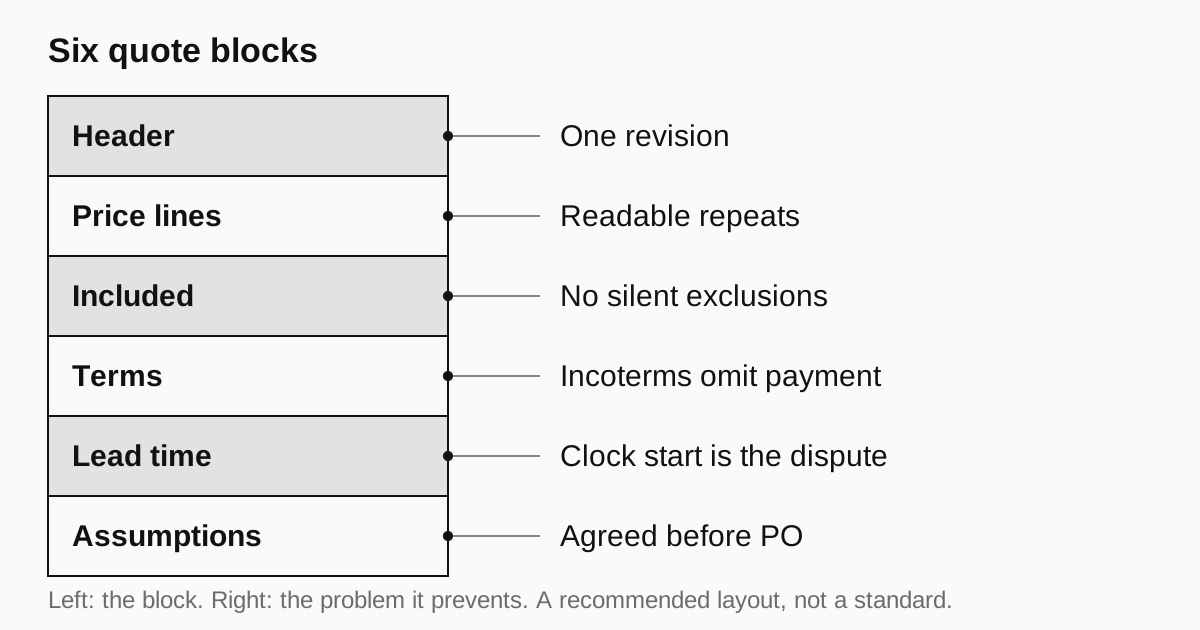
A machining quote the buyer can compare has six blocks in a fixed order: a header that ties the price to one drawing revision, price lines per quantity, what is included, the terms, lead time counted from a named event and a list of assumptions. Write them the same way every time, in short sentences with units. The buyer’s reading is the test: if the quote needs a follow-up email to be understood, it will get one, and the follow-up costs days. This guide goes block by block with wording you can copy, and then lists the small English points that cause most confusion.
The buyer’s side of this page is how to read a machining quote. Everything below is the same quote seen from the shop’s chair.
Block 1: the header
The header answers “what exactly is this price for?”. Put it at the top of page one. Every value in the tables on this page is an example, not a benchmark.
| Field | Example wording |
|---|---|
| Buyer’s RFQ reference | RFQ 2026-0417 |
| Your quote number and date | Quote Q-2203, 2026-11-02 |
| Drawing number and revision | DWG 301-441, Rev C |
| 3D file received | 301-441_RevC.step |
| Material | Aluminum 6061-T6, bar |
| Quantities quoted | 1, 10 and 50 pieces |
| Valid until | 2026-12-02 |
The revision is the line most often missing. A price belongs to one revision, and the buyer’s next revision can change it. If the RFQ drawing has no revision letter, write “no revision shown” instead of leaving the field out. How the buyer should manage revisions on their side is in drawing revision control with Vietnamese jig shops.
Block 2: price lines
Give a unit price at each quantity the RFQ asks for. Show one-time costs as their own lines, so a repeat order can be priced without them.
- Unit price per quantity break. “Unit price at 10 pieces: 38.20 USD” is a line. “About 40 USD each” is not.
- Setup and programming. One line, one time. Say whether it recurs on a repeat order.
- Tooling and fixtures. One line each, with a note on who owns them afterward.
- Finishing. Name the process and the specification, and say which areas are masked. See hard anodize or electropolish for the kind of distinction a buyer expects you to make.
- Inspection. Say what is in the price: a dimensional report, a first article report or only a certificate of conformance.
Block 3: what is included and what is not
Silent exclusions cause the worst arguments. A short two-column list settles them.
| Included in the price | Not included |
|---|---|
| Material with a 3.1 mill certificate | Second material source |
| Anodize, clear, to the specification on the drawing | Chromate or other post-treatment not on the drawing |
| Dimensional report on the first 3 pieces | Full inspection of every piece |
| Export carton packing | Cleanroom or vacuum-sealed packing |
The wording in the table is an example, not a standard. If a certificate type matters to the buyer, say which one; the types are explained in mill test certificates from Vietnam shops.
Block 4: terms
Incoterms rule and place. The ICC describes Incoterms as defining the tasks, costs and risks of delivery between seller and buyer. The current set is Incoterms 2020. Name the rule and the place together: “FOB Haiphong” or “FCA our factory, Binh Duong”, not “FOB” alone. The place decides where risk passes and who loads and unloads. What the buyer then pays on top is covered in landed cost of machined parts from Vietnam.
Payment, currency and title are separate lines. Incoterms do not set the price, the currency or the payment terms, and they do not decide when title passes. Write each one out. For staged payments on custom jigs, see payment milestones for custom jigs.
Lead time with a clock start. “6 weeks” is incomplete. Write “6 weeks from the later of receipt of PO and receipt of the first payment”. Add the steps outside your control: anodizing or heat treatment at a subcontractor, material that is not in stock. The usual causes of slippage are in machined part lead time explained, and the holiday effect is in Tet holiday and lead times.
Validity. A valid-until date, as in the header. Add “material price may change after this date” if it is true.
Need a quote for this part? Get a quote
Block 5: assumptions and exceptions
This block turns a quote from a number into an agreement.
- General tolerance. ISO 2768-1 sets four classes for linear dimensions with no tolerance of their own: f (fine), m (medium), c (coarse) and v (very coarse). Under one practitioner guide, class m allows ±0.2 mm from 6 to 30 mm and ±0.3 mm from 30 to 120 mm. The default applies only where the drawing refers to the standard, for example “ISO 2768-m” near the title block. If it does not, write: “Drawing shows no general tolerance. Quoted to ISO 2768-m. Please confirm.”
- Features you cannot hold or measure. List them by drawing callout. An exception list lets the buyer decide before the order, and the same discussion after a rejected first article is more expensive.
- Open questions. “Rev C shows two different thread depths on item 7. Quoted at the deeper one.” One line per question.
- What you need from the buyer. Approval of a drawing change, a sample of mating parts, a material callout.
Weak line against better line
| Weak | Better |
|---|---|
| Price: 40 USD | Unit price 38.20 USD at 10 pieces, 31.60 USD at 50 pieces, drawing 301-441 Rev C |
| Delivery ASAP | 6 weeks from the later of PO receipt and first payment receipt |
| Finish: anodize | Anodize clear to the specification on the drawing, threads masked |
| Price includes everything | Includes material, machining, anodize, first 3 pieces reported, export carton. Not included: freight, duty |
| Valid for a while | Valid until 2026-12-02 |
The prices and dates are illustrations of wording, not benchmarks.
English that causes confusion
- Write dates as year-month-day, for example 2026-12-02. “02/12” can mean two different days.
- Use a full stop for decimals and write units every time: 0.02 mm, not 0,02 and not 0.02 alone.
- Avoid “approx.”, “about”, “ASAP” and “normal”. Give the number or the condition.
- Spell out abbreviations once. “ARO” and “NRE” mean nothing to some buyers, so write “after receipt of order” and “one-time cost”.
- Keep part and feature names as they appear on the drawing, even if a Vietnamese word is more natural.
- A machine translation is a fine first draft. Read the result as the buyer would: numbers, units, conditions and negatives must be exactly right. For Japanese and Korean drawings and correspondence, see working with Vietnamese shops in Japanese or Korean.
Before you send
- Quote number, drawing number and revision match the RFQ.
- Every quantity the RFQ asks for has a price.
- Setup, tooling and finishing are on their own lines.
- The Incoterms rule has a named place, and currency and payment terms are written out.
- Lead time names its starting event.
- A valid-until date is present.
- Assumptions and exceptions are listed, even if the list is “none”.
- Totals add up, and units are on every number.
A shop that sends quotes like this is easier to work with. Qualification and supplier requirements are covered in what it takes to qualify for semiconductor work, and the supplier page explains how partner shops receive work. Partner shops do not deal with the buyer, and nothing here promises an order.
Sources
- ICC, Incoterms rules (tasks, costs and risks of delivery; Incoterms 2020)
- Wikipedia, Incoterms (naming the place; price, currency, credit terms and title are not covered)
- RPProto, ISO 2768 tolerance guide (classes f, m, c, v; class m values; designation on the drawing; practitioner summary, directional)
- Wikipedia, Request for quotation (a request involves more than the price; payment terms are among the items asked)
Frequently asked questions
Should a Vietnamese shop quote in USD or VND?
Use the currency the RFQ names. If it names none, pick one currency for the whole quote and say who carries an exchange rate change. Incoterms do not set the currency, so it has to be written as its own line, next to the payment terms.
How long should a machining quote be valid?
There is no standard period, so write an explicit valid-until date. Shorten it when material or freight prices are moving. A quote with no date invites an argument when the buyer orders months later at the old price.
What should I do when the drawing is incomplete?
Either ask the question before pricing or price with the gap written as an assumption, for example the general tolerance you assumed. A STEP file carries geometry, not intent, so a missing tolerance, finish or material callout should never be silently guessed.
Should setup and tooling be separate lines on a quote?
Yes. A setup cost buried in the unit price makes a repeat order look expensive and hides the saving the buyer gets from ordering a spare with the original. Show setup, programming and any fixtures as their own lines, once, and say whether they recur.
Need a quote for this part?
Send the drawing. We quote the finished parts, place the work with a partner shop in Vietnam and reply within 24 business hours.
Get a quoteMore on cost
- Sample Orders and Minimum Quantities for Semiconductor Jigs From Vietnam
- Landed Cost of Machined Parts From Vietnam: The Items Missing From the Quote
- Payment Milestones for Custom Jigs: Tie Each Release to a Document You Can Check
- US Tariffs on Machined Parts From Vietnam: The Stack in October 2026
All guides and the sourcing glossary.