Guides / Choosing a Supplier
Buying Machined Parts From a Vietnamese Shop as an EPE: Customs and VAT
October 31, 2026

If your plant is an export processing enterprise (EPE), buying a part from a Vietnamese machine shop is not an ordinary domestic purchase. Under Circular 38/2015/TT-BTC as originally published, goods traded between an inland enterprise and an EPE are an indirect export: the shop declares an export, the EPE declares the matching import within 15 working days and a VAT invoice stands in for the commercial invoice. VAT on the sale can be 0 percent, but only when the VAT law’s conditions are met. The customs rules were amended in 2018 and twice in 2025, so treat this guide as the map and your customs team as the authority.
What counts as an EPE
Decree 35/2022/ND-CP defines an export processing enterprise as an enterprise that carries out export processing activities in an export processing zone, industrial park or economic zone. It defines an export processing zone as an industrial park specialized in export production that is separated from the outside under the rules for non-tariff areas of the import and export duty law.
That separation is the point. Goods that move between the zone or the enterprise and the rest of Vietnam cross a customs line, even when the shop is a short drive from your gate. If you are unsure whether your plant is an EPE, your customs manager will know, because it decides every inbound and outbound declaration you file. For where these plants and zones sit, see where semiconductor machine shops and plants cluster in Vietnam.
The customs mechanics: indirect export and import
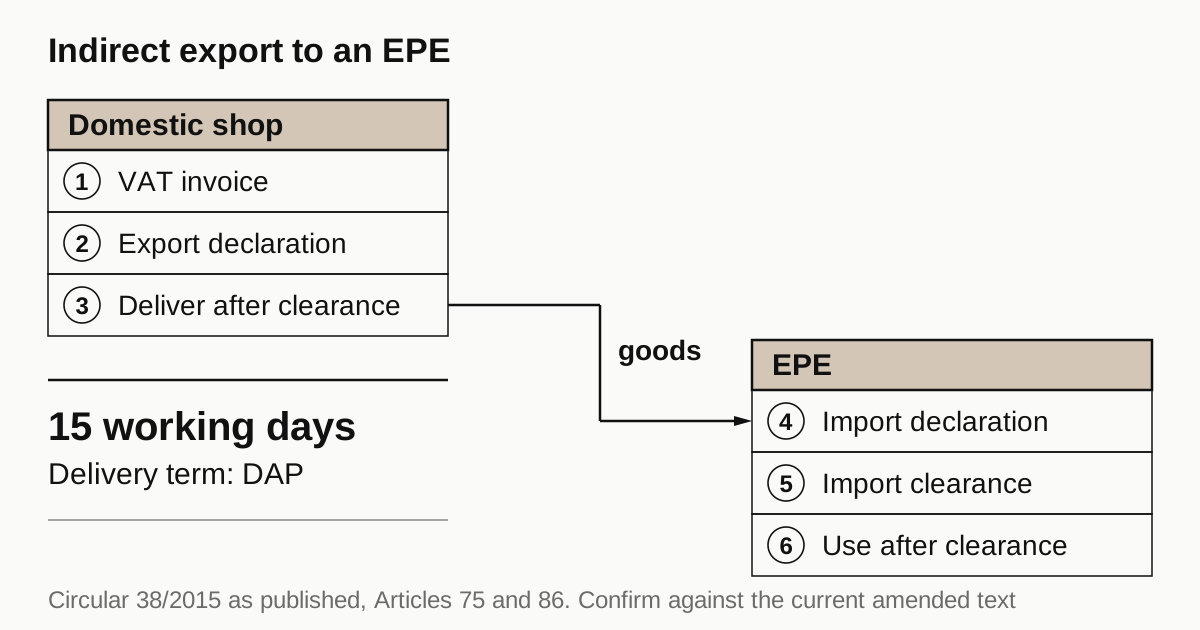
Article 75 of Circular 38 says that for goods traded between an EPE and a domestic enterprise, both follow the procedures for indirect export in Article 86. Article 86 lists goods traded between an inland enterprise and an EPE as an indirect export and sets out who does what.
| Step | Who | What | Clause |
|---|---|---|---|
| 1 | Shop | Declares the export, naming the customs sub-department where the import will be declared and the buyer’s enterprise identification number | 86(5)(a) |
| 2 | Shop | Completes export procedures and delivers only after clearance | 86(5)(a) |
| 3 | EPE | Declares the import by the deadline, quoting the number of the indirect export declaration | 86(5)(b) |
| 4 | EPE | Completes import procedures and sells or uses the goods for manufacturing only after clearance | 86(5)(b) |
Four details from the text matter in practice:
- The 15 working days. The importer completes procedures within 15 working days from the day the export is cleared and the goods are delivered.
- The VAT invoice replaces the commercial invoice. In a trade between an inland enterprise and an EPE, the declarant may use VAT invoices or sale invoices instead of commercial invoices. The VAT invoice number and date go into the invoice field of the declaration.
- The delivery term is DAP. The declaration instructions say to enter DAP as the delivery condition for trade between a domestic enterprise and an EPE.
- A faster route for repeat partners. A prioritized enterprise and its partners, with repeated deliveries under one contract, may deliver before declaring and declare within 30 days of delivery, keeping delivery documents for inspection.
Article 74 adds a limit. Goods an EPE imports for manufacturing must go through customs procedures and be used for manufacturing only. A short list of cases lets the EPE choose whether to follow customs procedures, including building materials, stationery, food and consumables bought on the domestic market to build and run the EPE and serve its staff. A jig, a nozzle or a change part for a production line reads as a production good, not a consumable, but which side a given spare falls on is a call for your customs team. Get that answer before the purchase order, not at the gate.
VAT: 0 percent, with conditions
Article 9 of Law 48/2024/QH15 puts goods sold from Vietnam to organizations in non-tariff areas and consumed in non-tariff areas to directly serve export production activities at the 0 percent rate. Article 9 also leaves the dossier and procedures for the 0 percent rate to the Minister of Finance. For the shop’s own input VAT credit on exported goods, Article 14 asks for a sales contract, a cashless payment document and a customs declaration for exported goods.
Three practical consequences follow:
- The shop needs the paperwork, so you need to supply some of it. The contract, the bank payment evidence and the customs declaration are what keep the 0 percent rate defensible on the shop’s side.
- Use decides the rate. The test is consumption in the zone that directly serves export production. The text does not define directly. Production tooling is the clearest reading and office or facility items are the doubtful ones, so ask the shop which rate its invoice will show.
- Agree the rate in writing before the purchase order. The shop’s own VAT position depends on it, and a dispute later in the chain is easier to avoid than to settle.
Need a quote for this part? Get a quote
What changed after 2015 and where offices disagree
The text above is Circular 38 as originally published in 2015. Since then Circular 39/2018/TT-BTC amended it, Decree 167/2025/ND-CP of 30 June 2025 amended Decree 08/2015 and narrowed on-the-spot import and export, and Circular 121/2025/TT-BTC of 18 December 2025 amended Circular 38 again. We did not read the amended Article 86, so confirm the clause numbers and deadlines above against the current text.
The change in 2025 produced conflicting readings. Letter 828 of the Ho Chi Minh City Customs Sub-Department II, dated 21 July 2025, told enterprises to follow Section 5 of Chapter III of Circular 38 as amended by Circular 39/2018 for sale, processing, leasing and borrowing contracts with EPEs, pending guidance. The High-Tech Park customs office answered a day later in Letter 1281 that domestic sales to EPEs are not on-the-spot import and export and that Letter 828 had no legal basis. A General Department of Customs letter, No. 21310/CHQ-GSQL of 4 September 2026, now addresses customs procedures and type codes for EPE goods, though we did not read its text. Ask your customs team for it.
What to ask a Vietnamese shop before it quotes an EPE
- Has the shop filed export declarations for sales to an EPE before, and who files them
- Which VAT rate will the invoice show, and what contract and payment evidence does it need from you
- Does the quote include customs handling or list it separately
- What do you need to give it: your enterprise identification number, the code of your customs sub-department and the delivery address inside the zone
- How many days sit between delivery and the day the parts may go on a line, given that the import must clear first
- Who handles a rejected or reworked part, since each trip across the line may need a declaration
Add the days. A domestic shop that sells you a part needs export clearance before the truck leaves, and your import must clear before the part is used. They are steps a domestic sale does not have, so ask the shop how many days it budgets for each. The schedule effects are broken out for any part in where the weeks go on a machined part, and the quote lines to compare are in reading a machining quote.
If you are an EPE buyer and want shops that have handled this paperwork, send the RFQ and say that you are an EPE, with your customs sub-department and the invoice rate you expect. We come back within 24 business hours with a quote or a plain no. The shop criteria are on how an order runs.
See also: Vietnam export control for dual-use goods, a screening routine for shops.
Sources
- Circular 38/2015/TT-BTC, English text as published (Articles 74, 75 and 86, Appendix II)
- Law 48/2024/QH15 on Value-Added Tax, English translation (Articles 9 and 14)
- Decree 35/2022/ND-CP, English translation (Article 2 definitions)
- Circular 121/2025/TT-BTC of 18 December 2025, English translation (partial)
- UNI Customs Consulting, domestic enterprises and EPEs under Decree 167/2025 (commercial, summarizes Letters 828 and 1281)
- UNI Customs Consulting, customs procedures and type codes for EPE goods (commercial, cites Letter 21310/CHQ-GSQL)
Frequently asked questions
Does a Vietnamese shop file an export declaration when it sells to an EPE?
Under Circular 38/2015 as originally published, yes. Goods traded between an inland enterprise and an export processing enterprise are handled as an indirect export: the shop declares the export and the EPE declares the matching import. The circular was amended in 2018 and again in December 2025, so confirm the current procedure with your customs team.
How long does an EPE have to file the import declaration?
The original text of Article 86 gives 15 working days from the day the export is cleared and the goods are delivered. A prioritized enterprise and a partner with repeat deliveries under one contract may deliver first and declare within 30 days of delivery. Check both periods against the current amended text.
Is VAT 0 percent when an EPE buys from a Vietnamese supplier?
It can be. The VAT Law of 2024 sets 0 percent for goods sold from Vietnam to organizations in non-tariff areas and consumed there to directly serve export production, subject to the Finance Ministry's dossier rules. The word directly is not defined, so agree the invoice rate with the shop before the purchase order.
Is a sale to an EPE an on-the-spot export?
Customs offices gave different answers in July 2025, after Decree 167/2025 narrowed on-the-spot procedures. One Ho Chi Minh City office pointed to the Circular 38 procedure for contracts with EPEs. The High-Tech Park customs office said domestic sales to EPEs are not on-the-spot trade. Ask your supervising customs office which procedure applies.
Need a quote for this part?
Send the drawing. We quote the finished parts, place the work with a partner shop in Vietnam and reply within 24 business hours.
Get a quoteMore on choosing a supplier
- How to Check a Vietnam Shop's Real Capacity and Backlog
- Weekly Progress Reports From a Vietnam Jig Shop: What a Useful One Contains
- Reading the Job Board in a Vietnam Jig Shop: Visual Management Signs a Buyer Can Check
- Moving an Existing Jig Program to a Vietnam Machine Shop
All guides and the sourcing glossary.