Guides / Choosing a Supplier
Where Semiconductor Plants Sit in Vietnam's Industrial Zones, and What It Means for Shops
November 1, 2026
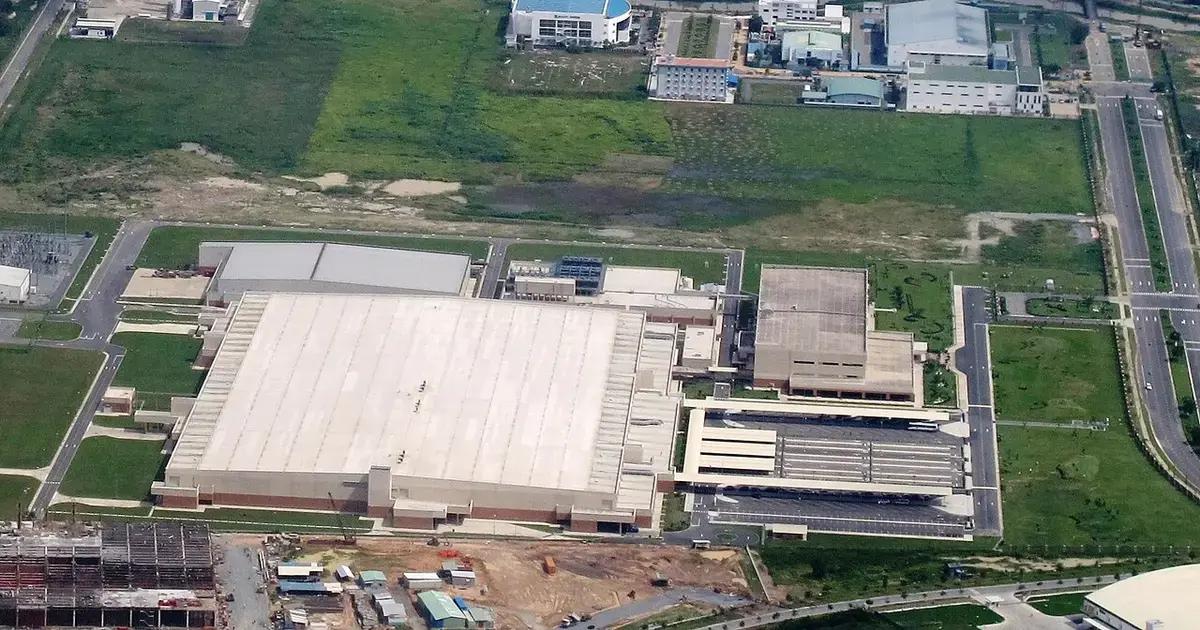
The semiconductor sites that Vietnam’s public record names are almost all back end plants, and they sit in a handful of industrial parks: Yen Phong 2C in Bac Ninh, Van Trung in Bac Giang, Saigon Hi-Tech Park in Ho Chi Minh City and, from 2027, Yen Binh in Thai Nguyen. For a parts buyer the useful question is not which province is best. It is where your plant sits, what kind of zone it is and how far the shop’s parts and finisher have to travel to reach it.
This guide lists the named anchors with their sources, explains what the zone labels mean in law and then turns that into questions to put to a shop. For the wider picture of why the back end is growing, see what Vietnam’s back end buildout means for parts buyers.
The named anchors, zone by zone
| Plant | Province and zone | What the public record says |
|---|---|---|
| Amkor Technology Vietnam | Bac Ninh, Yen Phong 2C Industrial Park (developer Viglacera) | Grand opening 11 October 2023, 230,000 square meters of floor area, 1.6 billion USD of total investment cited at opening |
| Hana Micron Vina | Bac Giang, Van Trung Industrial Park | Second factory inaugurated 16 September 2023, nearly 600 million USD committed in total, integrated circuit boards for phones and other devices |
| Intel Products Vietnam | Ho Chi Minh City, Saigon Hi-Tech Park | Assembly and test, about 6,500 workers, 11.67 billion USD of exports in 2025, 57 percent of the park’s export turnover, according to a June 2026 report |
| Samsung back end test fab | Thai Nguyen, Yen Binh Industrial Park, zones CN-11 and CN-12 | Planned. Equipment move-in from July 2027, official operation in the fourth quarter of 2027, a second line from October 2028, per an October 2026 report |
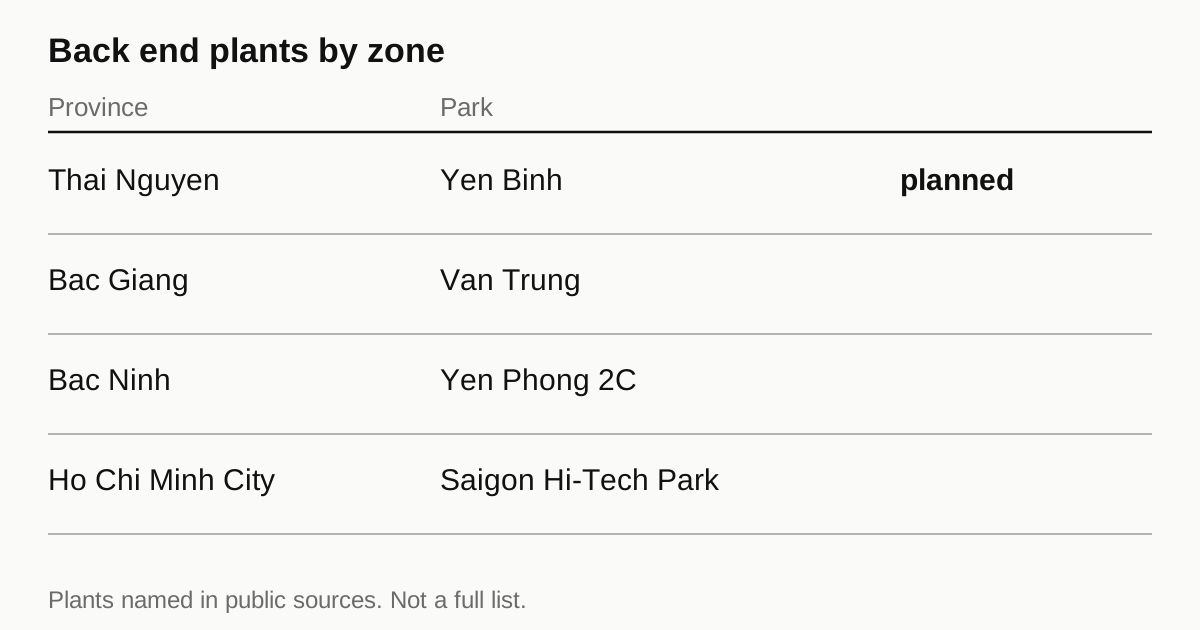
Read the table as a list of anchors, not a full census. Other plants exist. The Intel report calls its Vietnam site the largest assembly and test facility in Intel’s network, which is a company side claim, and the Samsung line is a plan, not an operating fact. Figures on investment move from report to report, so use them to size the plant, not to quote it.
Saigon Hi-Tech Park is a different kind of zone from the other three: Wikipedia describes a hi-tech park of 326 hectares in Tang Nhon Phu, about 15 kilometers east of central Ho Chi Minh City, established in 2002, managed by its own management board. The other three are described in the sources as industrial parks, and Yen Phong 2C was developed by Viglacera.
What the zone labels mean
Decree 35/2022/ND-CP sets the legal vocabulary. Each label changes something a buyer or a shop can feel.
| Label | Definition in Decree 35/2022 | What it changes for a parts order |
|---|---|---|
| Industrial park | A zone with delimited boundaries, specialized in production of industrial goods and services for it | Nothing special at the gate for an enterprise that is not an EPE: a domestic sale into it is an ordinary domestic delivery |
| Export processing zone | An industrial park specialized in export production, separated from the outside under the non-tariff area rules | A purchase from outside crosses a customs line. See the EPE customs and VAT guide |
| Export processing enterprise | An enterprise carrying out export processing activities in an export processing zone, industrial park or economic zone | The status, not the address, decides the customs treatment: an EPE can sit in an ordinary industrial park |
| Hi-tech industrial park | An industrial park that attracts high technology investment projects | Park rules differ, and Wikipedia notes preferential land, tax and customs support for high tech investors. Ask the plant which customs setup applies |
| Supporting industry park | An industrial park where at least 60 percent of industrial land is used for supporting industry projects | The place where component and tooling makers are meant to cluster |
Two plants in the same park can have different customs treatment, because the status belongs to the enterprise. Do not infer it from the address. Your plant’s customs team will tell you.
Where the shops are: what is known and what is not
We did not find a public count of precision machine shops by province, and a directory listing is not a count. What the public record does support is narrower: the plants above are the anchors of demand. How machining and finishing capacity sits around them is a separate question, and the regional picture, with the strengths and gaps of each cluster, is in the Vietnam machining map, written as a working view, not a directory.
Because there is no census, two shops in the same province can be very different. A shop in the same park as your plant is not better than one two provinces away, and a shop far away is not worse. Judge the shop on its inspection, documents and finishing chain, with the audit questions, and treat location as a practical factor.
Need a quote for this part? Get a quote
What a new test fab means for parts demand
The Samsung project is described as a test fab, the final stage where packaged DRAM and NAND chips are electrically tested and screened before shipment. Our reading, which is an inference and not a report, is that a plant of that kind runs test handlers, test boards and sockets in volume, which is where change kits, nests, carriers and fixtures wear out and get replaced. Those are the parts families the Vietnamese machining base is closest to, covered in handler change kits and burn-in board and socket fixture parts.
The timing matters more than the guess. With equipment move-in reported for July 2027, the window to qualify a local supplier for spares is the months before it, not the months after. A shop qualified early has a first article and a track record when the plant starts asking for spares, and a shop met after start-up is competing with the urgency of a line that already runs. That is the same logic as spares and consumable planning: the second order is cheap, the first order under pressure is not.
What location actually changes
- Courier time and emergency parts. A line-down fixture is a delivery problem as much as a machining problem. Ask how the shop delivers to your gate and how long that takes in a normal week.
- Witnessed inspection. First article inspection is easier to attend when the shop is a short trip away. For remote inspection, ask what the shop will send instead. See first article inspection reports.
- The finisher, not only the shop. Anodize, plating and heat treatment are bought outside the shop, so the distance that matters is shop to finisher to plant. A finisher two provinces from the shop adds days to every order, a point explained in where the weeks go on a machined part.
- The customs route. If your plant is an export processing enterprise, a delivery from outside is an indirect export with declarations at both ends. Shops that have done it before are worth asking for.
- Port, for parts going abroad. Which port a shop uses is a freight question and it changes with the plant’s region. Ask for the forwarder and the port in the quote.
Questions for the shop
- Where is the shop, and where does each outside process happen
- How does it deliver to a plant in a zone, and has it delivered to an EPE
- How many hours does a normal delivery to your gate take, and what is the emergency option
- Will it host a witnessed first article inspection, or what does it send in place of one
- Is the quoted lead time working days or calendar days, including the finisher
If you are choosing among shops for a specific plant, send the RFQ with the plant location and the zone type. We come back within 24 business hours with a quote that fits that delivery path, or a plain no. For a plant in Vietnam, name the park in the RFQ, because it changes the questions.
See also: machine shops in northern Vietnam and in southern Vietnam, with the province names in force since July 2025.
Sources
- Gelex, Amkor’s largest global factory opens in Yen Phong 2C Industrial Park, 13 October 2023
- Vietnam Investment Review, Hana Micron Vina launches factory in northern Vietnam, 18 September 2023
- Vietnam Investment Review, Intel marks 20 years of its Vietnam factory, 13 June 2026
- Seoul Economic Daily, Samsung builds chip test hub in Vietnam, 5 October 2026
- Wikipedia, Saigon Hi-Tech Park
- Decree 35/2022/ND-CP, English translation (Article 2 definitions)
Frequently asked questions
Where are the semiconductor plants in Vietnam?
The public record names four anchors. Amkor in the Yen Phong 2C industrial park in Bac Ninh, Hana Micron Vina in Van Trung industrial park in Bac Giang, Intel in Saigon Hi-Tech Park in Ho Chi Minh City, and a Samsung test fab planned at Yen Binh industrial park in Thai Nguyen. All are back end sites: assembly, packaging and test.
What is the difference between an industrial park and an export processing zone?
Decree 35/2022 defines an industrial park as a bounded zone specialized in industrial production and services for it. An export processing zone is an industrial park specialized in export production that is separated from the outside under the non-tariff area rules, so goods crossing its edge go through customs.
Are there machine shops inside these zones?
Some, but we found no public count of precision machine shops by province or zone, and a directory is not a count. Decree 35/2022 also defines a supporting industry park, where at least 60 percent of industrial land goes to supporting industry projects. Ask a shop where it sits and where its finisher sits.
Does it matter how close a shop is to the plant?
For capability, shop quality matters more than distance. Distance mostly decides courier time, how easy a witnessed inspection is and whether deliveries cross a customs line into a zone. Ask the shop how it delivers to the plant gate and how long that takes.
Need a quote for this part?
Send the drawing. We quote the finished parts, place the work with a partner shop in Vietnam and reply within 24 business hours.
Get a quoteMore on choosing a supplier
- How to Check a Vietnam Shop's Real Capacity and Backlog
- Weekly Progress Reports From a Vietnam Jig Shop: What a Useful One Contains
- Reading the Job Board in a Vietnam Jig Shop: Visual Management Signs a Buyer Can Check
- Moving an Existing Jig Program to a Vietnam Machine Shop
All guides and the sourcing glossary.