Guides / Process
Pick and Place Nozzles and Collets: Materials, Tolerances and Wear
October 21, 2026
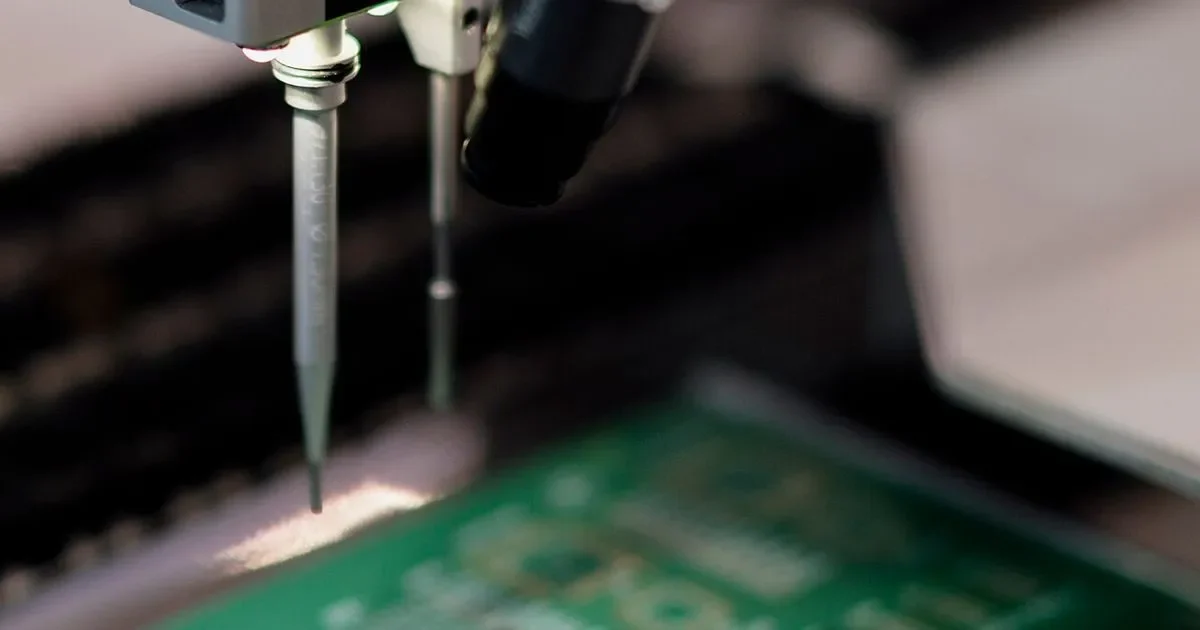
A pick and place machine moves a component from where it is to where it must go, and the nozzle is the only part that touches the component. A vacuum draws the part against the tip, the head moves and the vacuum releases. Everything else is the machine around it. When the nozzle is clean, flat, the right size and undamaged, the part comes up and goes down accurately. When it is not, the machine misses, drops, tilts or damages parts.
This guide covers the types of nozzle and collet, the materials, the tolerances that matter and what a machine shop can and cannot make.
How a nozzle works
The nozzle is a small tube with a shaped tip. Vacuum is applied through the bore. When the tip touches the component, the vacuum holds it. The tip has to seal well enough to hold the part against acceleration and motion, and it has to release it cleanly when the vacuum is switched off or a puff of air is applied.
Four features set performance:
- The bore. Its diameter determines holding force. It must be big enough to hold the part and small enough not to draw the part in or pull it off centre.
- The tip face. Its flatness and finish determine the seal and the contact with the part. It may be flat, rounded, stepped or shaped to a package.
- The shank. It connects to the head and sets position. Its fit in the head decides the placement accuracy, because a bent or loose shank moves the part.
- The overall length. It affects the nozzle’s weight, flexing and the way it clears neighbouring parts.
Nozzle and collet types
| Type | Used for | Tip style | Typical material |
|---|---|---|---|
| Small chip nozzle | Tiny passive parts, 0201 to 0603 | Flat, small bore | Stainless steel, ceramic |
| Standard SMT nozzle | Larger passives, SOT, SOIC | Flat or stepped | Stainless steel, aluminum |
| IC and QFP nozzle | Packages with leads | Wide flat or ring | Stainless steel, plastic tip |
| Odd form nozzle | Connectors, shields, large parts | Custom shaped | Aluminum, plastic, steel |
| Die collet, flat | Bare die with a smooth active face | Flat, vacuum holes | Carbide, ceramic, rubber tip |
| Die collet, pyramid | Die that must not be touched in the centre | Four sloped faces, contact at edges | Carbide, steel, plastic |
| Rubber tip collet | Fragile or small die | Soft, conforming | Rubber on a steel body |
The choice follows the part: its size, weight, surface and sensitivity.
Materials
Stainless steel. Strong, hard wearing and cheap. Hard enough to scratch a soft surface. Common for general SMT nozzles.
Hardened tool steel and carbide. Highest wear life for high volume work. Unforgiving to fragile die, so used with care or with a soft tip.
Ceramic. Hard, wear resistant, non magnetic and can be electrically insulating. Brittle and prone to chipping. Used for fine nozzles and clean contact.
Plastic, often ESD dissipative. Soft, gentle on parts, low cost. Wears fast and can generate particles. Chosen for die and packages that scratch easily. See ESD materials and coatings. For high temperature work, see PEEK, Vespel and Torlon parts.
Rubber tips. Conform to the die surface and seal on rough or curved faces. They wear and need replacing often.
Aluminum. Light, good for large nozzles that carry heavy components, easily machined. Usually anodized to resist wear and corrosion.
Weight matters on a fast machine, because a heavier nozzle slows the head or adds vibration.
Tolerances that decide yield
Many dimensions on a nozzle are loose. A few are not.
| Feature | Typical tolerance | Why it matters |
|---|---|---|
| Tip face flatness | 0.005 mm or better | Seal and part tilt |
| Bore diameter | plus or minus 0.02 mm, or tighter on small bores | Holding force |
| Shank diameter | h6 to h7 | Fit in the head, placement accuracy |
| Bore to shank concentricity | 0.01 to 0.02 mm | Part offset on pickup |
| Tip face to shank perpendicularity | 0.005 to 0.01 mm | Part tilt on placement |
| Length | plus or minus 0.05 mm | Height of pick and place |
Values are typical for general work and depend on the machine and part. Check the machine maker’s drawing for the shank, and the part data sheet for the contact area. See flatness, parallelism and GD&T for how to specify the geometry.
Surface finish on the tip face affects the seal. Too rough and the seal leaks. Too smooth on some soft packages causes a stuck part. A fine ground or lapped finish, around Ra 0.2 to 0.8 µm, is common. See the surface finish Ra guide.
Machining small, thin features
A nozzle is a small part with a small bore, often drilled very deep for its diameter. Drilling a bore of 0.3 mm to a depth of 10 mm demands a stable machine and the right drill, and a broken drill in a hardened body ruins the part. For very small bores, EDM drilling or a laser is used. Shops that make nozzles regularly know these limits and quote accordingly.
Shaped tips, such as pyramid collets, are ground or wire cut. The angle and the edge width matter, and a pyramid whose contact edge is rough scratches the die. These are small hand finished parts, inspected under a microscope.
Deburring is the last and most important step. A burr at the bore edge scratches a component, blocks vacuum or sheds particles. Burr free edges at the tip are part of the specification.
Need a quote for this part? Get a quote
Sizing the bore: a worked example
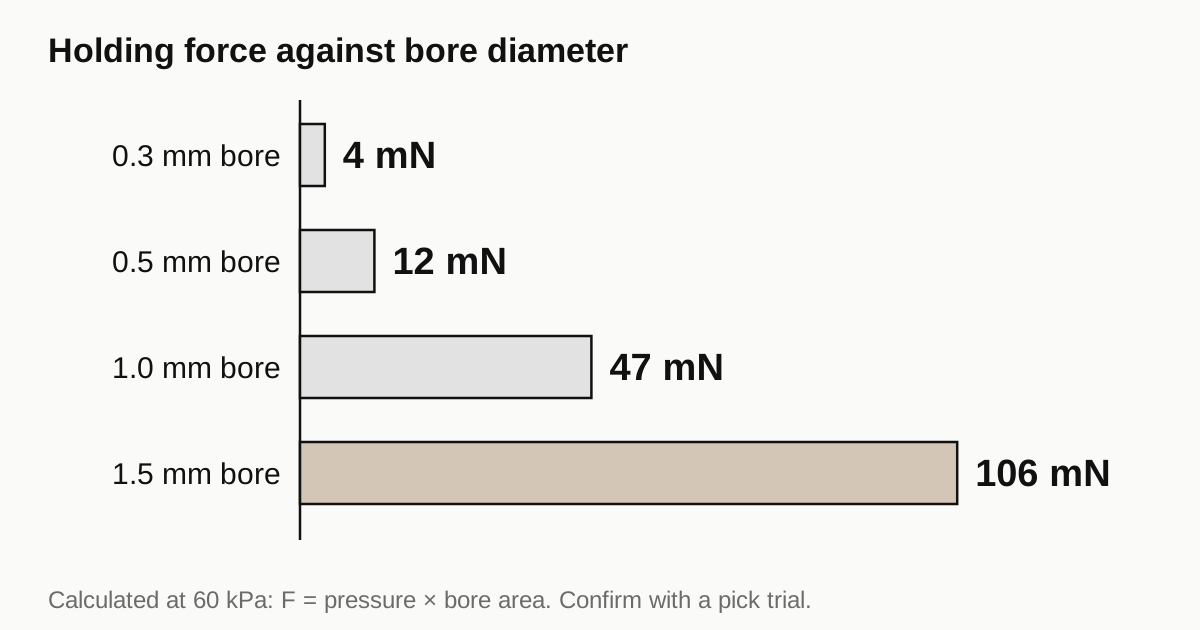
Holding force comes from vacuum pressure acting over the area of the bore, so it scales with the square of the bore diameter. A vacuum of about 60 kPa below atmosphere acting on a 0.5 mm bore gives roughly 12 millinewtons, which would hold a part of about 1.2 g at rest. Allow for head acceleration of several g and a safety factor of two or three, and the practical limit is around a tenth of a gram, far above a chip resistor that weighs a few milligrams. A 1 mm bore gives four times as much. A part that weighs a gram needs a bore of 1.5 to 2 mm or a wider seal. If the bore is too large relative to a small part, the part is drawn into the bore and tilts, or the vacuum picks up two parts at once. If it is too small, the part drops under acceleration. The sizing is a calculation plus a trial, and it is why the nozzle drawing carries the part dimensions, not just the shape of the tip.
Acceleration matters as much as weight. A head moving at several g multiplies the load on the part many times. A nozzle that holds a part at rest and drops it at speed has a bore or a seal problem, not a machine problem.
Collisions, bent shanks and damage
The most common cause of nozzle damage is a collision: the head descends onto a part that is not where it should be, or onto a tombstoned component. The shank bends, the tip chips or the spring seat cracks. A bent shank looks fine but places parts off position by tens of micrometers. Plants that see a sudden loss of placement accuracy should check for a bent shank before blaming the machine. A simple check is to roll the nozzle on a flat surface or spin it in a V block with a dial indicator.
A design that takes collisions into account uses a hardened shank, a stepped section that bends at a known place or a breakaway feature that protects the head. These are specified by the machine maker for its own nozzles. A copy that lacks them may save a few dollars and cost a head. That is another reason to trial copies before use.
Reordering and reverse engineering
Plants reorder nozzles often, and a machine shop gets the order from a sample or an old drawing. Three cautions:
- Interface. The shank, spring seat and vacuum connection must match the head exactly. Take the dimensions from the machine maker’s drawing or a new, unworn part.
- Material and hardness. A swap changes wear and part contact. Do not change without a trial.
- Trial before batch. Run a small lot of the new nozzle on the machine, check pick yield and placement accuracy and compare with the original.
Do not assume that a nozzle made to the dimensions of an old one will behave like the new one. Wear changes the old one. Measure an unworn tip or ask the maker for the nominal.
Cleaning, inspection and spares
Nozzles clog. Solder paste, flux, fibres and dust get into the bore and the tip. Plants clean nozzles ultrasonically or with a probe at set intervals, and inspect the tip under magnification. A chipped or worn tip is replaced. Keep a spare set for each nozzle type, and track pick failure rates by nozzle position to catch a failing nozzle early. Spares and consumable planning covers quantities.
Parts for a clean area should be cleaned and packed individually so the tip does not touch other parts. See packing and shipping to a fab.
What to ask a shop
- Have you made nozzles or collets for placement machines or die bonders, and for which models?
- What is the smallest bore you drill, and to what depth?
- How do you grind or lap the tip face, and how do you check its flatness?
- How do you deburr and inspect the bore edge?
- Can you supply a measurement report on the critical features?
- How do you pack small parts so tips are not damaged?
Whether to reorder a nozzle from the maker or a local shop is covered in OEM change kits vs locally made tooling, part of our guide to semiconductor jigs and fixtures.
Checklist before you send the RFQ
- Machine make and model, and the nozzle or collet type
- Drawing, sample or machine maker part number
- Material, hardness and surface treatment
- Bore, tip and shank dimensions, with the critical tolerances
- Tip face flatness and finish
- ESD requirement
- Cleaning and packing
- Quantity and a trial lot before the batch
Send them with the drawing through the RFQ form. We place it with a partner shop and send one itemised quote within 24 business hours.
Frequently asked questions
What is the difference between a nozzle and a collet?
Both pick a part by vacuum. Nozzle is the usual word on surface mount placement machines, where it picks components from a feeder and places them on a board. Collet is the usual word on die bonders and die sorters, where it picks a bare die. The shapes differ because the parts and the surfaces differ.
Can a machine shop make nozzles for a placement machine?
It can make a nozzle body that matches a drawing or a sample, but the machine maker's interface, such as the shank, the spring seat and the vacuum path, must be copied exactly. Many plants buy standard nozzles from the machine maker or a specialist and use machine shops for custom shapes and low volume parts.
Why do nozzles fail early?
Blocked vacuum holes, a worn or chipped tip, a contaminated face that fails to seal and bent shanks from collisions. A nozzle is a wear part. Cleaning on a schedule, inspection under magnification and a spare set for each type extend its life and keep placement yield up.
Need a quote for this part?
Send the drawing. We quote the finished parts, place the work with a partner shop in Vietnam and reply within 24 business hours.
Get a quoteMore on process
- JEDEC Matrix Trays and Custom Carrier Trays: When Machined Replaces Molded
- Designing a Package Nest: Pocket Size, Clearance, Lead-In and Datum
- Planning Production When Urgent Spares and New Jigs Share the Machines
- Semiconductor Jigs and Fixtures: Which Part Family, What to Specify, What Fails and Who Makes It
All guides and the sourcing glossary.