Guides / Process
Heat Treating Tool Steel Fixtures: Hardness, Distortion and Sequence
October 25, 2026
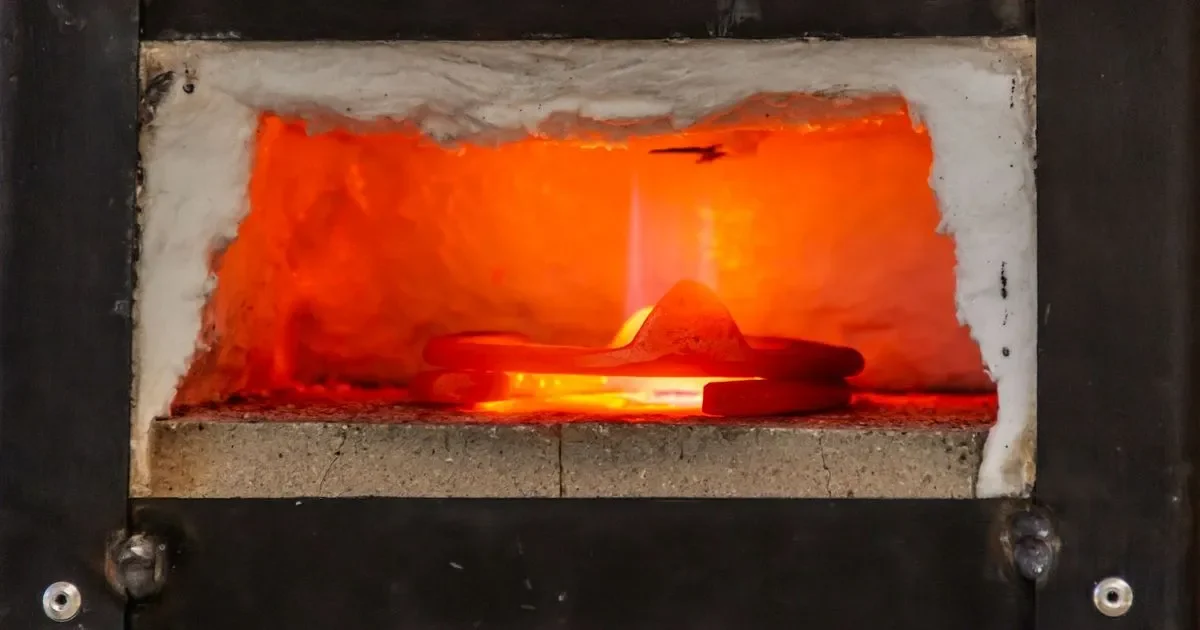
Hardened tool steel is the default for the parts of a fixture that wear: locating plates, nests, guide blocks, pins and punches. The hardness comes from heat treatment, and heat treatment moves metal. A plate that was flat and in tolerance before the furnace may be neither after. How well that is managed decides how much grinding follows and whether the fixture arrives on time.
This guide explains the steps, what each does and what a buyer should specify and ask for when the work is done in Vietnam.
What heat treatment does
Tool steel is shipped soft, usually annealed at around 200 to 250 HB, so that it machines. Heat treatment then makes it hard in three steps:
- Austenitizing. The steel is heated into a range where its structure changes, typically 1,000 to 1,050 °C for the common cold work and hot work grades.
- Quenching. It is cooled fast enough, in oil, gas or air depending on the grade, to lock the hard structure in place.
- Tempering. It is reheated to a lower temperature, usually 150 to 650 °C, to relieve the internal stress from quenching and set the final hardness and toughness.
After quenching the steel is very hard and brittle. Tempering trades some hardness for toughness. Skipping or delaying the first temper risks cracking.
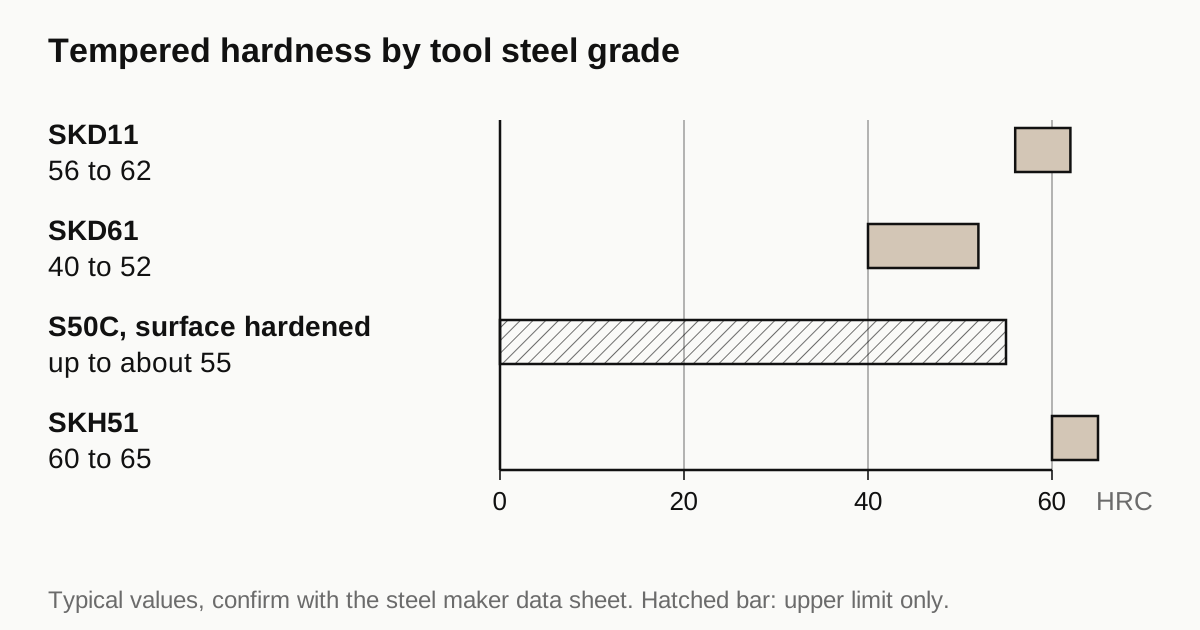
Typical hardness by grade
| Grade | Typical use | Hardening range, °C | Tempered hardness, HRC |
|---|---|---|---|
| SKD11 (D2 type) | Wear parts, punches, dies, nests | about 1,000 to 1,050 | 56 to 62 at low temper |
| SKD61 (H13 type) | Hot work tooling, tough plates | about 1,000 to 1,050 | 40 to 52 |
| S50C (1050 type) | General structural plates | about 820 to 860, or supplied pre-hard | up to about 55 with surface hardening |
| SKH51 (M2 type) | Cutters, punches under high load | about 1,200 and above | 60 to 65 |
Figures are typical. The steel maker’s data sheet gives the exact range for each melt and the supplier’s furnace gives the final result. The next article, SKD11, SKD61 and S50C for jigs and tooling, compares the three common grades in more detail.
Choosing hardness for the job
A harder plate is not always a better plate. The choices are:
- Through hardened to 56 to 62 HRC. For surfaces that slide, locate or wear against hardened pins. Brittle at corners and thin sections.
- Hardened and tempered to 45 to 52 HRC. For plates that take impact, such as clamp jaws and stops, where toughness matters.
- Pre-hardened, 30 to 40 HRC. Delivered at hardness, machined without a further furnace step. No distortion risk, lower wear resistance. The usual choice for base plates and body parts.
- Surface hardened. Induction hardening, nitriding or coating gives a hard skin on a tough core, for parts that need wear on one face only.
A common saving: make the body from pre-hardened or soft steel and use hardened inserts, pins or bushings only where contact occurs. The expensive treatment goes only where the function needs it.
Distortion and how to limit it
Every heat treated part changes. The change in a dimension is usually small in percent but large compared with fixture tolerances. A 200 mm plate that grows 0.05 percent grows 0.1 mm. Other changes, such as a bend or a twist, can be larger and less predictable.
Causes include residual stress from machining, uneven section thickness, asymmetric cutouts and quench severity. The ways to limit it:
- Rough machine first, leaving stock. Typically 0.3 to 0.5 mm per face on a plate, more on large parts.
- Stress relieve before hardening. A soak at 600 to 700 °C releases machining stress that would otherwise move during hardening.
- Keep sections even. Avoid thick and thin areas side by side where the design allows. Where it does not, say so, because it affects quench choice.
- Add dummy holes or ribs. Balanced geometry distorts more evenly.
- Use slower quenching. Gas and vacuum quenching are gentler than oil.
- Hang or support the part. Racked flat on a plate or hung on a pin, depending on the shape.
Even with care, plan to grind. Face grinding after hardening restores flatness and parallelism. Allowance for wire EDM and jig grinding comes after that, as described in wire EDM for precision jig plates and jig grinding.
Sub-zero and stability
High carbon, high chromium steels like SKD11 retain some austenite after quenching. Over time that can transform and change dimensions by a few micrometers per hundred millimetres. For fixtures where the position must remain stable for years, a sub-zero treatment, typically at minus 70 °C or colder, followed by a temper, converts most of it. Ask for it if the fixture is a reference or a gauge, not for ordinary working plates.
Vacuum and atmosphere
Heat treating in air leaves a scale and a decarburized surface layer that must be ground off. In a vacuum furnace or a controlled atmosphere, the surface stays bright. For parts with finished surfaces or small stock allowances, vacuum treatment saves grinding and risk. Ask what the furnace atmosphere is and how much stock to leave. A shop that says “leave 0.3 mm” for air treatment and “leave 0.1 mm” for vacuum is describing the same physics.
Need a quote for this part? Get a quote
Case hardening and carbon steel plates
Not every plate is a high alloy tool steel. S50C and similar medium carbon steels harden only to the low 50s HRC at the surface and much less through a thick section, because they lack the alloy content to harden deeply. That is enough for a bracket or a stop that sees light wear, and it is cheap. Induction hardening treats only a chosen surface, which limits distortion to that region. Low carbon steels such as S15C can be carburized, which adds carbon to the surface and hardens it after quenching to about 58 to 62 HRC with a soft core, a process often used for pins and shafts. Each route has its own distortion pattern and its own stock allowance, so name the process on the drawing rather than only the hardness.
Coatings after heat treatment
Many hardened fixture parts get a coating afterwards, such as black oxide, nitride or electroless nickel. The coating temperature must stay below the temper temperature, or the hardness drops. Electroless nickel baked at 200 °C is safe on parts tempered at 200 °C or higher but would soften a part tempered at 150 °C. Check the temper temperature against the coating cycle before choosing both. Electroless nickel on machined parts covers the plating side.
Records and verification
A heat treat record is short and worth having. It should state:
- Material grade and heat number from the mill certificate
- Furnace type and atmosphere
- Austenitizing temperature and time
- Quench medium
- Temper temperatures and number of tempers
- Measured hardness, with the method and the number of points
- Date and operator
Hardness is checked on a Rockwell C tester on a ground surface. Ask for readings at several places on the plate, not one. The certificate of the steel itself matters too: mill test certificates from Vietnamese shops covers what it should include.
Where heat treatment happens
Some Vietnamese machine shops treat in house. Many send the work to a specialist heat treater. Both can work, but the hand-off adds days and risks. If a plate leaves the shop for the furnace, ask how it is identified, how it is packed and who checks it on return. See where the weeks go on a machined part.
What to ask a shop
- Is heat treatment done in house or outsourced, and to whom?
- What furnace type and atmosphere will be used for SKD11 plates?
- How much stock is left for grinding after hardening?
- Is stress relief done before hardening on plates with large cutouts?
- How many hardness readings are reported, and on which surface?
- What is the process for a plate that comes back out of flatness?
Heat treatment is one step in our guide to semiconductor tooling materials.
Checklist before you send the RFQ
- Steel grade, using a standard such as JIS G4404
- Hardness target and tolerance, for example 58 to 60 HRC
- Which faces carry the hardness, if surface hardened
- Whether sub-zero treatment is needed
- Stock allowance and the grinding sequence after treatment
- Flatness required after final grinding
- The record to be delivered with the plate
Send the drawing through the RFQ form. We place it with a partner shop and send one itemised quote within 24 business hours.
Frequently asked questions
What hardness should a fixture plate have?
It depends on the job. A locating plate or nest that sees contact wear usually runs 56 to 62 HRC. A plate that mainly holds shape and takes screw loads can be much softer, pre-hardened at about 30 to 40 HRC, and avoids the hardening step altogether. Ask for the hardness the function needs, not the highest the steel can reach.
Why does a plate warp in the furnace?
Heating relieves residual stress from machining and the steel changes structure on quenching, which changes volume. Thin plates, plates with uneven sections and plates with large cutouts move most. Rough machining, stress relieving before hardening and leaving stock for grinding afterwards are the usual protections.
Is vacuum hardening better than salt bath or air furnace treatment?
Vacuum treatment gives a clean surface with no scale or decarburization, which saves grinding stock and is preferred for high alloy tool steels. It costs more per load. For simple carbon steel plates that will be ground heavily afterwards, a conventional furnace is often enough. The deciding factor is how much finish stock the plate carries.
Need a quote for this part?
Send the drawing. We quote the finished parts, place the work with a partner shop in Vietnam and reply within 24 business hours.
Get a quoteMore on process
- JEDEC Matrix Trays and Custom Carrier Trays: When Machined Replaces Molded
- Designing a Package Nest: Pocket Size, Clearance, Lead-In and Datum
- Planning Production When Urgent Spares and New Jigs Share the Machines
- Semiconductor Jigs and Fixtures: Which Part Family, What to Specify, What Fails and Who Makes It
All guides and the sourcing glossary.