Guides / Materials
SKD11, SKD61 and S50C: Choosing the Steel for a Jig or Tool
October 24, 2026
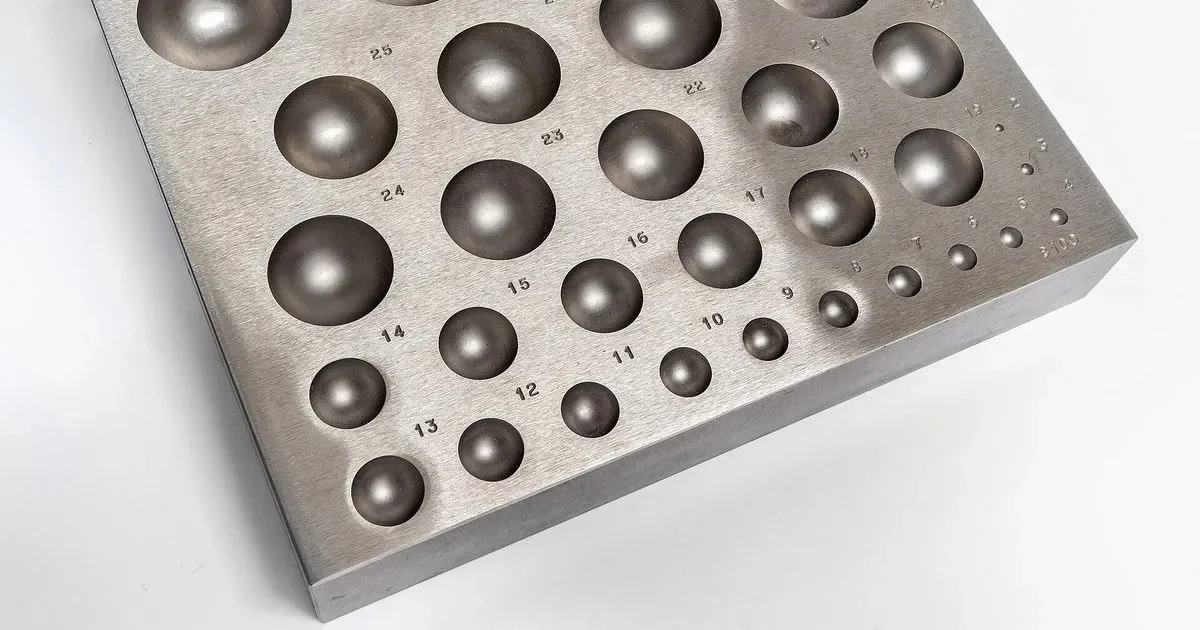
Most jigs and fixtures are made from a short list of steels. Three of them, SKD11, SKD61 and S50C, appear on Japanese and Vietnamese drawings so often that buyers elsewhere sometimes have to look them up. They are different materials for different jobs. Picking the wrong one costs money in two ways: a part that wears out early, or a part that carries expensive hardening it never needed.
This guide compares the three on what they do in service, shows the nearest ASTM, AISI and DIN grades and lists what to put on a drawing.
Where the names come from
SKD11 and SKD61 are alloy tool steels in the Japanese standard JIS G4404. S50C is a carbon steel for machine structural use in JIS G4051. The same letters appear on drawings from Japanese equipment makers, Korean subcontractors and many Vietnamese shops that learned from Japanese customers.
| JIS grade | Nearest AISI or ASTM | Nearest DIN or EN | Family |
|---|---|---|---|
| SKD11 | D2 | 1.2379, X153CrMoV12 | Cold work, high carbon, high chromium |
| SKD61 | H13 | 1.2344, X40CrMoV5-1 | Hot work, medium carbon, 5 percent chromium |
| S50C | 1050 | C50E, EN 10083 | Medium carbon steel |
Nearest means close, not identical. Composition limits differ between standards by a few tenths of a percent on some elements, and a mill certificate for one grade may not meet the limits of its neighbour. For a part where it matters, cite the standard on the drawing and ask for the certificate. See JIS against ASTM material grades on drawings.
What each steel is made of
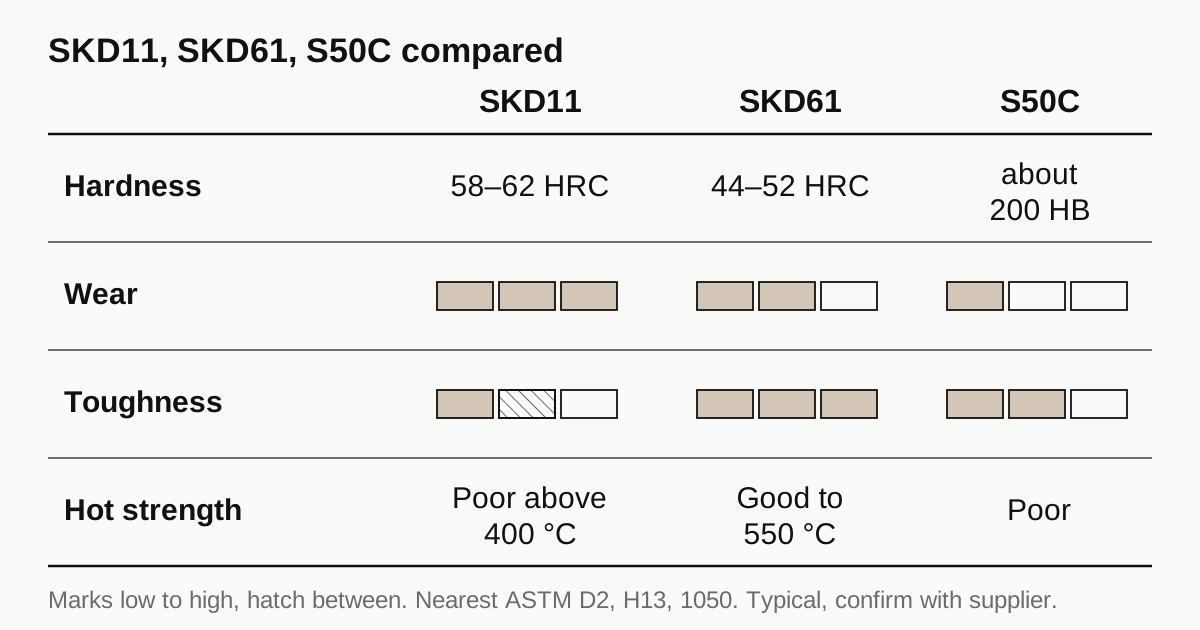
SKD11. About 1.4 to 1.6 percent carbon, 11 to 13 percent chromium, with molybdenum and vanadium. The high carbon and chromium form hard carbides that resist wear. It hardens to 58 to 62 HRC and holds an edge. The price is lower toughness: it chips at corners and thin sections.
SKD61. About 0.35 to 0.42 percent carbon, 4.8 to 5.5 percent chromium, with molybdenum and vanadium. Less carbide, more toughness. It is designed to take thermal cycling and keep its strength at elevated temperature. It hardens to 44 to 52 HRC for most uses and resists heat checking.
S50C. About 0.47 to 0.53 percent carbon with little else. It machines easily and is inexpensive, but through hardening is shallow, and it softens quickly with heat. Typically supplied at 170 to 230 HB, it can be induction hardened on the surface.
How they compare in service
| Property | SKD11 | SKD61 | S50C |
|---|---|---|---|
| Typical working hardness | 58 to 62 HRC | 44 to 52 HRC | about 200 HB, or 50 to 55 HRC surface hardened |
| Wear resistance | High | Medium | Low |
| Toughness | Low to medium | High | Medium |
| Hot strength | Poor above about 400 °C | Good to about 550 °C | Poor |
| Dimensional change on hardening | Low, air or vacuum quench | Low, air or vacuum quench | Higher, water or oil quench |
| Machinability annealed | Moderate | Good | Very good |
| Relative cost | Medium to high | Medium to high | Low |
Values are typical. Heat treatment shifts all of them. See heat treating tool steel fixtures for how hardness and distortion are managed.
Matching steel to jig parts
Locating pins, nests and guide blocks that slide or wear: SKD11 hardened to about 58 to 60 HRC. This is the default for parts where contact wear sets the life.
Punches and dies in trim and form tools: SKD11 for general work, carbide or powder metallurgy steel for long runs. See trim and form tooling for OSAT lines.
Clamp jaws, stops and parts that take impact: SKD61 at about 45 to 50 HRC, or a tough carbon steel. SKD11 at full hardness can chip.
Parts exposed to repeated heating: SKD61 resists cracking from thermal cycling. Heated test fixtures, hot plates and tooling near soldering or curing zones use it or aluminum instead.
Base plates, brackets, frames and covers: S50C, or aluminum if weight matters. Hardening is not needed, and the steel is cheaper to machine.
Plates where stability matters more than wear: pre-hardened alloy steels such as SCM440 at about 28 to 32 HRC are often used, avoiding a furnace cycle.
Where the choice goes wrong
SKD11 everywhere. Specifying SKD11 hardened to 60 HRC on a bracket that will never wear adds cost and risk. Hardening a bracket also adds a distortion step and a grinding step.
SKD61 for wear plates. The steel is tough, but it is softer. A plate that wears out in months costs more than the extra price of SKD11.
S50C as a hardened locating part. A through hardened S50C pin will not hold its hardness through the section and will wear sooner than a proper tool steel pin.
Hardness stated without the grade. “Hardened to 58 HRC” on a drawing without a steel grade lets the shop choose. A shop under price pressure may choose a steel that reaches 58 HRC on the surface and nowhere else.
Mixed-up equivalents. A buyer who orders “D2” and gets SKD11 usually gets what was meant. A buyer who orders “SKD11” and receives a Chinese Cr12MoV, a similar but not identical grade, may not. Verify against the certificate.
Need a quote for this part? Get a quote
Machining and finishing notes
SKD11 in the annealed state machines well, then hardens and distorts little. After hardening, only grinding and EDM cut it. It grinds slower than carbon steel and burns easily, so grinding needs a competent shop and proper coolant. SKD61 machines similarly and EDMs without trouble, though the recast layer cracks if cooled badly. S50C machines freely, produces long chips and benefits from sharp tools.
Surface treatments extend life. Nitriding SKD61 gives a hard surface at low distortion. Black oxide helps corrosion for a low cost. Electroless nickel works on all three, as covered in electroless nickel plating.
A worked example: one fixture, three steels
Take a test fixture with a base plate, a locating plate and a clamp. The base plate carries the loads and the screws, wears nowhere and never sees heat. S50C or an aluminum plate is enough, and the cheapest route is to machine it from annealed stock and leave it alone. The locating plate carries the dowel holes and the nest edges that a part slides against thousands of times. That plate is the place for SKD11, hardened to about 58 to 60 HRC, ground flat and wire cut. The clamp jaw has a spring behind it and snaps against a stop. It sees impact, so SKD61 at about 48 HRC or a tough pre-hardened steel will outlast a brittle SKD11 jaw.
One fixture, three steels, three heat treatment routes: one of the three needs no furnace at all. A drawing that puts SKD11 at 60 HRC on all three parts costs more, adds two distortion risks and lowers the life of the clamp. This is the place where a short note on the drawing, listing the steel and the hardness for each part separately, earns its time.
When to move beyond these three
Some jobs outgrow them. Very long production runs, abrasive filled plastics and thin ceramic parts wear SKD11 faster than the budget allows. The next steps up are powder metallurgy tool steels, which hold a finer carbide structure and wear longer at similar toughness, and tungsten carbide, which is far harder and far less tolerant of impact. Both cost more to buy and much more to grind and cut by EDM, so they are normally used for small inserts rather than whole plates. At the other end, a nitrided or coated SKD61 or a hard anodized aluminum plate can give adequate life at lower cost. The grade should follow the measured wear, not the other way round.
What to write on the drawing
- The steel grade and standard, such as SKD11 (JIS G4404) or D2 (ASTM A681)
- The heat treatment: hardness range and which faces
- Whether pre-hardened stock is acceptable
- The finish and the flatness after treatment
- An alternative grade if one is acceptable, stated as a note
- The certificate requirement: type of mill certificate and heat number marking
If more than one steel could work, say which is preferred and which is acceptable. A shop that has SKD11 stock but not SKD61 can offer a swap without the buyer discovering it at delivery.
Stock and lead time
In Vietnam, tool steel bar and plate are often supplied from Japan, Korea, Taiwan and China through local distributors. A common grade in a common size is in stock. A large plate, a rare size or a special melt, such as a premium remelted grade, can take weeks. Checking stock before quoting avoids a surprise. Where the weeks go on a machined part lists the other bottlenecks.
For where tool steel sits among the other tooling materials, see our guide to semiconductor tooling materials.
Checklist before you send the RFQ
- Steel grade and standard, with an acceptable alternative if any
- Hardness range and the surfaces it applies to
- Distortion and flatness allowance after treatment
- Whether sub-zero or surface treatment is needed
- Coating or plating after hardening
- Certificate type and heat number traceability
- Size of the starting stock and the delivery time
Send them with the drawing through the RFQ form. We place it with a partner shop and send one itemised quote within 24 business hours.
Frequently asked questions
Is SKD11 the same as D2?
They are close equivalents, not identical. SKD11 is the JIS designation and D2 is the AISI and ASTM name. Both are high carbon, high chromium cold work tool steels with similar composition ranges. The limits differ slightly between standards, so if the drawing needs a specific chemistry, cite the standard and ask for the mill certificate.
Can I use SKD61 instead of SKD11 for a wear plate?
Usually not as a direct swap. SKD61 is tougher and holds up better to heat cycling, but at the same hardness it wears faster than SKD11 because it carries much less chromium carbide. For a plate where sliding wear is the main failure, SKD11 is the usual choice. For a part that sees impact or heat, SKD61 fits better.
When is S50C enough?
For structural parts that do not need hardened wear surfaces: base plates, brackets, frames and covers. S50C is a medium carbon steel that machines easily, is cheap and can be surface hardened by induction. It is a poor fit for parts that depend on edge retention or through hardness.
Need a quote for this part?
Send the drawing. We quote the finished parts, place the work with a partner shop in Vietnam and reply within 24 business hours.
Get a quoteMore on materials
- Cleaning Agents Against Fixture Materials: IPA, Acetone, Alkaline Flux Removers and Plasma
- RoHS, REACH and Halogen-Free Declarations for Jig and Fixture Materials: What a Shop Can Sign and What It Cannot
- Materials for Semiconductor Tooling: Pick the Metal, Plastic and Finish, Write the Callout, Prove It on Receipt
- Thermal Expansion of Fixture Materials: Aluminum, Steel, Laminates and Plastics Against Silicon
All guides and the sourcing glossary.