Guides / Materials
Reading JIS and ASTM Material Grades on a Machining Drawing
October 18, 2026
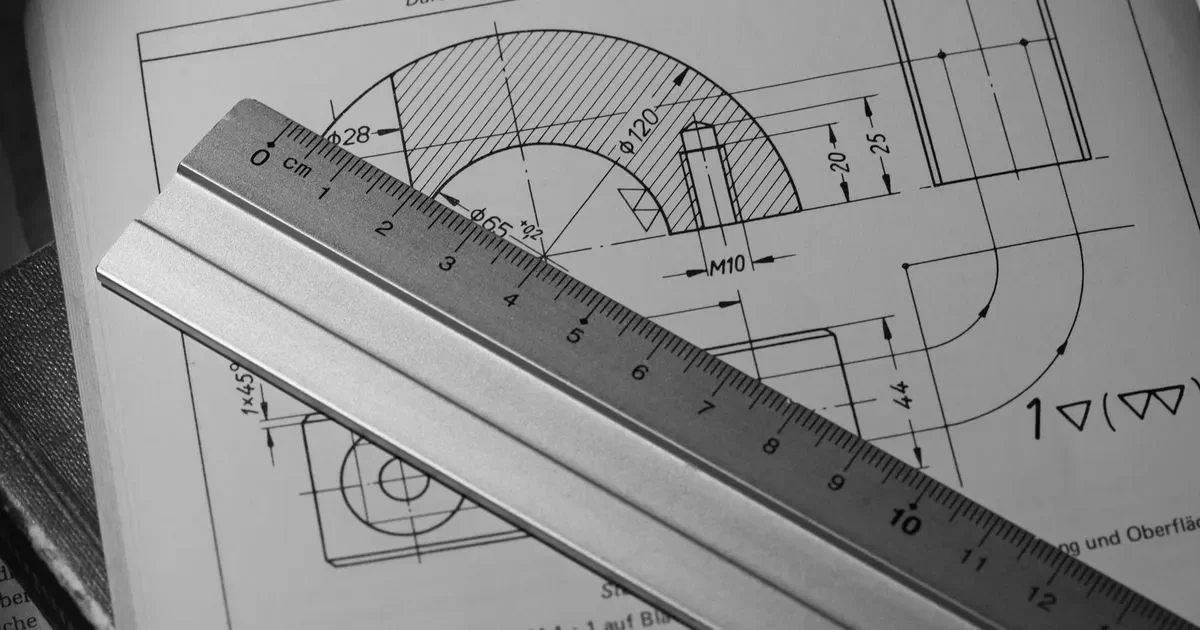
Drawings for fixtures, jigs and tooling that originate in Japan, Korea, Taiwan or a Japanese owned plant in Vietnam name materials in JIS grades. A buyer in the United States or Europe may be used to ASTM, AISI or EN. Neither is wrong. The problem begins when a grade is read as a different one, or when two grades are called equivalent and then one is delivered with a certificate to the other.
This guide gives a lookup table for the grades that appear most on jig and tooling drawings, explains what equivalent really means and lists the notes that prevent a dispute.
What the letters mean
JIS is the Japanese Industrial Standard. Its grades start with letters that tell the family, and the numbers follow. A short key:
- SUS is stainless steel, from Steel Use Stainless
- S followed by two digits and C, such as S45C, is a carbon steel for machine structure, with the digits giving about 100 times the carbon percentage
- SCM is chromium molybdenum alloy steel
- SK, SKD, SKH are tool steels: carbon tool, alloy die and high speed
- SUJ is high carbon chromium bearing steel
- A followed by digits, such as A6061, is aluminum, using the same four digit alloy number as the international system
- C followed by digits, such as C3604, is a copper alloy using the same number as the Copper Development Association
ASTM and AISI use their own systems: numbers for steels, letters and numbers for tool steels such as D2 and H13 and the four digit scheme for aluminum.
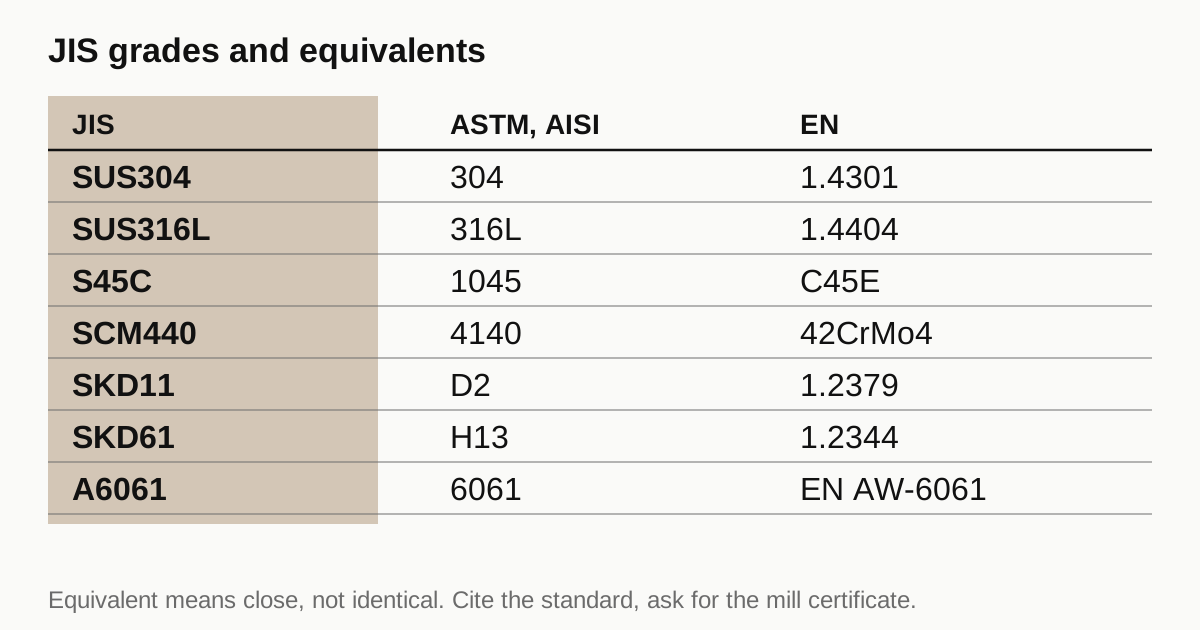
Nearest equivalents for common jig materials
| JIS grade | Material | Nearest ASTM, AISI or UNS | Nearest EN or DIN |
|---|---|---|---|
| SUS304 | Austenitic stainless | 304, UNS S30400 | 1.4301 |
| SUS303 | Free machining stainless | 303, UNS S30300 | 1.4305 |
| SUS316 | Austenitic stainless with molybdenum | 316, UNS S31600 | 1.4401 |
| SUS316L | Low carbon 316 | 316L, UNS S31603 | 1.4404 |
| SUS420J2 | Hardenable stainless | 420, UNS S42000 | 1.4034 |
| SUS440C | High carbon hardenable stainless | 440C, UNS S44004 | 1.4125 |
| S45C | Medium carbon steel | 1045 | C45E, 1.1191 |
| S50C | Medium carbon steel | 1050 | C50E |
| SCM440 | Chromium molybdenum steel | 4140 | 42CrMo4, 1.7225 |
| SKD11 | Cold work tool steel | D2 | 1.2379 |
| SKD61 | Hot work tool steel | H13 | 1.2344 |
| SKH51 | High speed steel | M2 | 1.3343 |
| SUJ2 | Bearing steel | 52100 | 100Cr6, 1.3505 |
| A5052 | Aluminum magnesium | 5052 | EN AW-5052 |
| A6061 | Aluminum magnesium silicon | 6061 | EN AW-6061 |
| A7075 | Aluminum zinc | 7075 | EN AW-7075 |
| C3604 | Free cutting brass | C36000 | CuZn39Pb3 |
| C1100 | Tough pitch copper | C11000 | Cu-ETP |
The table is a lookup, not a substitution rule. Where the cells say nearest, they mean close in composition and use. The rest of this guide explains why that is not enough for a controlled part.
What equivalent really means
Two grades called equivalent have overlapping composition ranges. They rarely have identical ranges. SUS303 and 303 are an example: both are sulfur bearing free machining stainless, but the limit on sulfur, phosphorus and the added elements differs between JIS and ASTM, and some Japanese grades allow a little selenium or copper. The material works the same way on a machine and in service, in nearly all cases.
For a fixture, that distinction does not matter. For a vacuum part, a medical part or anything with a customer rule on composition, it does. Differences that matter in practice:
- Carbon and sulfur limits in stainless affect corrosion and weld behavior
- Chromium and nickel ranges change magnetic response and cold work behavior
- Residual elements such as copper or lead in steel and brass, which some customers restrict
- Mechanical property requirements, which the grade does not set. They come from the product standard or the temper you ask for
A mill certificate to one standard does not prove compliance with another. If the drawing says SUS304 and the certificate says 304 to ASTM A276, a careful buyer asks whether the composition also meets JIS G4303.
The standard sets the product, not just the grade
A grade name only names the alloy. The product form, size tolerance, surface condition and test requirements come from a product standard. For bar, plate, sheet and pipe, different standards apply, even for the same alloy. Examples: JIS G4303 for stainless bar, JIS G4304 and G4305 for stainless plate and sheet, ASTM A276 for stainless bar and A240 for plate. Aluminum plate, bar and extrusion follow JIS H4000, H4040 and H4100, or ASTM B209, B211 and B221.
Dimension and tolerance rules differ. A bar rated h9 or “turned and polished” in one standard is not the same in another. If the part is machined from the bar, the difference is small. If the part uses the bar surface, it matters.
Temper and condition
The grade is not the whole material. A6061 can be soft, T4 or T6, and each has a different strength. S45C can be annealed, normalized or quenched and tempered. Cold work stainless is stronger than annealed stainless of the same grade. A drawing that gives a grade without a condition leaves the shop to choose, usually the cheapest in stock.
Write the condition with the grade: A6061-T651, S45C quenched and tempered to 25 to 30 HRC, SUS304 annealed. For tool steels, specify the heat treatment as covered in heat treating tool steel fixtures. For aluminum alloys in semiconductor parts, see aluminum alloys for semiconductor parts.
Need a quote for this part? Get a quote
Chinese and other national grades
Vietnamese shops buy steel from Japan, Korea, Taiwan, China, India and local mills. A distributor may offer a Chinese grade at a lower price as a replacement for a JIS one. Some replacements are fine for a jig plate. Others change the material in ways that matter. For example, Cr12MoV is a Chinese die steel often compared with SKD11 and D2, and it is similar but differs in carbon and vanadium content, with different hardening and wear behavior.
If a substitute is acceptable, list it on the drawing as an approved alternative. If it is not, say so with a plain note: “No substitute without written approval.” A shop that has to ask is cheaper than a shop that guesses.
Writing the callout so nobody has to guess
A callout that works in any country has five parts:
- The grade, in the standard you work to
- The standard number
- The condition or temper
- The accepted equivalents, if any
- The certificate requirement
An example: “Stainless steel SUS304 per JIS G4303, annealed. Equivalent accepted: ASTM A276 Type 304 annealed. Mill certificate EN 10204 type 3.1 required.” That is one line and it removes most of the arguments.
For parts where composition is critical, add the limit that matters: “Sulfur 0.030 percent maximum”, or “no added lead”.
A short example of how it goes wrong
A buyer sends a drawing from a Japanese equipment maker. The material note says SUS304 and nothing else. The shop in Vietnam buys 304 bar from a local distributor, machines the part and ships it with a certificate that cites ASTM A276. The buyer’s quality group reads the drawing, sees JIS, sees ASTM on the certificate and rejects the lot as a wrong standard. The material is correct. The paperwork is not what the drawing asked for, and the part sits in quarantine for three weeks while two quality departments exchange emails.
Nothing in the metal was wrong. The note was. One extra line, “Certificate to JIS G4303 or ASTM A276, either accepted”, would have closed it before the order was placed. The cheapest time to settle a standard is before cutting starts, and the cheapest place is the drawing.
When the drawing has no grade at all
Some drawings name only a generic material, such as “stainless steel” or “aluminum”. The shop must then choose, and it will choose by price and stock. For a bracket or a cover, that is fine. For a locating plate, a vacuum part or anything that touches product, it is not. If a drawing comes from an old design without a grade, ask the original maker, or measure the existing part with an analyzer and a hardness tester and write the result on the new drawing. Do not let the supplier decide silently, and do not accept “commercial grade” as a specification.
Checking what arrives
A certificate is a document. The material in the bar is what matters. For high stakes parts, positive material identification with a handheld X-ray fluorescence analyzer takes seconds and confirms the main alloy elements. It does not replace a lab analysis but catches the wrong grade, a mix up between 304 and 316 or between brass and bronze. Ask whether the shop owns an analyzer and uses it on incoming stock. Mill test certificates from Vietnamese shops covers certificate types and what to check on them.
What to ask a shop
- Which standard does your stock follow, and can you show the certificate to that standard?
- Where does the material come from: mill, distributor or import?
- Do you check incoming stock with an analyzer or by lab test?
- If the drawing names a grade you do not stock, what do you offer and do you ask first?
- How do you mark and segregate material so grades do not mix?
Checklist before you send the RFQ
- Grade, standard and condition on the drawing
- Equivalent grades accepted, and any that are not
- Composition limits that matter, stated as numbers
- Certificate type and the standard it must cite
- Whether positive material identification is required on receipt
- Material and standard in the RFQ text, not only on the drawing
Send them with the drawing through the RFQ form. We place it with a partner shop and send one itemised quote within 24 business hours. For a quick pre-send review, the drawing checklist covers material notes along with tolerances and finish.
See also: the full JIS, ASTM and EN cross-reference table, including Korean KS names.
Frequently asked questions
Is SUS304 exactly the same as ASTM 304?
They are the same family with nearly the same composition limits. SUS304 comes from the Japanese standard JIS G4303 and similar parts, and 304 stainless is covered by ASTM A276 for bar. A small difference in the limit on one element is possible, so a part with a strict specification should cite the standard and carry a mill certificate to that standard.
Which standard should the drawing cite if I am buying in Vietnam?
The one your own specification and customer use. Vietnamese shops read JIS, ASTM, DIN and EN grades daily and can source any of them. State the standard, the grade and the condition, and allow a stated equivalent if you accept one. Never write only a trade name or a local name.
Can a shop substitute a Chinese grade for a JIS grade?
Only if the drawing allows it and the buyer agrees. Chinese GB grades such as 1Cr18Ni9Ti, 45 steel or Cr12MoV are close to JIS and ASTM grades in some cases and different in others. If an equivalent is acceptable, list it by name on the drawing. If it is not, say so.
Need a quote for this part?
Send the drawing. We quote the finished parts, place the work with a partner shop in Vietnam and reply within 24 business hours.
Get a quoteMore on materials
- Cleaning Agents Against Fixture Materials: IPA, Acetone, Alkaline Flux Removers and Plasma
- RoHS, REACH and Halogen-Free Declarations for Jig and Fixture Materials: What a Shop Can Sign and What It Cannot
- Materials for Semiconductor Tooling: Pick the Metal, Plastic and Finish, Write the Callout, Prove It on Receipt
- Thermal Expansion of Fixture Materials: Aluminum, Steel, Laminates and Plastics Against Silicon
All guides and the sourcing glossary.