Guides / Materials
Beryllium Copper and Copper Alloys for Contact Parts: Choosing and Machining
October 11, 2026
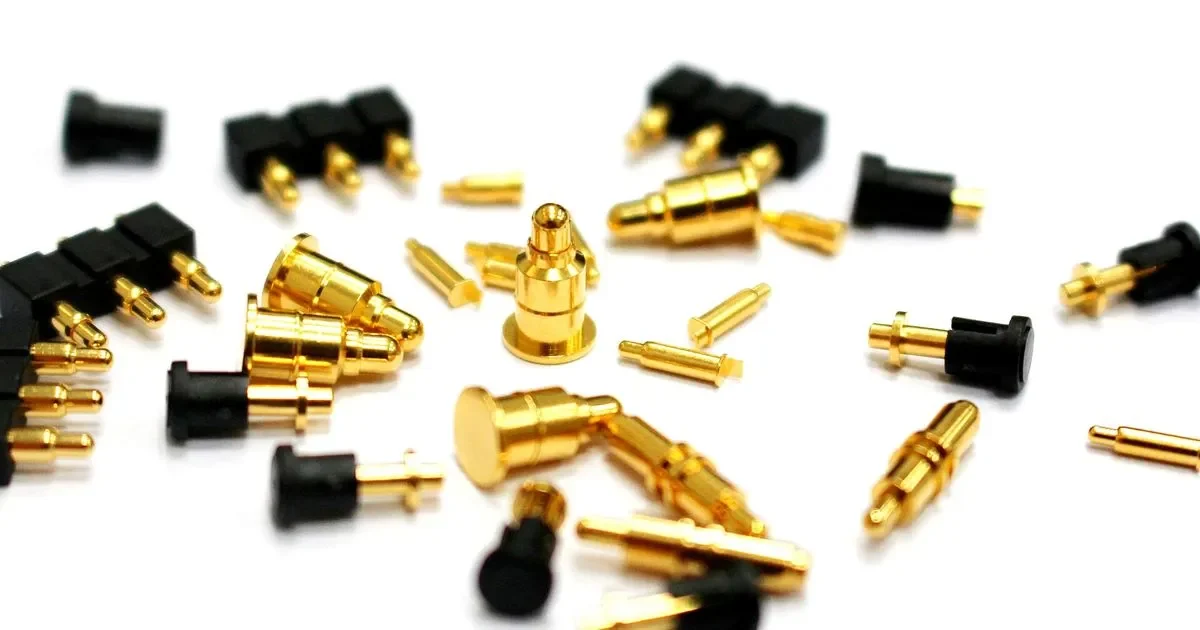
Test sockets, probe contacts, burn-in connectors and handler pins need a metal that is springy, conductive and tough enough to survive thousands of mating cycles. Few alloys deliver all three. Beryllium copper does, which is why it appears on drawings for contact parts in spite of its price and the safety rules that come with it.
This guide covers where beryllium copper fits, what the heat treatment does, how the common alternatives compare and what to ask a shop before sending it a drawing.
What beryllium copper is
Beryllium copper is a copper alloy with about 0.4 to 2 percent beryllium. The high strength grades, such as the one numbered C17200, hold about 1.8 to 2 percent. The low beryllium, high conductivity grades, such as C17510, hold 0.2 to 0.7 percent along with cobalt or nickel.
The alloy is precipitation hardening. Supplied in the solution annealed condition it is soft and cuts like other copper alloys. A low temperature age hardening cycle then forms fine precipitates that raise its tensile strength to a level near that of many steels, with a high fatigue life and no loss of its non magnetic, non sparking character.
Why contact parts use it
Three properties together:
- Spring behavior. After aging, the alloy has a high yield strength and a modulus lower than steel, so it flexes a long way without taking a set.
- Fatigue life. It survives repeated flexing, which is what a contact finger does on every cycle.
- Conductivity. Lower than pure copper, far above steel and stainless, so current flows without heating the contact.
It is also non magnetic and does not produce sparks on impact, which is the reason it shows up in tools for explosive atmospheres.
Comparing the alloys
| Alloy | Tensile strength, aged, MPa | Electrical conductivity, % IACS | Notes |
|---|---|---|---|
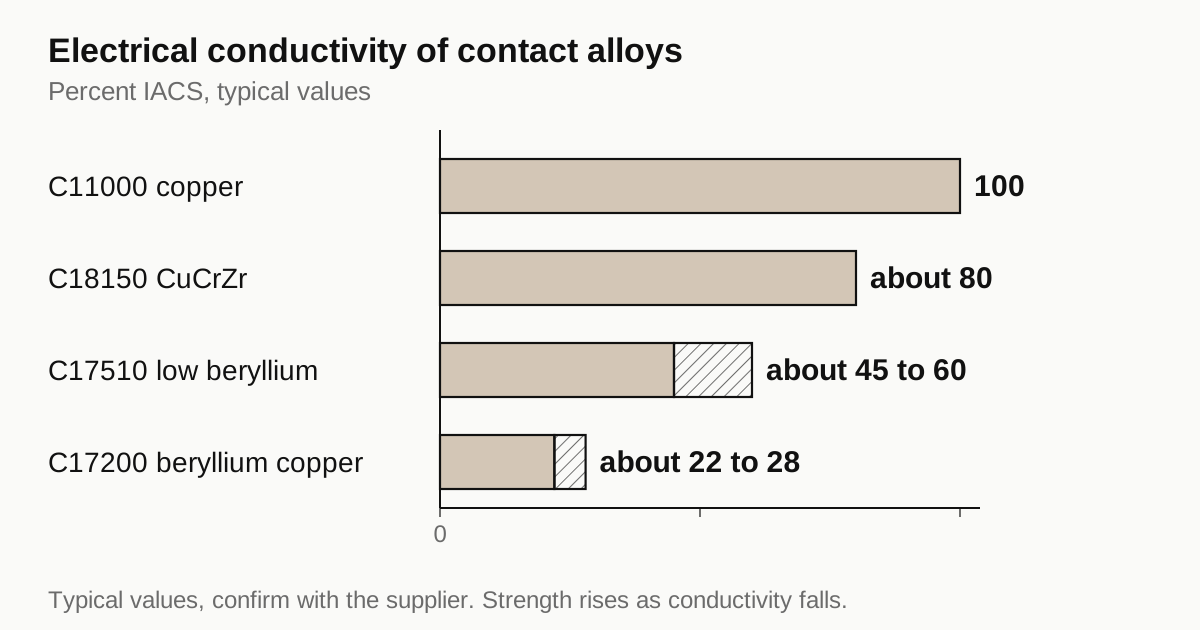
| C17200 beryllium copper | about 1,200 to 1,400 | about 22 to 28 | Highest strength, springs, probes |
| C17510 low beryllium | about 700 to 900 | about 45 to 60 | Balance of strength and current |
| C51000 phosphor bronze | about 500 to 700 | about 15 to 20 | No beryllium, common spring alloy |
| C18150 copper chromium zirconium | about 450 to 550 | about 80 | High conductivity, lower spring strength |
| C14500 tellurium copper | about 300 to 400 | about 90 | Free machining, not a spring |
| C11000 copper | about 220 to 340 | 100 | Pure conductor, soft |
Values are typical ranges. Condition and form change them. IACS means International Annealed Copper Standard, with 100 percent equal to pure annealed copper.
The table shows the trade. High strength costs conductivity. If a contact carries a high current, a spring that heats up loses temper and fails, so the usual solution is a stronger alloy for the spring member and a high conductivity material for the current path.
Machining beryllium copper
In the soft, solution annealed condition the alloy machines like a medium copper alloy. Use sharp carbide tooling, positive rake and plenty of coolant. Chips are stringy. Free cutting grades exist but contain lead, which is a separate concern for some customers.
Machine to the pre-aging shape, then age harden. Aging causes a small, repeatable change in size, usually a shrinkage of 0.1 to 0.2 percent for C17200. Shops that run the alloy regularly know the factor for their stock and heat cycle. Parts with tight tolerances are often finished by grinding after aging.
Aging itself is a furnace step. Typical conditions are about 315 to 340 °C for 2 to 3 hours for C17200. The result depends on the starting temper, so the specification should state both. If a shop outsources aging, see heat treating tool steel fixtures for the same hand off questions that apply to steel.
Safety and what to ask a shop
This is the section buyers skip and should not. The hazard from beryllium is inhalation of airborne particles. It can sensitize the lungs and cause chronic beryllium disease, an incurable condition. Solid metal in finished form is not a hazard to handle. Dust, fume and mist from grinding, polishing, sanding, EDM and some cutting are.
Regulators set strict exposure limits. In the United States, the OSHA limit is 0.2 micrograms per cubic metre as an eight hour average. Other regions have similar or tighter limits, and customers often add their own rules. A shop that handles the alloy should have:
- A written exposure control plan
- Local exhaust ventilation on grinding and polishing
- Separate collection of chips and dust
- Operator training and a medical surveillance policy
- Rules for cleaning surfaces and clothing
- Waste handling for chips, sludge and filters
Ask the shop which of these it has. A shop that machines C17200 with the same dust extraction it uses for aluminum is not controlling the risk. A shop that declines the job is making a responsible choice, and we take that as useful information about the shop, not a failure.
Some shops decline beryllium copper altogether. Others limit it to turning and milling in the soft state and send grinding to a specialist. Check before the order, not after the quote.
Need a quote for this part? Get a quote
When to use something else
If the drawing says C17200 because it always has, check whether the function needs it. Consider alternatives when:
- The contact is a simple spring with a modest force and a modest cycle count. Phosphor bronze or a copper nickel silicon alloy is often enough.
- The part carries significant current. A low beryllium alloy or a copper chromium zirconium part gives lower resistance and less heating.
- The customer limits beryllium. Some plants exclude it by policy.
- The part is a probe body or a housing rather than a spring. Brass or copper alloy machines freely and costs much less.
The part may also be plated. Hard gold over nickel is typical on contact surfaces, and nickel alone suits internal parts. Plating adds a thickness that changes the fit. See electroless nickel plating for how thickness interacts with tolerance.
Fatigue, stress relief and handling after aging
A contact finger lives by flexing. Its life depends on the stress amplitude at the root of the bend, the surface finish at the root and any notch left by machining. Tool marks across a bend act as starting points for fatigue cracks, so spring members are often finished with a light polish or electropolish along the stress direction, after aging, with the same dust controls as any other grinding step. Burrs at the root of a slot do the same job. Specify an edge break or a radius where the finger meets its base, not a sharp internal corner.
Aged beryllium copper is hard and springy but not tough in the way steel is. Bending a part after aging, to adjust a contact, can crack it. Adjustments should be made before aging, in the soft state, or are designed out. Packing matters as well: contact parts are small, fragile and easily bent, so they ship in individual cells or in a tray, not loose in a bag. See packing and shipping to a fab for what a careful pack looks like.
Specifying the part
A drawing for a beryllium copper part needs more than the alloy number:
- Alloy and temper. For example C17200 in the TB00 or solution annealed condition, aged to TF00 after machining.
- Heat treatment. Aging temperature and time, or the target hardness after aging.
- Hardness. Aged C17200 typically reaches about 36 to 42 HRC.
- Tolerance and the stage it applies to. Before or after aging.
- Finish and plating. Thickness, material and masked areas.
- Cleaning. Contact parts are cleaned and packed to avoid contamination of the contact surface.
- Certificate. Mill certificate with heat number. See mill test certificates from Vietnamese shops.
What to ask a shop
- Do you machine beryllium copper, and which operations do you perform in house?
- What exposure controls and training do you have?
- Who ages the parts, and what record do you provide?
- What dimensional change do you allow for during aging?
- How do you control chips and dust and dispose of waste?
- Can you quote an alternative alloy if beryllium copper is not required?
This is a specialist entry in our guide to semiconductor tooling materials.
Checklist before you send the RFQ
- Alloy and temper, with an acceptable alternative stated
- Heat treatment or target hardness
- Which tolerances apply before and after aging
- Plating and masked areas
- Cleaning and packing requirement
- Whether the customer restricts beryllium
- Certificate and traceability requirement
Send it with the drawing through the RFQ form. We place it with a partner shop that handles the alloy or its alternatives and send one itemised quote within 24 business hours. For the sockets and fixtures these parts go into, see test handler change kits.
Frequently asked questions
Is beryllium copper dangerous to machine?
Solid beryllium copper in finished form is not a hazard to handle. The risk comes from fine dust, fume and mist produced by grinding, sanding, polishing and some cutting, because inhaled beryllium can cause chronic beryllium disease. A shop should have a written program, controls and trained operators. If it has none, it should not quote the work.
What does age hardening mean?
Beryllium copper is supplied soft, in a condition that machines easily. A low temperature heat treatment, around 315 to 340 °C for a few hours, then raises the strength and hardness sharply. It is done after machining, with only a small, predictable dimensional change, which is why the alloy suits fine springs and contacts.
Can a copper alloy without beryllium replace it?
In some jobs, yes. Phosphor bronze, copper nickel silicon alloys, copper chromium zirconium and low beryllium grades cover many contact and spring roles with less risk. They give up some combination of strength, conductivity or fatigue life. The right choice depends on the spring load, the current and the cycle count.
Need a quote for this part?
Send the drawing. We quote the finished parts, place the work with a partner shop in Vietnam and reply within 24 business hours.
Get a quoteMore on materials
- Cleaning Agents Against Fixture Materials: IPA, Acetone, Alkaline Flux Removers and Plasma
- RoHS, REACH and Halogen-Free Declarations for Jig and Fixture Materials: What a Shop Can Sign and What It Cannot
- Materials for Semiconductor Tooling: Pick the Metal, Plastic and Finish, Write the Callout, Prove It on Receipt
- Thermal Expansion of Fixture Materials: Aluminum, Steel, Laminates and Plastics Against Silicon
All guides and the sourcing glossary.