Guides / Choosing a Supplier
Buying Spares and Tooling Made in Vietnam: A Guide for OSAT Maintenance and Spares Planners
November 21, 2026
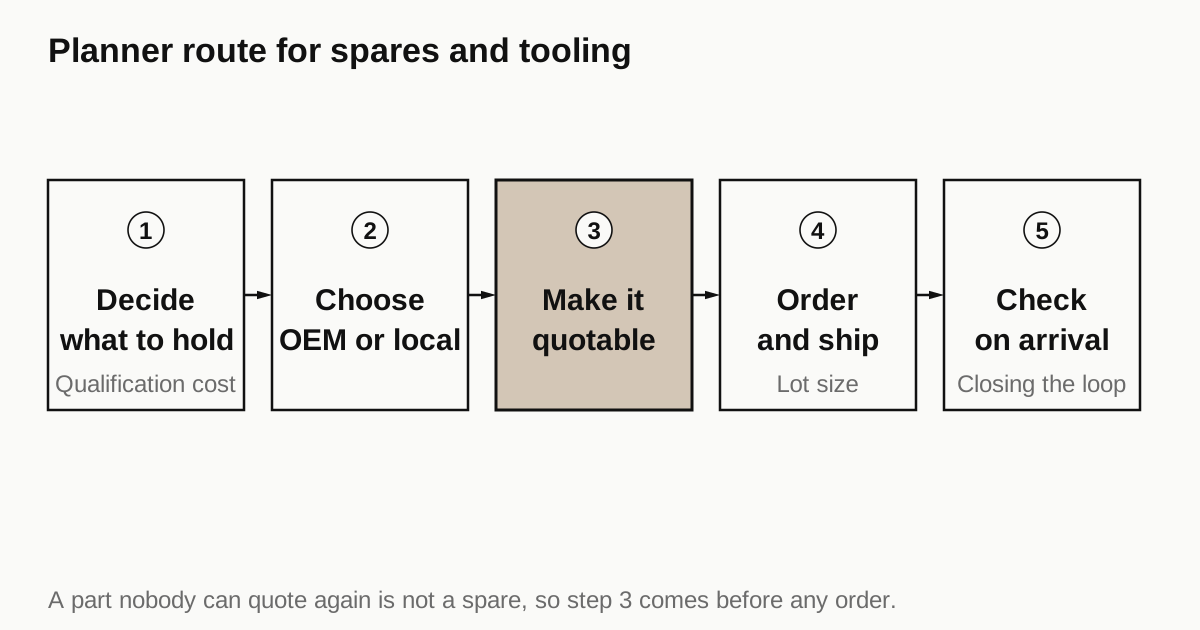
A spares planner who buys machined tooling from Vietnam makes five decisions in a fixed order: what to hold, whether to buy OEM or local, how to make the part quotable again, how to order and ship it, and how to check it on arrival. This guide routes each decision to the post on this site that covers it. It contains no new data, only the route, so a planner can go from a line-down part to a standing source without reading all the posts at once.
Route table by planner task
| Task | What to decide | Read |
|---|---|---|
| Decide what to hold | Which parts earn buffer stock and how big the buffer is | Planning spares and consumable hardware without overstocking |
| Understand the lead time you are buffering against | Quote, material, queue, finishing, inspection and freight | Where the weeks go on a machined semiconductor part |
| Choose OEM or local | By part family: nest, socket plate, nozzle, magazine, pallet | OEM change kits vs locally made tooling |
| Specify handler parts | Pocket, pitch and dowel features, wear surfaces | Test handler change kits: what buyers should specify and the change kit reference page |
| Specify line consumables | Nozzles, collets, magazines, carriers | Pick and place nozzles and collets, lead frame magazine checklist, reflow carriers and wave solder pallets |
| Keep a part quotable | One revision, the accepted first article, finish and packing level | Drawing revision control with a supplier and first article inspection reports |
| Hold the price | Why a repeat price moves and how to freeze it | Why a qualified part changes price between orders |
| Add a second source | Which parts justify a second supplier | Second sourcing a critical machined part |
| Move a running program | Hand over files and run two shops in parallel | Moving an existing jig program to a Vietnam machine shop |
| Order a small quantity | What a minimum quantity covers | Sample orders and minimum quantities for semiconductor jigs |
| Send a complete request | The package that gets a priced answer | RFQ package checklist for machined parts and reading a machining quote |
| Plan around Tet | Closure dates, restart and finisher queues | Tet and machined part lead times in Vietnam |
| Ship and clear | Packing, documents, classification, landed cost | Packing and shipping machined parts to a fab, document pack by shipment type, landed cost |
| Follow an open order | What a weekly report should show | Weekly progress reports from a Vietnam jig shop |
| Understand a failure | Warpage, wear, loosening, contamination and who pays | Why jigs and fixtures fail on the line |
Step 1: decide what to hold
The first post sets the test: a part belongs in a buffer when at least two of five conditions are true, and the buffer is sized against the full replacement path, not against the machining step. The lead time breakdown shows why. Finishing batches and inspection often dominate, so a part with a long path needs a deeper buffer than a part that machines slowly but finishes fast. Review the list once a year; an old drawing with no recent orders is a project, not a spare.
Need a quote for this part? Get a quote
Step 2: OEM or local
The decision table in the OEM against local post is the quickest route. In short, it treats parts that touch the device as OEM first with a local copy workable on a plant or maker drawing and a trial, and treats plant-defined parts such as magazines and solder pallets as local first. It also states what it could not find: no public price comparison, no public rule that settles warranty. Read it with your own warranty terms open. For the kit itself, the change kit post lists which features carry the tolerance.
Step 3: make the part quotable
This is the step most planners skip, and it is the one that decides the next lead time. Keep one released revision, the accepted first article report, the finish specification with masking, the packing level and the last quote. The same package is what a second source needs, so it pays twice. If the price of a repeat order moves, the price change post lists the legitimate causes and the ones inside your control, mainly quiet drawing revisions and an unstated repeat schedule.
Step 4: order and ship
Order spares with the original jigs when setup is already paid, and group wear parts into one quarterly order rather than a trickle of single pieces. Say the repeat schedule out loud so the shop can plan material and capacity. Before a Tet closure, work backward from the closure date and forward from the restart. The Tet post gives the 2027 government calendar and the three patterns private shops may choose, and tells you to get both dates in writing. For the shipment, packing level goes on the drawing so it is priced, and the document pack depends on what is moving and where.
Step 5: check on arrival
Compare the delivered part with the accepted first article and the packing level you ordered. If a fixture fails in use, the failure catalogue helps separate a design issue from wear or contamination before a claim. A weekly status report on an open order is easier to ask for at quote time than to add later.
Starting a spares source
If you have a running part and no second source, the practical first move is a trial order of the part with the longest replacement path, on a drawing you can hold at one revision. If you want to see which shops fit it, send the RFQ with the drawing and the current quote and we will come back within 24 business hours with a quote or a plain no. Partner shops do not deal with the buyer, and nothing here promises an order or a price.
Sources
This is a route guide. It states no figures of its own. Every claim above is taken from the posts linked in the table, and the outside sources behind each one are listed at the end of that post.
- Spares and consumable planning
- OEM change kits vs locally made tooling
- Tet and machined part lead times in Vietnam
- Why a qualified part changes price between orders
Frequently asked questions
What should an OSAT spares planner hold as buffer stock?
Hold a part when at least two of five things are true: it wears, its replacement lead time is longer than the downtime you can absorb, its qualification was expensive, its material or finish is unusual, or its drawing is old and the original supplier is gone. Size the buffer against the whole replacement path, from quote to freight, not against machining time alone.
Should spares for handlers come from the OEM or a local shop?
For parts that touch the device, such as nests, socket plates, nozzles and collets, the OEM spare is the first choice and a local copy is workable only with the plant's or the maker's drawing and a trial. For plant-defined parts such as lead frame magazines and solder pallets, local tooling is often the first choice.
Why order spares together with the original jigs?
Setup, programming, fixturing and the first article are paid once per order, so extra pieces on the original order cost little at the margin. A year later the same part pays for all of it again, plus whatever material and finishing prices have done since.
How does Tet affect a spares order from Vietnam?
A Tet closure takes at least seven calendar days out of the schedule, and an order that crosses it usually loses more because work queues before the break and restarts unevenly after it. For 2027 the public break is 4 to 10 February; private shops may choose their own pattern, so get both dates in writing.
Need a quote for this part?
Send the drawing. We quote the finished parts, place the work with a partner shop in Vietnam and reply within 24 business hours.
Get a quoteMore on choosing a supplier
- How to Check a Vietnam Shop's Real Capacity and Backlog
- Weekly Progress Reports From a Vietnam Jig Shop: What a Useful One Contains
- Reading the Job Board in a Vietnam Jig Shop: Visual Management Signs a Buyer Can Check
- Moving an Existing Jig Program to a Vietnam Machine Shop
All guides and the sourcing glossary.