Guides / Choosing a Supplier
How a Jig Shop Turns One Order Into Recurring OSAT Spares
November 20, 2026
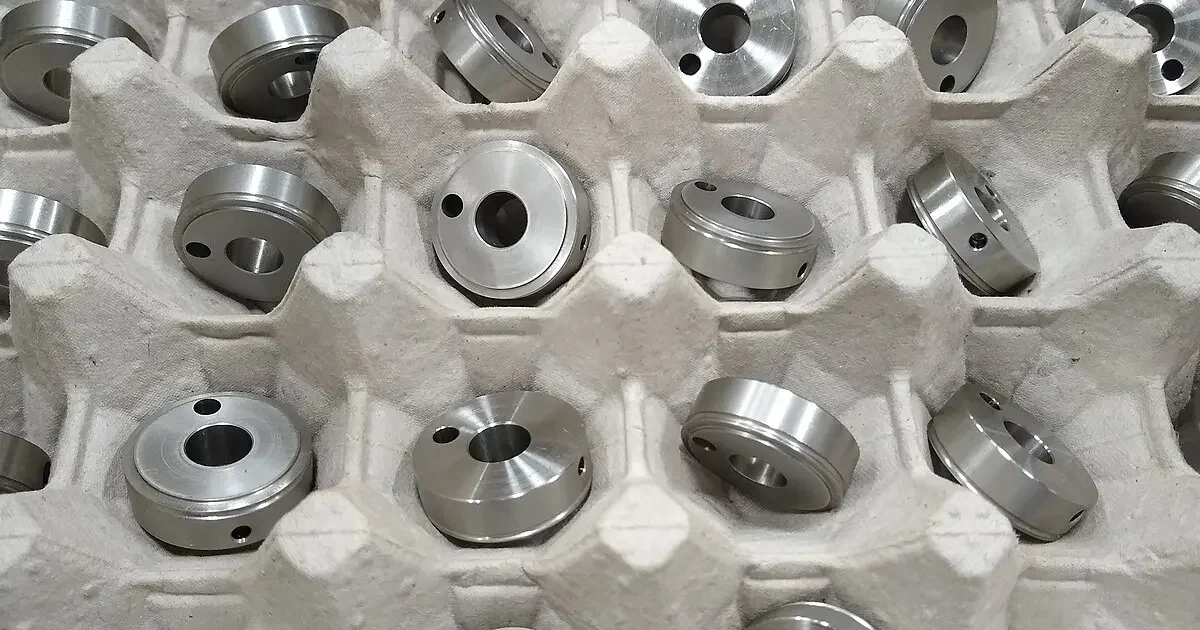
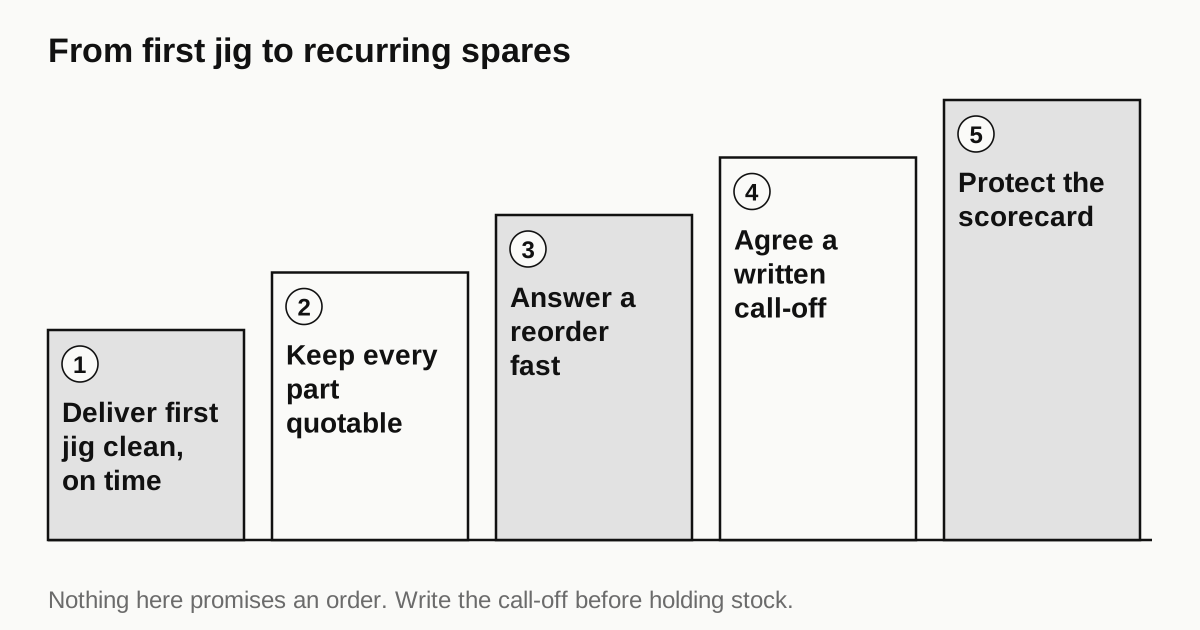
A first jig order becomes a stream of spare orders when the plant can reorder without friction: the part is still quotable, the answer comes fast, the delivery record is clean and the terms are written down. No OSAT publishes how it buys spares and we found no reorder statistics, so this guide describes what a shop controls and labels the rest as our reading. What is public is thin but consistent. A posting for a procurement buyer at Amkor Technology Vietnam in Bac Ninh lists purchasing for spare parts and tooling, with supplier performance evaluations and improvement in quality, cost and service. Nothing here promises an order.
Why a plant reorders
These are the forms repeat demand takes, from our reading of how back end lines run. We found no published figures for how often any of them recurs, so do not size stock on a rate you cannot source.
- Wear. Nests, pickup tools, guides and locating pins touch product every cycle. See pick and place nozzles and collets and test handler change kits.
- Damage. A dropped plate or a bent pin is usually replaced.
- Copies. A new line or a second tester needs the same set of jigs.
- Revisions. The part changes and the old stock becomes scrap.
- Changeovers. A new package size needs a new kit.
The buyer’s view of what to hold is in planning spares and consumable hardware. This guide takes the shop’s side of the same table.
A thin local base, and what it says
In August 2014 Tuoi Tre reported that only 5 percent of the spare parts used in foreign-invested assembly plants in Vietnam were made locally. It also reported that Samsung Vietnam sought local suppliers for 170 types of spare parts and that, in the words of a ministry official, not a single domestic business was qualified. The reasons given were that foreign firms usually choose suppliers from their home countries or existing partners, and that local firms could not meet the high requirements: one executive said that when partners ordered ten product types, Vietnamese firms could make only three.
That is twelve years old and the base has moved, see what Vietnam’s back end buildout means for parts buyers. It is still a public statement of why plants hesitated, and the reasons were capability and requirements, not a lack of machines. A shop that answers a reorder with the documents a plant expects is working on that gap.
Keep every part quotable
A spare can only be reordered if it can be made again. Keep one file per part number.
| In the file | Why a reorder needs it |
|---|---|
| Released drawing and revision | The order, the part and the label must agree, see drawing revision control |
| Accepted first article report | The next piece is judged against what was accepted, see first article inspection reports |
| Program, setup sheet and tool list | A repeat a year later may fall to a different operator |
| Material lot and certificate | Traceability, see mill test certificates |
| Finish specification and the finisher | The slow step, see where the weeks go |
| Packing and labeling specification with the plant part number | Prevents rework at the plant |
| Concessions granted | Records the tolerance the buyer actually accepted |
| Last quote and measured cycle times | Lets you explain a price move, see why a qualified part changes price |
Semsysco’s published quality guidelines, one equipment maker’s rules, ask suppliers to keep process and quality records for at least ten years and say product or process changes are subject to approval and must be reported. A reorder two years on is exactly the case they cover.
Make the reorder easy to place
- Quote repeats in a fixed form with a validity date and quantity breaks, so a buyer can reorder from a price list instead of starting a new RFQ.
- Put the plant’s own part number and revision on every document and label.
- State a repeat lead time you can keep. A repeat skips programming and fixturing, but the finishing queue is still there. Ask your finisher whether a standing slot is possible.
- Learn the customs path before the first reorder if the plant sits in an export processing zone. A delivery can carry steps that a domestic sale does not, see buying from a Vietnamese shop as an EPE.
- Reply fast. Our supplier page asks shops to answer buyers within 48 hours, in English.
Three ways to agree repeat demand
| Structure | How it works | What the shop should settle in writing |
|---|---|---|
| Spot orders | Each order is its own purchase order | A repeat price list with a validity date |
| Blanket order | A standing agreement with releases. The price is fixed for a period such as one or two years, the buyer gives a forecast and the supplier may require a minimum purchase, for example 80 percent of the forecast | The forecast, the minimum, the period, what happens to material or stock left at the end and a trigger for a price review |
| Vendor-managed or consignment stock | The supplier sets order size and holds stock at the customer’s site or its own premises. In consignment the supplier keeps ownership until a sale | Who pays for the stock, who counts it and how often, and what happens when the part is revised |
The blanket order and vendor-managed inventory descriptions are from Wikipedia and are general, not specific to OSAT plants. Both put risk on the shop. The blanket order reference lists the supplier holding inventory for demand that never materializes, and delayed-delivery charges when it cannot deliver on time. A 2003 high-tech sector study cited for vendor-managed inventory found significant additional operating expenses for the supplier and sizeable inventory burdens moving to it.
Without a written forecast and minimum, our reading is to hold material or semi-finished blanks for the parts that repeat and to keep finished stock for what a written call-off covers.
Need a quote for this part? Get a quote
What the plant scores you on
The Amkor posting describes the buyer’s job as conducting supplier performance evaluations and driving improvement in quality, cost and service. Semsysco publishes its criteria: on-time delivery, quantity accuracy, number of complaints, PPM, pricing, customer service, QMS status and audit results. Class A is the preferred supplier, class B needs action on delivery and class C is blocked for new orders.
Track the same numbers for your own shop from the first order: on-time delivery, quantity accuracy and reject rate. A shop that can send a plant its own figures is a step ahead of one that waits to be told. This is our suggestion.
Complaints arrive without warning. Semsysco’s clock is one working day for immediate measures, two working days for a preliminary report and ten working days for an updated 8D report, and it does not accept instruction or training as the corrective measure. Keep someone who can reply in that time, and a finisher who can support you inside it, as covered in what an OSAT expects from a new local jig supplier.
Position early, at the first quote
- Offer a spare line with the original. Setup, programming and the first article are paid once per order, so a spare set quoted with the original usually carries less setup cost than a reorder later.
- Ask for a non-binding usage estimate for the part family, in writing.
- Ask who owns the part number and the change notices on the plant side.
- Agree the repeat packing and labeling at the first delivery, not at the first complaint.
- Ask for notice of planned revisions and last-time buys. Packages and lines end, and stock left after a last order stays with the shop unless the agreement says otherwise.
If you want to talk it through
Shops that want to see how we place semiconductor work with partner shops, by the machines they run, can read how that works on the for suppliers page. If you are working out how to handle repeat orders, talk to us before you register. A plant’s reorders are its own decision, and nothing here promises one.
Sources
- Tuoi Tre Jobs, Procurement Buyer (Direct Material or MRO, Equipment), Amkor Technology Viet Nam, Bac Ninh (listing viewed October 2026; purchasing for spare parts and tooling, supplier performance evaluations)
- Tuoi Tre News, 27 August 2014, Vietnam part suppliers incapable of partnering with global tech giants (5 percent local share of spare parts, 170 spare part types; dated, directional)
- Semsysco, Quality Assurance Guidelines TE_0030 revision 03, hosted on Lam Research’s site (supplier evaluation criteria and classes, 8D timing, record retention, change approval; one equipment maker’s rules)
- Wikipedia, Blanket order (standing agreement, fixed price period, forecast, minimum purchase, supplier stock risk)
- Wikipedia, Vendor-managed inventory (who decides order size, where stock sits, consignment, supplier burden)
Frequently asked questions
Do OSAT plants publish how they buy spare parts?
We found nothing. A procurement buyer posting at Amkor Technology Vietnam covers purchasing for spare parts and tooling, with supplier performance evaluations and improvement in quality, cost and service. That shows the function exists, not its rules. Ask each plant how it reorders and who owns the part number.
Should a shop stock finished spare parts before a customer commits?
Not without a written forecast and a minimum. A reference on blanket orders lists the supplier holding inventory for demand that never materializes as a risk. Hold raw material or semi-finished blanks for the parts that repeat, and keep finished stock for what a written call-off covers.
What is a blanket order?
A standing agreement between a buyer and a supplier for repeated deliveries, usually at a price fixed for a period such as one or two years. The buyer issues releases as needed against a forecast, and the supplier may require a minimum purchase, for example 80 percent of the forecast.
Can a shop count on repeat orders after a good first lot?
No. A good first lot starts a delivery record and nothing more. A plant reorders when the part is still needed, the shop is easy to reorder from and the record is clean. This guide describes what a shop controls, and none of it promises an order.
Need a quote for this part?
Send the drawing. We quote the finished parts, place the work with a partner shop in Vietnam and reply within 24 business hours.
Get a quoteMore on choosing a supplier
- How to Check a Vietnam Shop's Real Capacity and Backlog
- Weekly Progress Reports From a Vietnam Jig Shop: What a Useful One Contains
- Reading the Job Board in a Vietnam Jig Shop: Visual Management Signs a Buyer Can Check
- Moving an Existing Jig Program to a Vietnam Machine Shop
All guides and the sourcing glossary.