Guides / Choosing a Supplier
Vietnam or India for Semiconductor Tooling and Machined Parts
November 21, 2026
Neither country is simply better, and any single-number answer is a guess. In October 2026 the two differ in four ways that matter to a buyer of jigs, fixtures and machined tooling: the US duty layer, how long each country has served semiconductor back end plants, which trade agreements apply to your lane and how much of the comparison no public source can settle. This guide sets out what is documented, labels what is our reading and ends with a way to decide on your own drawing.
What is documented, side by side
| Question | Vietnam | India | Basis |
|---|---|---|---|
| Section 301 forced-labor duty on US entries (one layer) | 12.5 percent | 10 percent | USTR press release, 23 July 2026 |
| Back end plants | Intel assembly and test in Ho Chi Minh City, Amkor packaging in Bac Ninh with more than 1.07 billion USD invested | First ISM-supported plants in commercial production in 2026 | Vietnam Briefing, March 2025. ISM page, updated 9 October 2026 |
| Government plan for packaging and test | 10 plants by 2030, 15 by 2040, 20 by 2050 (Decision 1018/QD-TTg) | Semicon 1.0 outlay of 76,000 crore rupees, Semicon 2.0 outlay of 1,27,500 crore rupees | Vietnam Briefing. ISM page |
| EU lane | EVFTA in force since 1 August 2020 | EU and India concluded talks on 27 January 2026, not yet in force | EU Commission. Wikipedia |
| Asia-Pacific lane | Party to RCEP from 1 January 2022 | Took part in early talks, then opted out | Wikipedia |
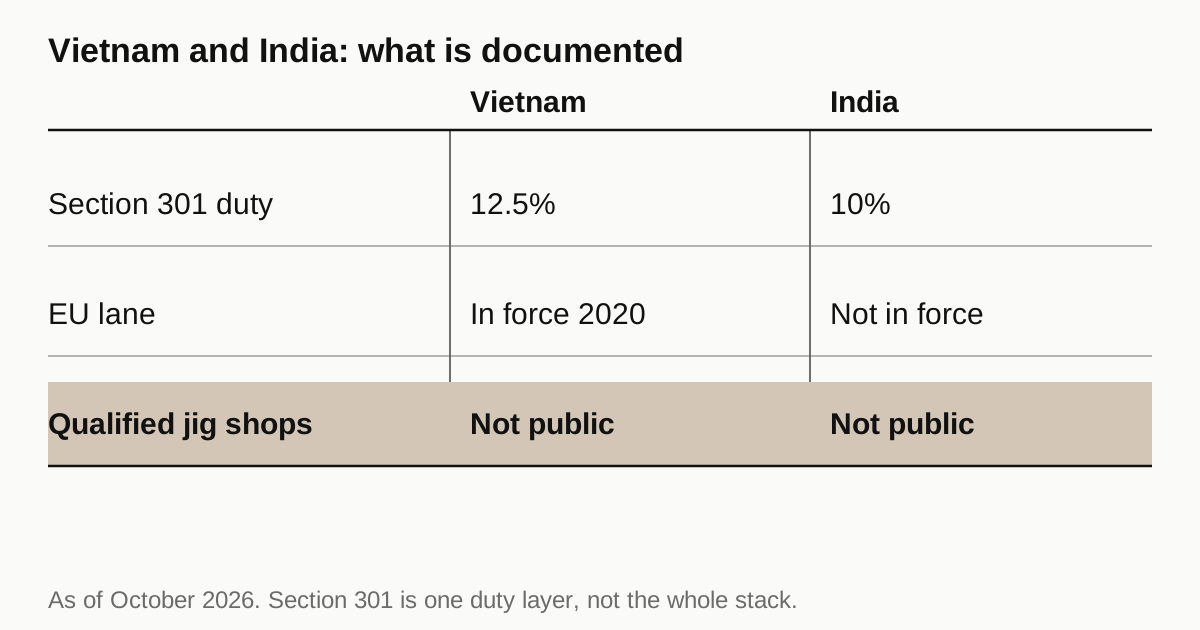
| Public count of qualified jig shops | None found | None found | Our search |
The last row matters most. Neither country has a public directory that tells you how many shops can hold a semiconductor jig specification, and the first four rows say nothing about the shop that will actually cut your part.
Duty: one layer, not the whole stack
The USTR notice on its Section 301 forced-labor investigations puts India at 10 percent and Vietnam at 12.5 percent, as of the 23 July 2026 press release. That is a 2.5 point gap on one layer. The total a US importer pays also depends on the general rate for the classification, on whether a part is a steel, aluminum or copper article under Section 232 and on origin rules, so the gap on a given part can be larger, smaller or absent. The full stack for Vietnam, with a worked example, is in US tariffs on machined parts from Vietnam. We have not checked a specific jig for India and we do not publish an India stack.
For a buyer outside the United States the picture is different. A European buyer should look at the EU lane. Vietnam’s agreement has been in force since 1 August 2020 and the EU Commission says it eliminates 99 percent of tariffs on trade between the two sides. For India, talks concluded in January 2026, but the agreement is subject to legal vetting, signing and ratification and one summary says it could come into force by early 2027. Tariff lines, phase-in periods and rules of origin decide what applies to a machined part, so read the text for your heading, not the headline.
Back end plants: where the demand sits
Jigs, change kits, nests and spares are consumed by assembly, packaging and test plants. Vietnam has hosted them for longer. Vietnam Briefing names Intel, Hana Micron, Amkor and OnSemi among the established players, and reports that Amkor has invested more than 1.07 billion USD in its Bac Ninh packaging facility. The government’s Decision 1018/QD-TTg sets targets of 10 packaging and testing plants by 2030, 15 by 2040 and 20 by 2050. The same source lists constraints too: a shortage of semiconductor engineers and unstable electricity supply. Our own summary of the demand this creates is in what Vietnam’s back end buildout means for parts buyers.
India’s back end is newer and moving quickly. The India Semiconductor Mission page, last updated on 9 October 2026, lists commercial production at Micron’s ATMP facility in Sanand from February 2026, at Kaynes Semicon’s OSAT facility in Sanand from March 2026 and at plants in Mohali and Surat launched at SEMICON India 2026, and says five Semicon 1.0 projects have started commercial production. It also lists a CG Semi OSAT facility inaugurated on 4 July 2026 and further approvals in May 2026. The scheme outlays are 76,000 crore rupees for Semicon 1.0 and 1,27,500 crore rupees for Semicon 2.0. Secondary sources disagree on project counts, so use the official page for anything that matters.
What this means for a jig buyer is our reading, not a published finding. A shop that has served an OSAT line for several years has seen the drawing notes, the packing rules and the complaint routine. A shop in a plant cluster that opened this year may be capable and still new to them. In either country, ask the shop what back end work it has delivered and ask for the first article report to prove it.
What no public source settles
These are the parts buyers most want a verdict on, and where we found nothing to cite.
- Price. We found no published comparison of quoted prices for jigs and fixtures between India and Vietnam. Anyone quoting a percentage is estimating.
- Drawing practice. Many Vietnam shops are used to Japanese and Korean drawings, as covered in Japanese and Korean drawings in a Vietnam machine shop. We found no public survey of drawing standards in Indian shops. Ask which standards a shop works to and test it with your own drawing.
- Finishing. Whether the anodize, plating or heat treatment you need is available locally and at your specification is a per-shop question in both countries.
- Lead time. Neither country publishes typical lead times for jigs. Compare quoted lead times and then check them against what the shop is already carrying, see lead time and finishing bottlenecks.
Need a quote for this part? Get a quote
When each origin tends to fit
These are reasoning points, not statistics.
| Situation | Leans towards | Why |
|---|---|---|
| Your plant, or your customer, is in Vietnam or the surrounding region | Vietnam | Short delivery loop, local finishing, shops used to back end customers |
| Your plant is in India or serves Indian OSAT sites | India | No export leg and no import duty on a domestic part |
| You ship to the EU and the lane matters | Check both | Vietnam’s agreement is in force, India’s is not yet |
| You need a hedge against one country’s risk | Both | A second source in a different country spreads the risk, see second sourcing a critical machined part |
A deeper country comparison with different questions is in Vietnam or China for machined parts and Vietnam, Taiwan or Malaysia.
How to decide on your own drawing
- Pick one drawing that is representative: a plate with holes, a pocket and a finish.
- Ask two or three shops in each country for the same quote: quantities of 1, 5 and 20, with programming, machining, finishing, inspection, packing and freight as separate lines.
- Ask each for a first article report format and the lead time for a sample and for a repeat.
- Compare landed cost, using the duty rate your broker assigns for the entry date, as in landed cost of machined parts from Vietnam.
- Order a paid sample lot from the best two and measure it yourself.
If the drawing is for a plant in Vietnam or one you ship from Vietnam, send the RFQ and we will reply within 24 business hours with a quote or a plain no.
Sources
- USTR press release, 23 July 2026 (Section 301 forced-labor action, rates for India and Vietnam)
- India Semiconductor Mission, project status page (last updated 9 October 2026)
- Wikipedia, Semiconductor industry in India (scheme outlay, project background; secondary, project counts vary)
- Vietnam Briefing, Vietnam semiconductor industry (3 March 2025; players, Amkor investment, Decision 1018/QD-TTg targets, constraints)
- European Commission, EU-Vietnam trade agreement (in force 1 August 2020, 99 percent of tariffs eliminated)
- Wikipedia, India-European Union free trade agreement (concluded 27 January 2026, not yet in force; the page carries a reliability warning, so check official EU and Indian sources)
- Wikipedia, Regional Comprehensive Economic Partnership (in force 1 January 2022, Vietnam ratified 29 October 2021, India opted out)
Frequently asked questions
Is India cheaper than Vietnam for machined semiconductor parts?
No public source compares quoted prices for jigs and fixtures between the two countries, and we do not publish one. An honest comparison needs the same drawing quoted by qualified shops in each country at the same quantity, finish and inspection. Quote both and compare landed cost.
What US duty applies to parts from India compared with Vietnam?
As of October 2026 the USTR Section 301 forced-labor action lists 10 percent for India and 12.5 percent for Vietnam, on top of the normal rate for the product. It is one layer only. Other duties and the classification of the part decide the total, so confirm with a customs broker.
Does India have semiconductor back end plants like Vietnam?
India's Semiconductor Mission page lists commercial production at Micron's ATMP site in Sanand from February 2026 and at Kaynes in March 2026, with further plants opening in September 2026. Vietnam has hosted assembly and test plants for longer, including Intel in Ho Chi Minh City and Amkor in Bac Ninh.
Should I move a qualified jig program from one country to the other?
Only for a reason that survives the cost of requalification, such as capacity, risk concentration or a degraded supplier relationship. A quoted saving on one part rarely does. Run a sample lot in the new country first and keep the old source until the new one has delivered.
Need a quote for this part?
Send the drawing. We quote the finished parts, place the work with a partner shop in Vietnam and reply within 24 business hours.
Get a quoteMore on choosing a supplier
- How to Check a Vietnam Shop's Real Capacity and Backlog
- Weekly Progress Reports From a Vietnam Jig Shop: What a Useful One Contains
- Reading the Job Board in a Vietnam Jig Shop: Visual Management Signs a Buyer Can Check
- Moving an Existing Jig Program to a Vietnam Machine Shop
All guides and the sourcing glossary.