Guides / Process
5 Axis Machining in Vietnam: What the Label Covers and What It Does Not
October 6, 2026
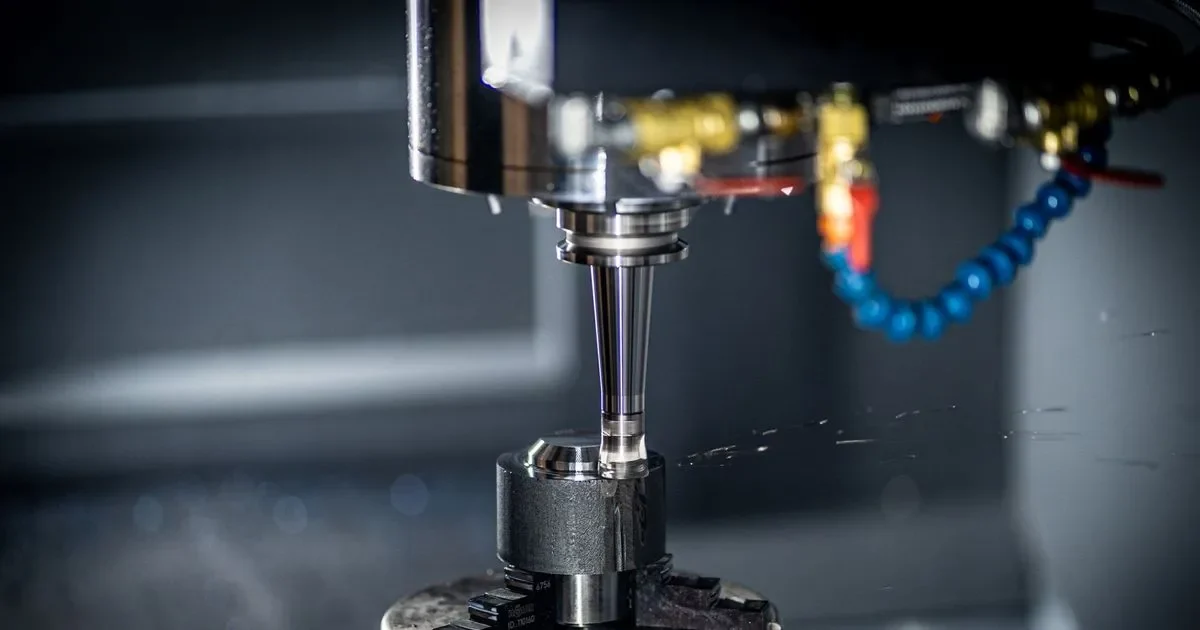
Five axis machining has become a selling point on almost every shop website. The label hides a lot of difference. One shop means a 3 axis mill with a manual indexing head. Another means a trunnion table machine that positions the part at an angle and then cuts. A third means a machine that moves all five axes at once through a smooth contour. They are different capabilities with different costs and different results.
This guide separates the three, shows which semiconductor related parts need which and lists what to ask when a shop in Vietnam says it does 5 axis work.
Three things shops call 5 axis
Indexed 3 axis, sometimes called 3+1 or 4 axis. One rotary axis, locked between cuts. It can reach several sides of a part in one setup but not angled features in two planes.
3+2 positioning. A machine with two rotary axes. The part is tilted and turned to a fixed angle, locked and then cut with the three linear axes. The machine can reach nearly every face in one clamping, but the tool never moves in all five axes at once.
Simultaneous 5 axis. All five axes move together under one program. The tool stays at a chosen angle to a curved surface, which allows smooth contours, undercuts and short tool length on deep features.
Most of what buyers call 5 axis work is 3+2. Simultaneous work is a smaller set of parts.
What each machine type does to a part
| Machine type | Typical setups for a part with features on five faces | Where error comes from | Typical use |
|---|---|---|---|
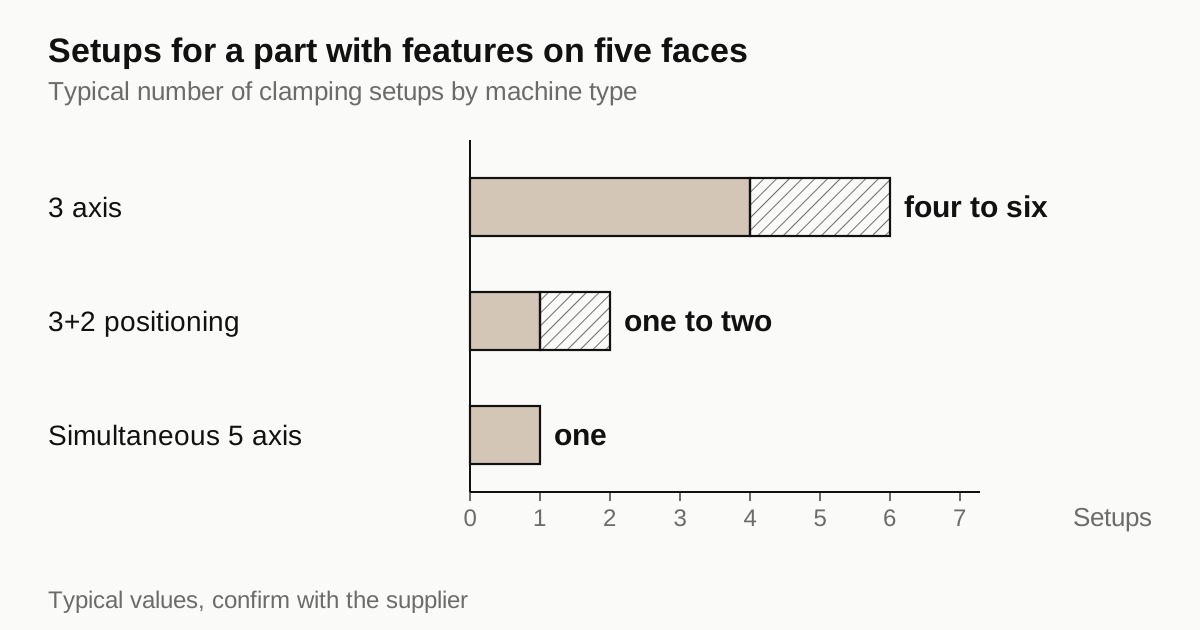
| 3 axis | Four to six | Re-clamping, datum transfer between setups | Plates, brackets, flat parts |
| 3+2 | One to two | Rotary axis alignment, pivot point calibration | Manifolds, housings, angled hole patterns |
| Simultaneous 5 axis | One | Kinematic model, tool length, program accuracy | Blended contours, impellers, complex molds |
The setup count is the number that matters. Every time the part comes off the machine and goes back on, the positions between old and new features shift by the clamping repeatability. On a part where two faces must hold a position to 0.02 mm, one setup is a different job from three.
Which semiconductor parts use which
Semiconductor back end parts rarely call for simultaneous 5 axis cutting. Most of the 5 axis machine hours go into 3+2 work.
3+2 is the right call for:
- Test handler nest bodies with angled vacuum paths
- Manifold blocks with ports on several faces
- Housings and brackets with features on five sides
- Fixture bodies with datum faces at defined angles
- Pick and place heads with angled nozzle seats
Simultaneous 5 axis fits:
- End effectors with smooth contoured pockets that follow the part shape
- Complex ducts and flow shapes in equipment components
- Prototypes of curved covers or guards
- Parts where a smooth tool path removes the hand blending that follows
Plain 3 axis is enough for:
- Jig plates and base plates, which depend on flatness and hole position rather than reach
- Brackets and covers
- Most carriers and trays
If a shop proposes simultaneous 5 axis for a flat plate, it is either upselling or covering for a lack of other machines. Ask why.
Where setups still matter on a 5 axis machine
A 5 axis machine reduces setups, it does not remove the need to check them. The rotary axes have to be calibrated against the machine’s linear axes, and the pivot point has to be known. On a 3+2 job, if the pivot is wrong by 0.01 mm, every angled feature lands 0.01 mm away from where it should.
Good shops check this with a probe and a calibration sphere on a regular schedule and after any collision. Ask how often. A shop that says “when something looks wrong” is describing a different quality system from one that says “every shift” or “weekly”.
Tolerances on angled features
Specify angles with the same care as positions. An angled hole is not fully defined by a diameter and an angle: the position of its entry point and exit point matter too. On a manifold with two ports meeting inside the block, the intersection is a tolerance problem in three dimensions.
Write the angle with a tolerance in degrees or minutes, and reference the entry point to the datum frame. Where two angled holes must meet, give a position tolerance for the junction. See flatness, parallelism and GD&T for the reference rules and tolerance stack-up for fixtures for how errors add when features come from different setups.
Need a quote for this part? Get a quote
What to ask a shop
These questions give a clear read on whether 5 axis capacity is real.
- Is the machine 3+2 only or simultaneous? Which control?
- Which software generates the toolpaths, and does it simulate the machine and the fixture before cutting?
- How are the rotary axes calibrated, and how often?
- Is there a tool probe and a part probe on the machine?
- Can you show a part with angled features on at least three faces, with a CMM report?
- How do you hold the part so the tool can reach all faces: a vise, a dovetail or a pull stud?
- What is the longest tool you run, and how do you control deflection?
The answers about calibration and simulation matter more than the machine brand. A new machine with no calibration routine will produce worse parts than a ten year old one on a weekly check.
Where the capacity sits in Vietnam
5 axis machines are concentrated where the electronics and precision work is. The map of machining clusters describes the regional picture: the Ho Chi Minh City area and the south hold the widest pool of precision shops, the north around Hanoi and Bac Ninh has a growing base serving the electronics belt. Capacity varies a lot between shops in the same region. A shop’s machine list is a starting point for a conversation, not a measure of ability.
Placement is by capability, not by label. When an RFQ includes angled features, we look for partner shops that run a rotary table machine and are willing to share an inspection report on a similar part.
Cost: when 5 axis saves money and when it adds it
A 5 axis machine hour costs more than a 3 axis hour. The part costs less only when the saved setups outweigh that difference. This usually happens when:
- The part has features on four or more faces
- The tolerance between features on different faces is tight
- The quantity is small and fixtures would cost more than the part
- The tool needs a tilted approach to reach a deep pocket
It adds cost on flat parts, on large series where a dedicated 3 axis fixture is cheaper per part and when the shop runs the job on a machine it has to learn as it goes. See reading a machining quote for how to compare setup and run lines.
Programs, simulation and the first part
A 5 axis program is more than a toolpath. It has to account for the machine’s kinematics, the fixture geometry and the tool holder, because a collision at 5 axis speed is expensive. Good shops simulate the full machine model before cutting metal and run the first part in a soft material or at reduced feed to prove the path. Ask whether the shop does a dry run and whether the first metal part gets a full inspection before the batch runs.
For a repeat part, ask who owns the program. If the shop’s CAM file is the only record of how the angled features were cut, a change of supplier means starting again. Many buyers ask for the final setup sheet and the fixture drawing as part of the order, so a second source can match the process. See second sourcing a critical part for how that transfer is usually handled.
Checklist before you send the RFQ
- A 3D model in STEP format as well as the drawing, since angled features are easier to check on a model
- Angles with tolerances, and entry points referenced to the datums
- Which faces are datums and which features are most critical
- The quantity and the repeat schedule, since they decide whether a dedicated fixture pays off
- The inspection report you expect for angled features
- Whether the part can be quoted as 3+2 or whether you require simultaneous machining, and why
Send the package with the RFQ. We place it with a partner shop that runs rotary table machines and send one itemised quote within 24 business hours.
Frequently asked questions
Does my part need simultaneous 5 axis machining?
Only if the surface itself is curved in a way that needs the tool to tilt while it cuts, such as a blended contour or an angled pocket with a smooth wall. Parts with several flat faces at different angles, angled holes or features on five sides usually need 3+2 positioning, which is cheaper and often more accurate.
Is a 5 axis machine more accurate than a 3 axis machine?
Not by itself. The advantage is fewer setups, because every setup adds position error. A well kept 3 axis machine with a good fixture can beat a worn 5 axis machine on a flat plate. The label on the machine tells you about its geometry, not about its accuracy.
How do I find out whether a shop truly runs 5 axis?
Ask for the machine type, the control, the probing routine and a sample part with a measurement report. A shop with real 5 axis capacity can name how it checks the rotary axes and how it verifies a program before cutting metal.
Need a quote for this part?
Send the drawing. We quote the finished parts, place the work with a partner shop in Vietnam and reply within 24 business hours.
Get a quoteMore on process
- JEDEC Matrix Trays and Custom Carrier Trays: When Machined Replaces Molded
- Designing a Package Nest: Pocket Size, Clearance, Lead-In and Datum
- Planning Production When Urgent Spares and New Jigs Share the Machines
- Semiconductor Jigs and Fixtures: Which Part Family, What to Specify, What Fails and Who Makes It
All guides and the sourcing glossary.